Date
2026-09-21
Duration
7 nights
Departure Port
Siem Reap
Cambodia
Arrival Port
Ho Chi Minh City
Vietnam
Rating
Luxury
Theme
History & Culture
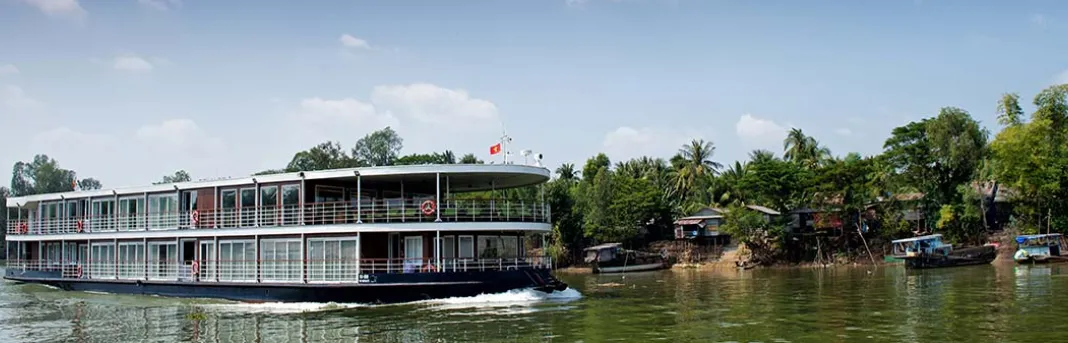


Avalon Waterways
2018
—
950 GT
36
18
24
195 m
—
9 knots
No

Paris rewards every arrival as though it were the first — the sweep of the Seine, the Gothic tracery of Notre-Dame rising again from its 2019 ashes, the Eiffel Tower somehow managing to astonish at each encounter, the Louvre's glass pyramid reflecting clouds in the courtyard of a palace that served French kings for four centuries. Beyond the monuments, Paris is a city of neighbourhoods: the Belle Époque brasseries of Montparnasse, the covered passages of the 2nd arrondissement, the rooftop terraces of Le Marais. The Luxembourg Gardens in April, or a late-September evening on the Canal Saint-Martin, are among the most civilised experiences in the world.

Founded in 1517 by Francis I and rebuilt after World War II devastation by Auguste Perret's visionary grid of reinforced concrete — now a UNESCO World Heritage Site — Le Havre is a city where urban architecture becomes a form of art. The monumental church of Saint-Joseph, lit from within by fifteen thousand pieces of coloured glass, is a masterpiece of post-war modernism. Day trips to Honfleur, the exquisite half-timbered port that launched Impressionism, and to the D-Day beaches of Normandy, make Le Havre one of the channel's most strategically placed cruise calls. The city is most agreeable May through September; the Honfleur excursion rewards in any season.

Caudebec-en-Caux nestles in a Seine meander between Rouen and the sea, famous for its Flamboyant Gothic Eglise Notre-Dame — a masterwork of late medieval stone lacework so exquisite that Henri IV called it 'the most beautiful chapel in my kingdom.' The town serves as an ideal quiet base for exploring the Seine Valley's quieter pleasures: the remarkable Abbaye de Jumiéges, its roofless nave open to the Norman sky, and the Manoir d'Ango, a Renaissance manor of extraordinary ambition, are both within easy reach. The tidal atmosphere of the Seine at this point rewards early morning walks along the embankment. Rouen, with its Gothic cathedral and Impressionist legacy, lies forty minutes east.

Rouen, the medieval capital of Normandy set in a wooded meander of the Seine, rewards slow exploration with one of France's richest concentrations of Gothic architecture. The vast cathedral — immortalised by Monet in his celebrated series of canvases — dominates a city where half-timbered lanes wind between Renaissance mansions and the square where Joan of Arc was burned in 1431. The covered market overflows with Normandy's great dairy bounty: camembert, livarot, and pont-l'évêque alongside cider and calvados. Paris lies just ninety minutes south by train. Spring and early autumn offer the most atmospheric conditions.

Kampong Tralach, Cambodia is a distinctive port city where deep cultural heritage meets authentic local atmosphere, featured on itineraries by AmaWaterways. Must-do experiences include exploring the vibrant local markets for regional specialties and fresh seafood, and discovering the waterfront quarter where maritime heritage meets contemporary energy. The optimal time to visit is November through April, when dry season brings clear skies and calm seas.

Les Andelys occupies one of the Seine's most dramatic bends, dominated by the spectral ruins of Château Gaillard — Richard the Lionheart's 'Saucy Castle,' built with medieval speed in a single year and considered a masterpiece of twelfth-century military engineering. The view from the castle's white chalk promontory across the river's great loop is among the most beautiful in Normandy, a landscape that captivated Monet and Pissarro. Below, the twin villages of Grand and Petit Andely offer excellent Normandy cuisine, notably duck dishes prepared with local cider. Les Andelys is best visited April through October as part of a Seine river cruise; golden autumn light renders the chalk cliffs particularly luminous.

Phnom Penh rises from the confluence of the Mekong, Tonlé Sap, and Bassac rivers with a resilience that makes it one of Southeast Asia's most affecting capitals — a city that endured the Khmer Rouge's "Year Zero" and has re-emerged as a place of broad riverfront boulevards, excellent Khmer cuisine, and a cultural energy that feels earned rather than manufactured. The Royal Palace and its Silver Pagoda, housing a life-size gold Buddha studded with 9,584 diamonds, is the city's architectural centrepiece; the Tuol Sleng Genocide Museum, a former high school converted to a prison by the Khmer Rouge, is sobering but essential history. November through February offers the most comfortable climate for extended exploration.

Poised at the confluence of the Oise and the Seine, Conflans-Sainte-Honorine has been France's inland waterway capital for over a century, its quays mooring more than a thousand traditional péniches whose painted hulls form a floating village of singular charm. The hilltop medieval town commands sweeping views over the meeting of rivers, while the National Inland Waterways Museum aboard a converted barge chronicles France's extraordinary network of canals and waterways. Just thirty kilometres from Paris, Conflans is best visited in summer, when barge festivals fill the riverbank with music, local produce, and the unhurried pleasures of la vie fluviale.

Paris rewards every arrival as though it were the first — the sweep of the Seine, the Gothic tracery of Notre-Dame rising again from its 2019 ashes, the Eiffel Tower somehow managing to astonish at each encounter, the Louvre's glass pyramid reflecting clouds in the courtyard of a palace that served French kings for four centuries. Beyond the monuments, Paris is a city of neighbourhoods: the Belle Époque brasseries of Montparnasse, the covered passages of the 2nd arrondissement, the rooftop terraces of Le Marais. The Luxembourg Gardens in April, or a late-September evening on the Canal Saint-Martin, are among the most civilised experiences in the world.

Châu Đốc is a mystical border town where the Mekong meets Cambodia, combining Vietnamese, Cham Muslim, and Khmer Buddhist cultures around the pilgrimage mountain of Sam (Núi Sam). Must-do experiences include visiting Sam Mountain's pagodas, touring floating fish farms, and tasting the town's famous bún cá turmeric fish noodle soup. November through April's dry season is most comfortable; the flood season reveals the delta's full hydraulic drama.
Day 1

Paris rewards every arrival as though it were the first — the sweep of the Seine, the Gothic tracery of Notre-Dame rising again from its 2019 ashes, the Eiffel Tower somehow managing to astonish at each encounter, the Louvre's glass pyramid reflecting clouds in the courtyard of a palace that served French kings for four centuries. Beyond the monuments, Paris is a city of neighbourhoods: the Belle Époque brasseries of Montparnasse, the covered passages of the 2nd arrondissement, the rooftop terraces of Le Marais. The Luxembourg Gardens in April, or a late-September evening on the Canal Saint-Martin, are among the most civilised experiences in the world.
Day 3

Founded in 1517 by Francis I and rebuilt after World War II devastation by Auguste Perret's visionary grid of reinforced concrete — now a UNESCO World Heritage Site — Le Havre is a city where urban architecture becomes a form of art. The monumental church of Saint-Joseph, lit from within by fifteen thousand pieces of coloured glass, is a masterpiece of post-war modernism. Day trips to Honfleur, the exquisite half-timbered port that launched Impressionism, and to the D-Day beaches of Normandy, make Le Havre one of the channel's most strategically placed cruise calls. The city is most agreeable May through September; the Honfleur excursion rewards in any season.
Day 4

Caudebec-en-Caux nestles in a Seine meander between Rouen and the sea, famous for its Flamboyant Gothic Eglise Notre-Dame — a masterwork of late medieval stone lacework so exquisite that Henri IV called it 'the most beautiful chapel in my kingdom.' The town serves as an ideal quiet base for exploring the Seine Valley's quieter pleasures: the remarkable Abbaye de Jumiéges, its roofless nave open to the Norman sky, and the Manoir d'Ango, a Renaissance manor of extraordinary ambition, are both within easy reach. The tidal atmosphere of the Seine at this point rewards early morning walks along the embankment. Rouen, with its Gothic cathedral and Impressionist legacy, lies forty minutes east.
Day 5

Rouen, the medieval capital of Normandy set in a wooded meander of the Seine, rewards slow exploration with one of France's richest concentrations of Gothic architecture. The vast cathedral — immortalised by Monet in his celebrated series of canvases — dominates a city where half-timbered lanes wind between Renaissance mansions and the square where Joan of Arc was burned in 1431. The covered market overflows with Normandy's great dairy bounty: camembert, livarot, and pont-l'évêque alongside cider and calvados. Paris lies just ninety minutes south by train. Spring and early autumn offer the most atmospheric conditions.
Day 6

Kampong Tralach, Cambodia is a distinctive port city where deep cultural heritage meets authentic local atmosphere, featured on itineraries by AmaWaterways. Must-do experiences include exploring the vibrant local markets for regional specialties and fresh seafood, and discovering the waterfront quarter where maritime heritage meets contemporary energy. The optimal time to visit is November through April, when dry season brings clear skies and calm seas.

Les Andelys occupies one of the Seine's most dramatic bends, dominated by the spectral ruins of Château Gaillard — Richard the Lionheart's 'Saucy Castle,' built with medieval speed in a single year and considered a masterpiece of twelfth-century military engineering. The view from the castle's white chalk promontory across the river's great loop is among the most beautiful in Normandy, a landscape that captivated Monet and Pissarro. Below, the twin villages of Grand and Petit Andely offer excellent Normandy cuisine, notably duck dishes prepared with local cider. Les Andelys is best visited April through October as part of a Seine river cruise; golden autumn light renders the chalk cliffs particularly luminous.

Phnom Penh rises from the confluence of the Mekong, Tonlé Sap, and Bassac rivers with a resilience that makes it one of Southeast Asia's most affecting capitals — a city that endured the Khmer Rouge's "Year Zero" and has re-emerged as a place of broad riverfront boulevards, excellent Khmer cuisine, and a cultural energy that feels earned rather than manufactured. The Royal Palace and its Silver Pagoda, housing a life-size gold Buddha studded with 9,584 diamonds, is the city's architectural centrepiece; the Tuol Sleng Genocide Museum, a former high school converted to a prison by the Khmer Rouge, is sobering but essential history. November through February offers the most comfortable climate for extended exploration.
Day 7

Poised at the confluence of the Oise and the Seine, Conflans-Sainte-Honorine has been France's inland waterway capital for over a century, its quays mooring more than a thousand traditional péniches whose painted hulls form a floating village of singular charm. The hilltop medieval town commands sweeping views over the meeting of rivers, while the National Inland Waterways Museum aboard a converted barge chronicles France's extraordinary network of canals and waterways. Just thirty kilometres from Paris, Conflans is best visited in summer, when barge festivals fill the riverbank with music, local produce, and the unhurried pleasures of la vie fluviale.
Day 8

Paris rewards every arrival as though it were the first — the sweep of the Seine, the Gothic tracery of Notre-Dame rising again from its 2019 ashes, the Eiffel Tower somehow managing to astonish at each encounter, the Louvre's glass pyramid reflecting clouds in the courtyard of a palace that served French kings for four centuries. Beyond the monuments, Paris is a city of neighbourhoods: the Belle Époque brasseries of Montparnasse, the covered passages of the 2nd arrondissement, the rooftop terraces of Le Marais. The Luxembourg Gardens in April, or a late-September evening on the Canal Saint-Martin, are among the most civilised experiences in the world.

Châu Đốc is a mystical border town where the Mekong meets Cambodia, combining Vietnamese, Cham Muslim, and Khmer Buddhist cultures around the pilgrimage mountain of Sam (Núi Sam). Must-do experiences include visiting Sam Mountain's pagodas, touring floating fish farms, and tasting the town's famous bún cá turmeric fish noodle soup. November through April's dry season is most comfortable; the flood season reveals the delta's full hydraulic drama.


Stateroom Features:
Comfort Collection Beds
Egyptian super-combed cotton linens
Soft & firm pillows
Choice of bed configuration
Nightly turn-down service
Bedside tables with reading lamps
14' Wall-to-Wall Panoramic window measuring that opens to create a large Open-Air Balcony
Large private bathroom featuring full shower with glass door, hairdryer, and premium L'Occitane bath amenities
Spacious closets with shelves for ample storage
Easy under-bed luggage storage
Alarm clock
Writing desk/vanity with mirror & comfortable chair
In-house telephone
Bathrobes & slippers
Complimentary filtered water
In-room safe
Individual climate control
One King-Sized Bed or Two Twins
USB Ports
Our cruise specialists can help you find the perfect cabin and the best available pricing.
(+886) 02-2721-7300Contact Advisor