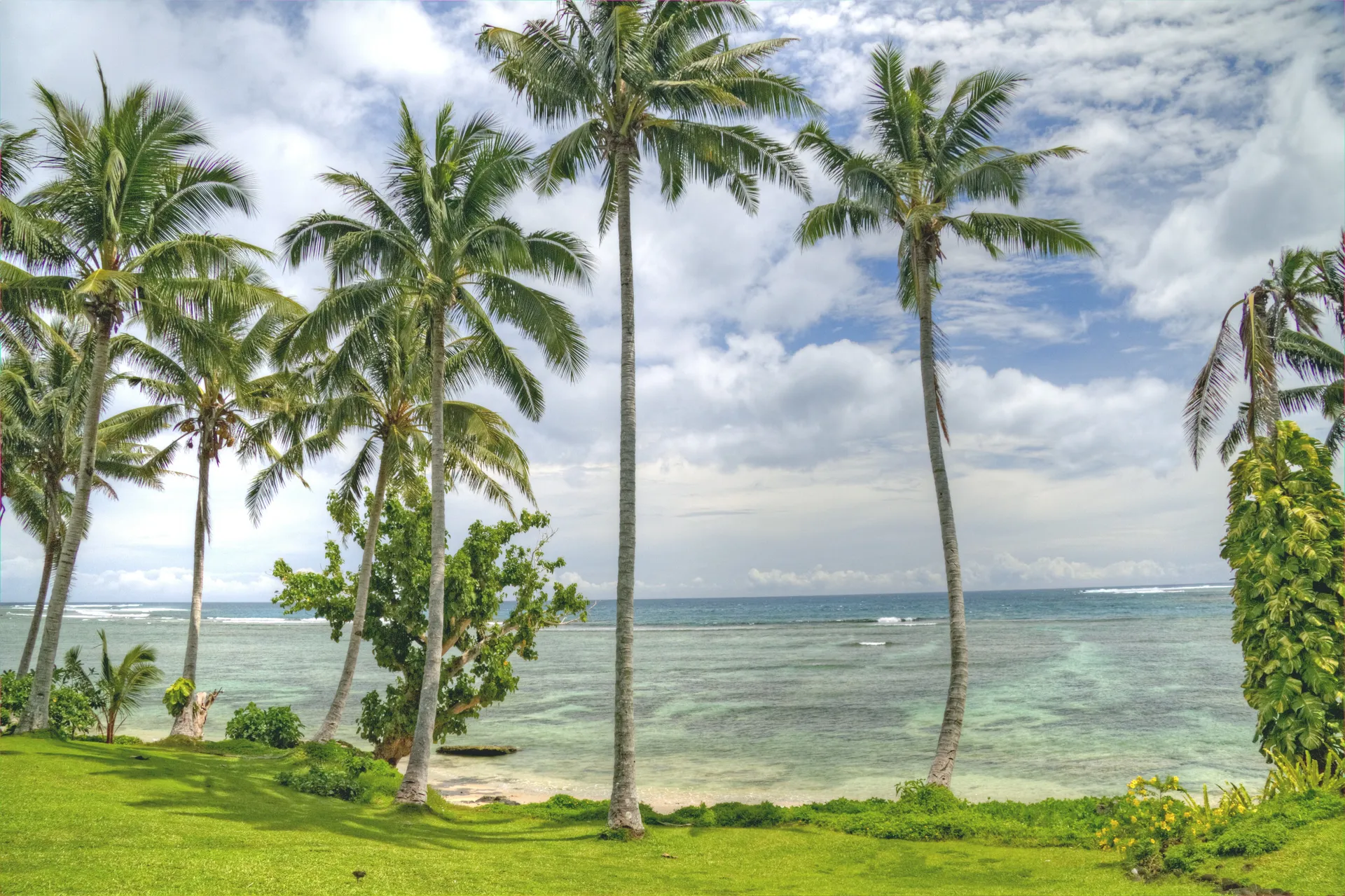
Deep in the heart of the South Pacific, where the volcanic islands of American Samoa rise from the ocean floor like verdant cathedrals draped in tropical forest, Pago Pago occupies one of the most dramatic natural harbours in the world. The harbour is actually the flooded caldera of an ancient volcano, its steep walls climbing over five hundred meters on either side of the narrow inlet, creating a fjord-like anchorage that Pacific navigators have prized for centuries. This is the most southerly territory of the United States, yet it feels nothing like America — Polynesian culture permeates every aspect of life, from the fa'a Samoa (the Samoan way) that governs village social structure to the communal ovens where whole pigs are wrapped in banana leaves and baked over hot stones.
Rainmaker Mountain — Mount Pioa — towers above the harbour at 523 meters, its summit perpetually wreathed in clouds that produce some of the heaviest rainfall in the South Pacific. This extraordinary precipitation feeds the lush tropical forest that covers the mountain's slopes in an almost impenetrable canopy of banyan, breadfruit, and pandanus, creating one of the most intact lowland tropical forests remaining in the Pacific Islands. The National Park of American Samoa, one of the least visited in the entire national park system, protects significant portions of this forest along with pristine coral reefs and the traditional village lands that have sustained Samoan communities for over three thousand years.
The cultural heritage of Pago Pago and its surrounding villages provides the most meaningful dimension of any visit. Samoan village life operates under a system of matai — chiefs — whose authority encompasses everything from land use to social behavior, creating a communal structure that has survived colonial administration, military presence, and the relentless pressures of globalization with remarkable resilience. The fale, the traditional open-sided house with its domed roof of woven coconut fronds, remains the center of family and village life, its lack of walls a physical expression of the communal transparency that defines Samoan social values. Church services — Methodist, Catholic, and Congregational — are the weekly social highlight, with the hymn singing of astonishing power and beauty.
The tuna canneries that line the inner harbour provide Pago Pago's primary industry and its most pungent olfactory experience. StarKist's facility here is one of the largest in the world, processing skipjack and albacore into the canned tuna that appears on American supermarket shelves. Beyond the industrial waterfront, however, the natural beauty reasserts itself dramatically. Two Lovers' Point offers heart-stopping cliff-top views across the harbour entrance, while the villages along the southern coast — Leone, Amanave, and Poloa — preserve traditional Samoan architecture and community life with an authenticity that rewards respectful visitors with genuine cultural exchange.
Celebrity Cruises, Oceania Cruises, and Regent Seven Seas Cruises include Pago Pago in their South Pacific and round-the-world itineraries, with vessels docking in the deep-water harbour that comfortably accommodates the largest cruise ships. The tropical climate is warm year-round, with the dry season from May through October offering the most comfortable conditions and the least rainfall — though "dry" is relative in a place that receives over three hundred centimeters of rain annually. Pago Pago rewards visitors who look beyond the industrial waterfront to discover the Polynesian cultural richness and extraordinary natural beauty that make American Samoa one of the South Pacific's most underrated destinations.

