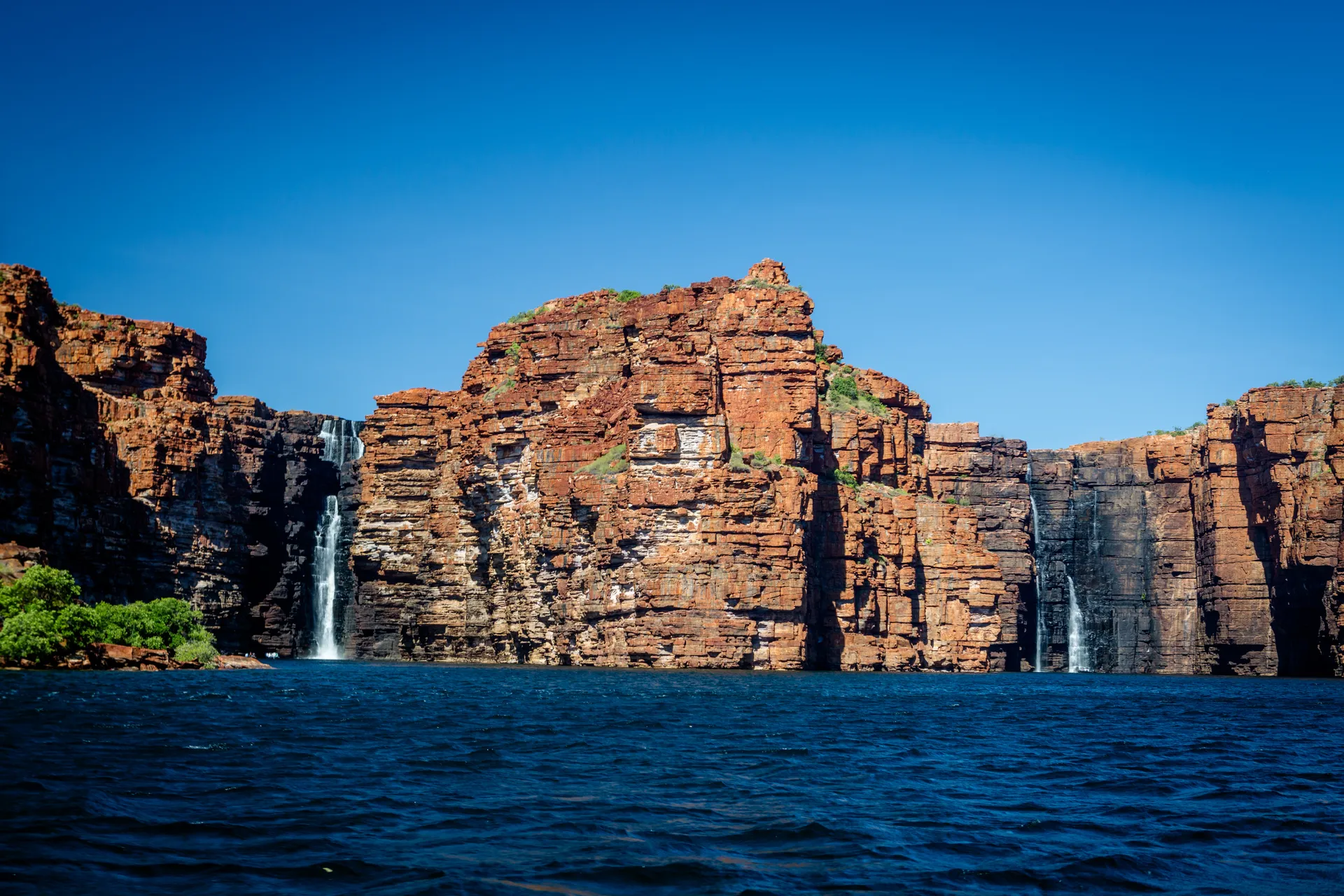
In the remote Kimberley region of Western Australia, where the continent's northwestern edge meets the Indian Ocean in a rugged frontier of sandstone, mangrove, and tidal estuary, the Hunter River provides access to one of the last great wilderness experiences on earth. Mitchell Falls, the four-tiered waterfall that cascades over ancient sandstone terraces into plunge pools of extraordinary clarity, represents the culmination of a journey through landscapes so vast and untouched that they seem to predate human consciousness. The Kimberley, roughly three times the size of England with a population of fewer than forty thousand, is Australia's final frontier — a region where crocodiles outnumber people and the Aboriginal cultural heritage stretches back over sixty thousand years.
The approach by expedition vessel through the Hunter River estuary introduces the Kimberley's defining character: enormous tidal ranges — up to eleven meters — that transform the landscape twice daily, revealing mudflats where saltwater crocodiles bask with prehistoric patience, then flooding mangrove forests that extend for miles along the river's banks. Zodiac excursions through these tidal waterways offer encounters with wildlife that has barely registered humanity's existence: brahminy kites circle overhead, archer fish spit at insects from the water's surface, and the occasional crocodile slides from a mudbank with a splash that concentrates the mind wonderfully.
Mitchell Falls itself, reached by helicopter from the vessel or by a challenging overland trek from Mitchell Plateau, presents a spectacle that justifies every kilometer of the journey. The falls descend in four distinct stages over Proterozoic sandstone that is nearly two billion years old, each tier creating its own plunge pool fringed by monsoon vine forest. The aerial view reveals a landscape of such primal beauty — ochre rock, sapphire pools, emerald forest — that it seems more like a planetary surface from science fiction than a corner of contemporary Australia. The rock art sites surrounding the falls contain some of the oldest and most significant examples of Bradshaw (Gwion Gwion) paintings, enigmatic figures whose age and origin continue to challenge archaeological understanding.
The broader Kimberley coast, of which the Hunter River is just one chapter, contains an archipelago of over two thousand islands, most of them unnamed and unvisited. The horizontal waterfalls at Talbot Bay, where massive tidal flows are forced through narrow gorges in the McLarty Range, create a phenomenon unique in the world — waterfalls that flow horizontally as the ocean literally pours through gaps in the rock. King George Falls, at eighty meters the highest twin falls in Western Australia, plunge from the sandstone plateau directly into tidal saltwater, accessible only by vessel or helicopter.
Ponant, Seabourn, and Silversea operate expedition voyages along the Kimberley coast between April and September, the dry season when the monsoon rains have ceased and the waterfalls are at their most spectacular. The Hunter River and Mitchell Falls are typically included in voyages between Broome and Darwin (or the reverse), with Zodiac landings and helicopter excursions providing access to sites unreachable by road. This is expedition cruising at its most authentic — there are no port facilities, no infrastructure, and no other way for most travelers to reach these places. The experience demands comfort with remoteness and rewards it with encounters that feel genuinely unprecedented.

