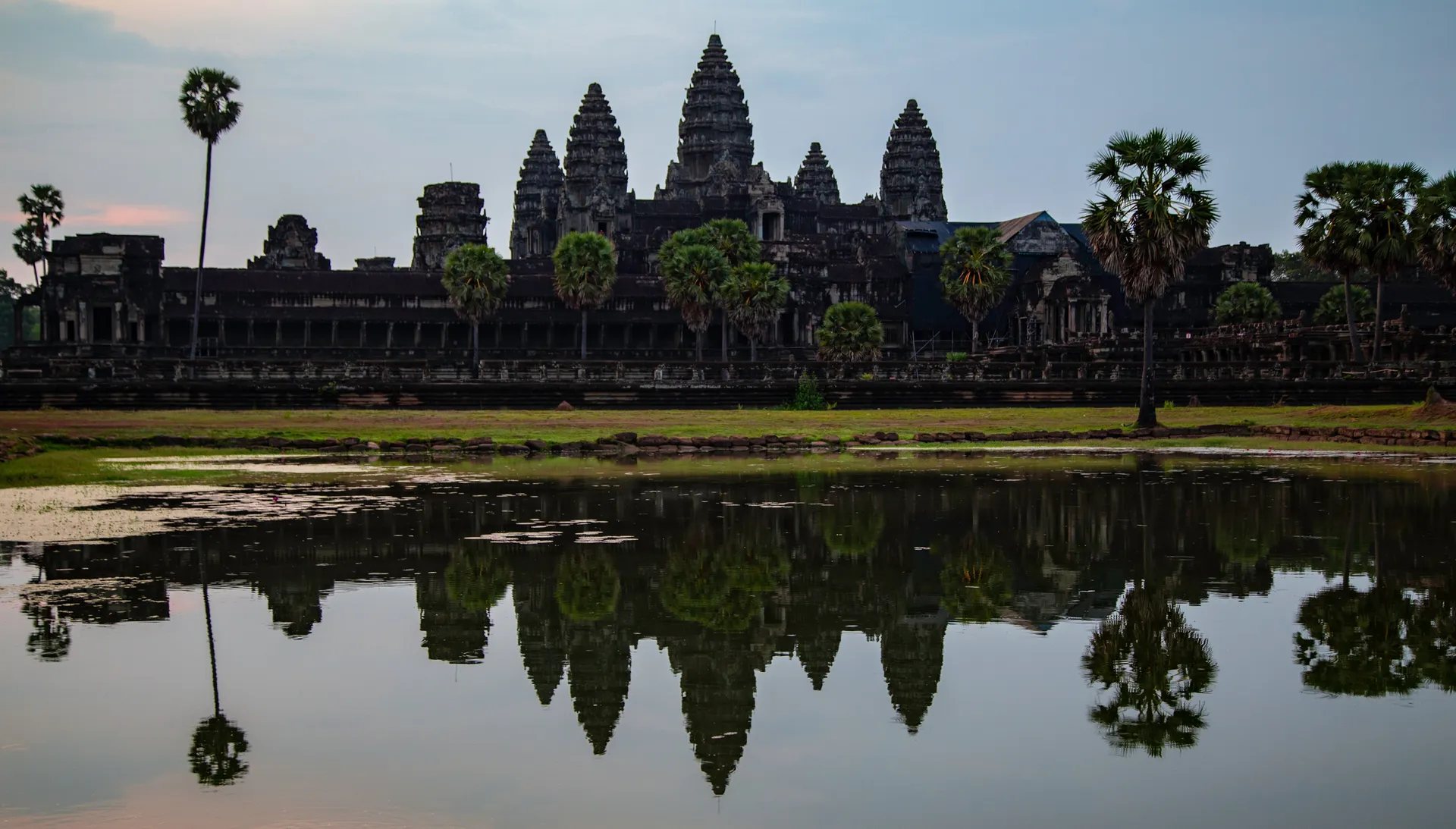
In the humid forests of northwestern Cambodia, a civilization that once ruled much of Southeast Asia left behind a city of temples so vast that its full extent was not understood until satellite imaging revealed its contours in the 21st century. Angkor, capital of the Khmer Empire from the 9th to the 15th century, was among the largest pre-industrial cities on Earth — a hydraulic metropolis of reservoirs, canals, and rice paddies that sustained a population estimated at over one million when London was a medieval town of 50,000. The word "Angkor" derives from the Sanskrit nagara, meaning "city," and the scale of ambition contained in that simple noun still stuns visitors who stand before its monuments for the first time.
Angkor Wat, the crown jewel of the complex, is the largest religious monument ever constructed — a five-towered mountain of sandstone representing Mount Meru, the home of the Hindu gods, surrounded by a moat 200 metres wide that symbolizes the cosmic ocean. Built by King Suryavarman II in the early 12th century and gradually converted to Buddhist use, the temple's bas-relief galleries stretch for nearly a kilometre, depicting scenes from the Ramayana, the Mahabharata, and the military campaigns of the Khmer kings with a sculptural refinement that rivals anything produced in medieval Europe. At dawn, when the five lotus-bud towers are silhouetted against a sky of salmon and gold and reflected in the still waters of the moat, Angkor Wat achieves a beauty that transcends cultural boundaries.
The broader Angkor Archaeological Park encompasses over 400 square kilometres and more than a thousand temples spanning five centuries of Khmer artistic evolution. The Bayon, centrepiece of Angkor Thom, confronts visitors with 216 enigmatic stone faces — each wearing an identical Mona Lisa smile — gazing in four cardinal directions from 54 towers. Ta Prohm, deliberately left in a state of photogenic ruin, is embraced by the roots of silk-cotton and strangler fig trees that have spent centuries slowly dismantling its walls and galleries, creating an extraordinary fusion of human architecture and vegetal power. Banteay Srei, a jewel-box temple 25 kilometres northeast of the main complex, displays the finest decorative carving in all of Khmer art — pink sandstone worked to the delicacy of lacework.
The modern gateway to Angkor is Siem Reap, a town that has transformed over the past three decades from a dusty provincial capital into a sophisticated base for temple exploration. Its Old Market quarter, Pub Street, and the restaurants along the river serve refined Cambodian cuisine — amok (steamed fish curry in banana leaves), lok lak (stir-fried beef with kampot pepper), and fresh spring rolls stuffed with river prawns and morning glory. The Artisans Angkor workshops employ young Cambodians in traditional silk weaving and stone carving, reviving skills that trace directly back to the Khmer artisans who built the temples themselves.
Angkor is accessible on river cruise itineraries operated by APT Cruising and CroisiEurope along the Mekong and Tonle Sap, with excursions typically departing from Siem Reap. The most comfortable visiting season runs from November through March, when lower humidity and cooler temperatures make temple exploration pleasant. December and January are ideal, with clear skies and the landscape still lush from the preceding monsoon season.

