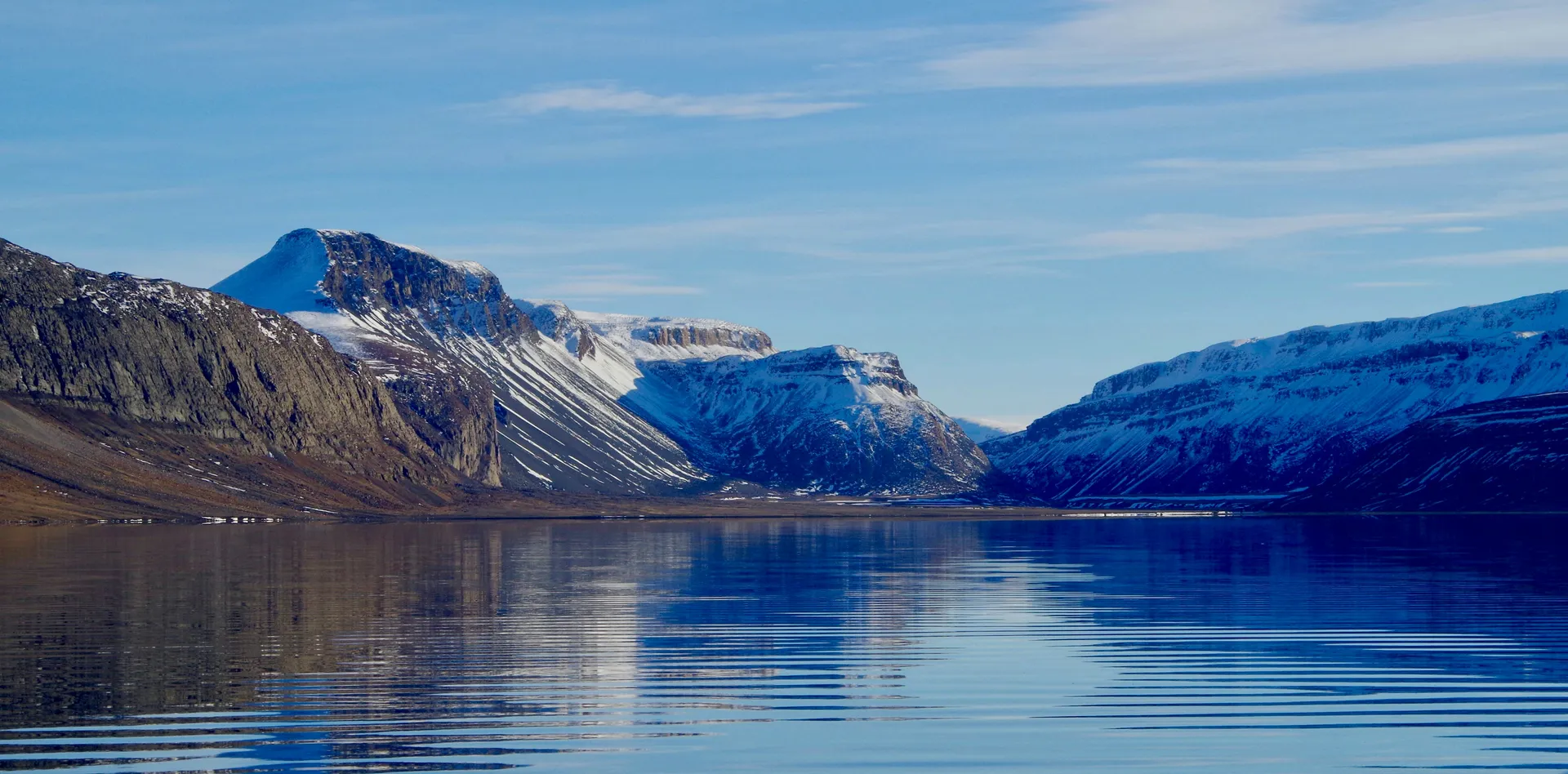
At the northern extremity of Baffin Island, where Adams Sound meets the frigid waters of Admiralty Inlet, the Inuit hamlet of Arctic Bay clings to existence at latitude 73 degrees north—one of the most northerly communities on earth. The Inuit have inhabited this region for over four thousand years, their survival in one of the planet's harshest environments standing as one of humanity's great achievements. European explorers, drawn by the fantasy of the Northwest Passage, arrived only in the nineteenth century; the Scottish whaling captain William Adams gave his name to the sound in the 1870s, but the Inuit name, Ikpiarjuk—meaning "the pocket"—better captures the settlement's sheltered position beneath soaring cliffs.
The landscape surrounding Arctic Bay transcends conventional notions of beauty to achieve something closer to the sublime. Permafrost extends to depths of over 500 meters, and for three months each winter the sun never rises, plunging the community into a twilight world illuminated by stars, the moon, and the ethereal curtains of the aurora borealis. In summer, the transformation is equally extreme: twenty-four hours of daylight bathe the mountains, fjords, and ice floes in a golden luminosity that seems to suspend time itself. The surrounding mountains—some exceeding 800 meters—are composed of ancient sedimentary rock in bands of burgundy, grey, and ochre that geologists have dated to over a billion years.
The living culture of Arctic Bay offers expedition travelers one of the most authentic Indigenous experiences available in the Canadian Arctic. The community of approximately 900 people maintains strong connections to traditional practices: hunting narwhal and seal, fishing for Arctic char, and crafting clothing from caribou hide and sealskin. Visitors may be invited to participate in drum dancing, throat singing demonstrations, and community feasts where country food—raw frozen char (quaq), dried caribou, and muktuk (narwhal skin and blubber)—is shared with genuine hospitality. The local co-operative store and the Tumivut archaeological site provide additional windows into both contemporary and ancient Inuit life.
The natural environment around Arctic Bay harbors wildlife spectacles of extraordinary caliber. Admiralty Inlet is one of the world's most reliable locations for observing narwhal, the so-called unicorns of the sea, whose twisted ivory tusks can exceed two meters in length. Pods of belugas pass through in summer, their ghostly white forms visible in the clear Arctic water. Polar bears roam the sea ice and shoreline, while thick-billed murres nest in enormous colonies on the cliffs of nearby Bylot Island. The midnight sun in July illuminates a landscape where Arctic hares, foxes, and ermine move through a brief, intense summer that transforms the tundra with wildflowers.
Arctic Bay is accessible by air from Iqaluit via scheduled flights or by expedition cruise vessel navigating the Northwest Passage. The expedition season runs from late July through September, with August offering the best combination of navigable waters and wildlife activity. Ice conditions vary dramatically from year to year and determine whether vessels can reach the community. Travelers should be prepared for temperatures that can drop below freezing even in summer and for the possibility that weather or ice may alter itineraries on short notice—flexibility is not optional but essential in this part of the world.

