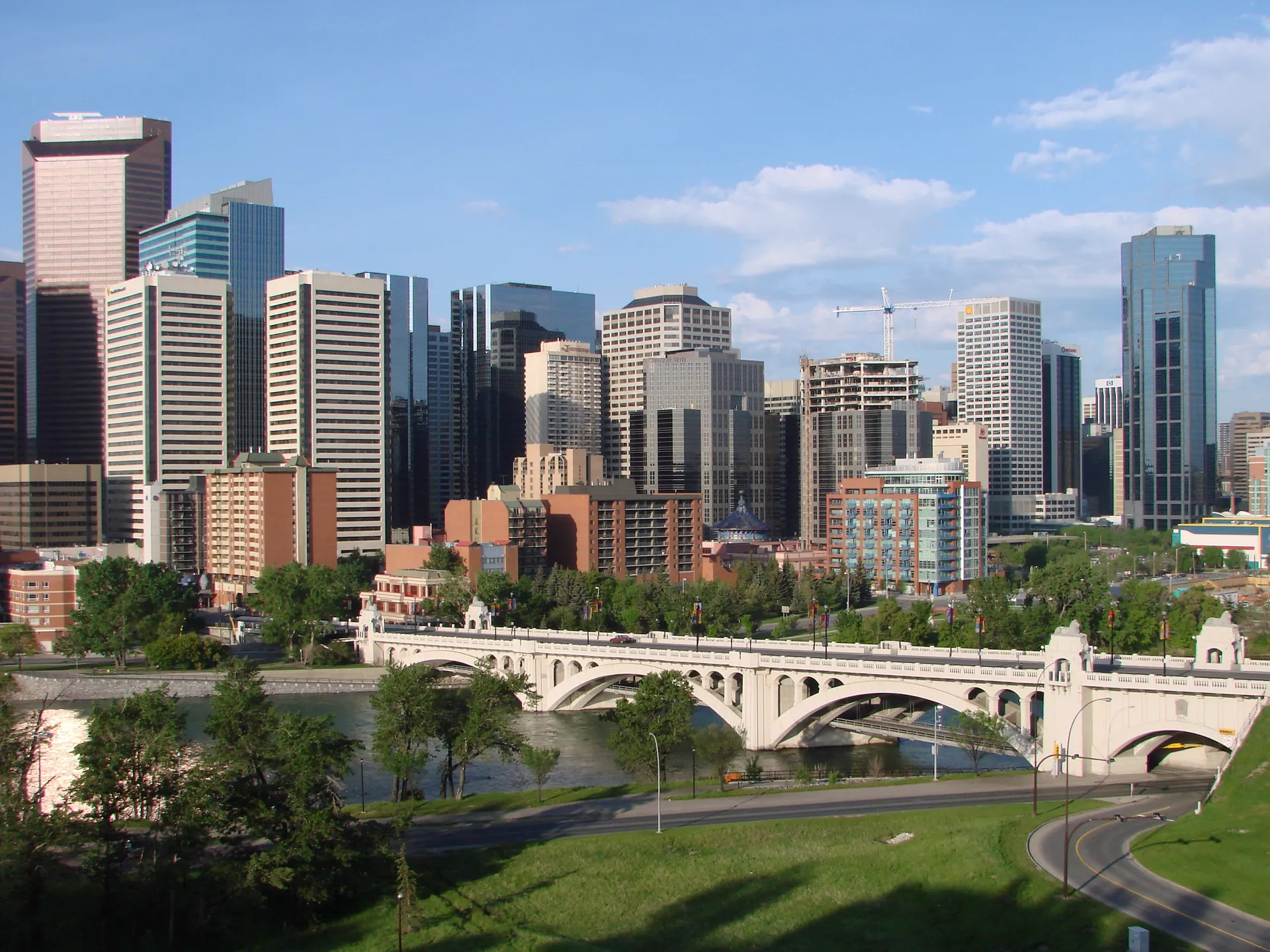
Calgary sits where the Canadian prairies meet the Rocky Mountains, a city of one and a quarter million people whose skyline of glass towers rises from a landscape that, just an hour to the west, gives way to some of the most spectacular mountain scenery in North America. Founded as a North-West Mounted Police fort in 1875 and transformed by the oil boom of the mid-twentieth century, Calgary has grown into a dynamic, prosperous, and surprisingly cosmopolitan western Canadian city — a place where cowboy culture and corporate ambition coexist with a growing arts scene, world-class restaurants, and the annual Calgary Stampede, the self-proclaimed "Greatest Outdoor Show on Earth."
The Stampede, held each July, is a ten-day rodeo and exhibition that transforms Calgary into a city-wide celebration of Western heritage. Professional rodeo competitions — bull riding, bareback bronc riding, barrel racing — draw the continent's top cowboys and cowgirls, while the chuck-wagon races, the midway, and the pancake breakfasts served on every street corner create an atmosphere of carnival exuberance that is uniquely Calgarian. Outside Stampede season, the city's cultural offerings are substantial: the Glenbow Museum chronicles the history of western Canada through art and artefact, Studio Bell houses the National Music Centre in an architecturally striking building, and the East Village neighbourhood has emerged as a hub of galleries, restaurants, and public art.
Calgary's food scene reflects its position as both a cattle capital and a multicultural city. Alberta beef — grain-fed, corn-finished, and widely considered the finest in Canada — is the foundation, served as thick-cut steaks in the city's numerous steakhouses and as gourmet burgers in its growing casual-dining scene. But Calgary has evolved far beyond beef: the city now boasts Vietnamese pho corridors, Ethiopian injera houses, Japanese izakayas, and farm-to-table restaurants that celebrate Alberta's agricultural diversity — bison, elk, Saskatoon berries, and the wild honey produced on the prairies.
The Rocky Mountains are Calgary's ultimate draw, and the access is extraordinary. Banff National Park, Canada's first national park and a UNESCO World Heritage Site, lies barely ninety minutes west — a drive that transitions from prairie flatland to towering peaks in one of the most dramatic landscape shifts imaginable. Lake Louise, its turquoise glacial waters backed by the Victoria Glacier, is one of the most photographed views on earth. The Icefields Parkway, connecting Lake Louise to Jasper through 230 kilometres of mountain scenery, is frequently called the most beautiful road in the world. Closer to Calgary, Kananaskis Country offers hiking, mountain biking, and white-water rafting in a less-crowded alternative to Banff.
Calgary is included in itineraries by Aurora Expeditions and Tauck, typically as a pre- or post-cruise extension linked to Canadian Rockies and Pacific Northwest voyages. The Calgary International Airport is the gateway to the Canadian Rockies for travellers from around the world. The best time to visit is June through September, when mountain trails are snow-free, wildflowers carpet the alpine meadows, and the long summer days offer up to sixteen hours of daylight.

