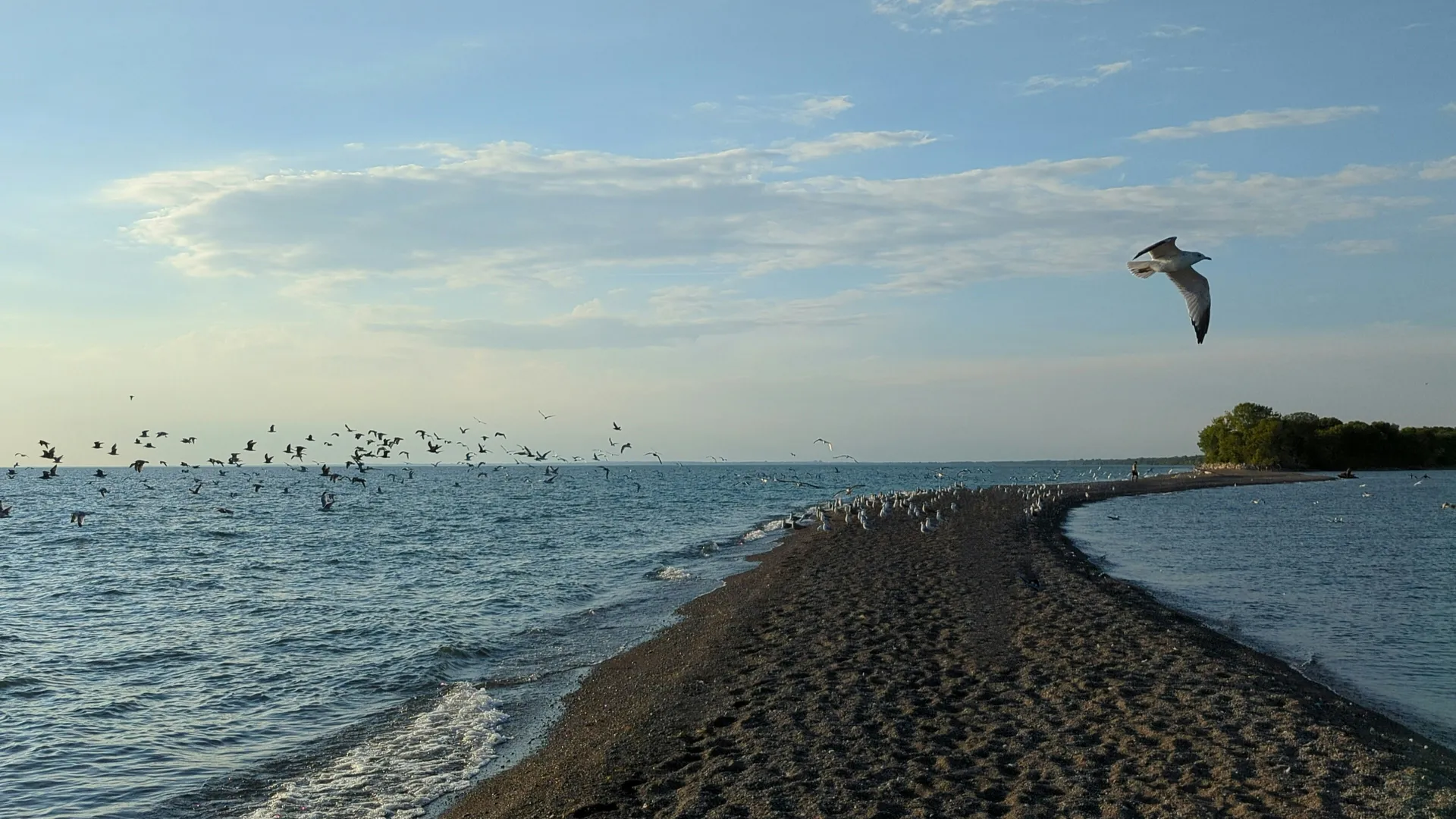
Point Pelee National Park occupies the southernmost tip of mainland Canada — a narrow sandspit extending into Lake Erie at a latitude south of northern California, where Carolinian forest, marshland, and migratory flyways converge to create one of North America's most important ecological intersections in one of its smallest national parks.
The park's fame rests primarily on its extraordinary position along two of North America's great migratory corridors. Each spring and autumn, millions of birds funnel through Point Pelee's narrow tip, creating birding spectacles that draw ornithologists from around the world. The spring migration in May is particularly legendary — warblers, vireos, thrushes, and tanagers arrive in waves that can produce daily species counts exceeding a hundred. The autumn monarch butterfly migration transforms the park's trees into orange-and-black tapestries as millions of butterflies pause here before their crossing of Lake Erie.
The Carolinian forest that covers much of the park — the northernmost extension of a forest type more commonly associated with the American South — supports tree species found nowhere else in Canada: sassafras, tulip tree, and hackberry. The park's boardwalk traverses the largest remaining freshwater marsh in the Great Lakes region, a cattail labyrinth that supports fish-spawning habitat, turtle nesting sites, and the chorus of spring peepers that transforms April evenings into natural concert halls.
Viking includes Point Pelee on Great Lakes itineraries, with the park providing a nature-focused counterpoint to the industrial heritage of nearby Windsor and Detroit. The park's visitor center provides migration timing information that can mean the difference between an ordinary visit and a life-altering birding experience.
May for spring birding and September for monarch butterflies represent the peak experiences, though summer offers warm Lake Erie swimming and the distinctive pleasure of walking to Canada's southernmost point — a sandspit that shifts position with every storm, reminding visitors that even national boundaries defer to natural forces. Point Pelee proves that ecological significance bears no relationship to physical size — this park of fifteen square kilometers contains biodiversity that parks a thousand times larger cannot match.

