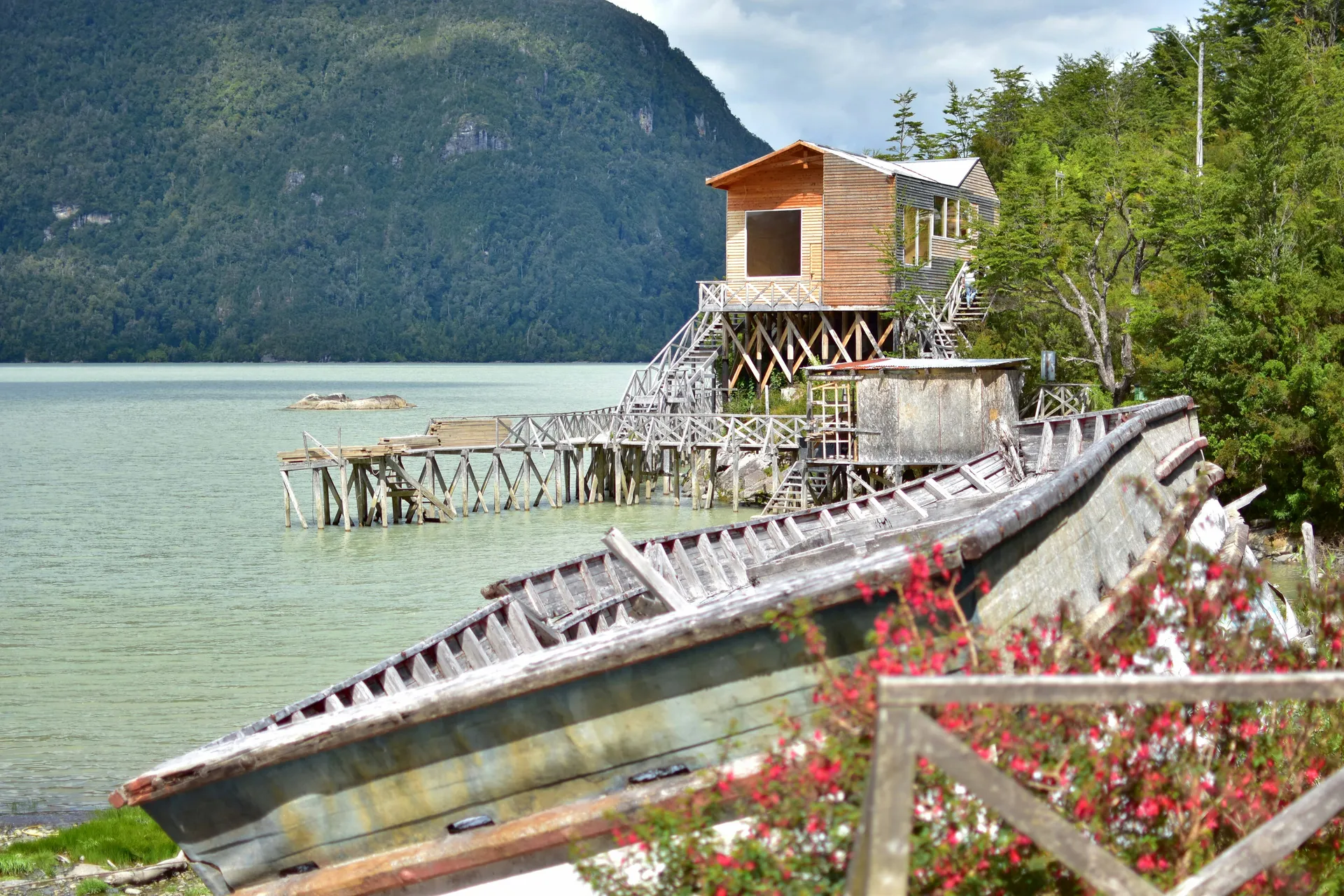
Perched at the confluence of the Baker and Pascua rivers where they empty into the fjords of southern Aysén, Caleta Tortel is a village that seems to defy the conventional requirements of human settlement. There are no streets here — the entire community is connected by a network of elevated wooden walkways, boardwalks, and staircases that thread through the cypress forest, over the water, and between houses that cling to the steep hillsides like barnacles. Founded in 1955 as a cypress-logging settlement, Tortel has evolved into one of Chilean Patagonia's most singular destinations — a place where architecture and landscape merge so completely that it is impossible to say where one ends and the other begins.
The walkway system is both infrastructure and attraction. Over eight kilometres of pasarelas — wooden boardwalks elevated on stilts — constitute the village's entire transportation network. Walking through Tortel is a constant negotiation of stairs, ramps, and narrow passages that wind through dense forest, cross tidal inlets, and connect scattered clusters of wooden houses painted in faded reds and blues. The experience is intimate, physical, and utterly unlike any other village in South America. Rain or shine (and rain is frequent — this region receives over 4,000 millimetres annually), the boardwalks are the village's arteries, carrying all traffic from school children to grocery deliveries.
Tortel's food culture is defined by its extreme isolation and maritime setting. The Baker River, one of Chile's most powerful rivers, delivers glacial meltwater that supports populations of king crab, sea urchin, and various shellfish that form the backbone of local cuisine. Curanto — the traditional Patagonian feast of shellfish, meats, and potatoes cooked in an earth oven — appears at celebrations and can sometimes be arranged for visitors. Simple restaurants along the boardwalks serve fresh fish soup, empanadas filled with local seafood, and centolla prepared simply, letting the sweet, cold-water crab speak for itself.
The surrounding landscape is some of the most dramatic in Patagonian Chile. The Northern Patagonian Ice Field — the world's third-largest contiguous ice mass outside the polar regions — lies just to the west, feeding glaciers that calve into the Jorge Montt fjord. Boat excursions to the Jorge Montt Glacier reveal a retreating ice wall of stunning blue intensity. The Baker River itself, turquoise with glacial flour, is considered one of the most beautiful rivers in Chile and offers world-class kayaking through a landscape of temperate rainforest, waterfalls, and granite canyons.
Caleta Tortel is accessible by the Carretera Austral — Chile's legendary southern highway — via a 23-kilometre spur road from the main route. The nearest airports are in Coyhaique (8 hours north by road) and Cochrane (2 hours north). Expedition cruise ships occasionally visit the fjord, anchoring offshore and tendering passengers to the boardwalks. The best visiting season is November through March, when longer days and relatively drier weather (by Patagonian standards) make outdoor exploration most rewarding.

