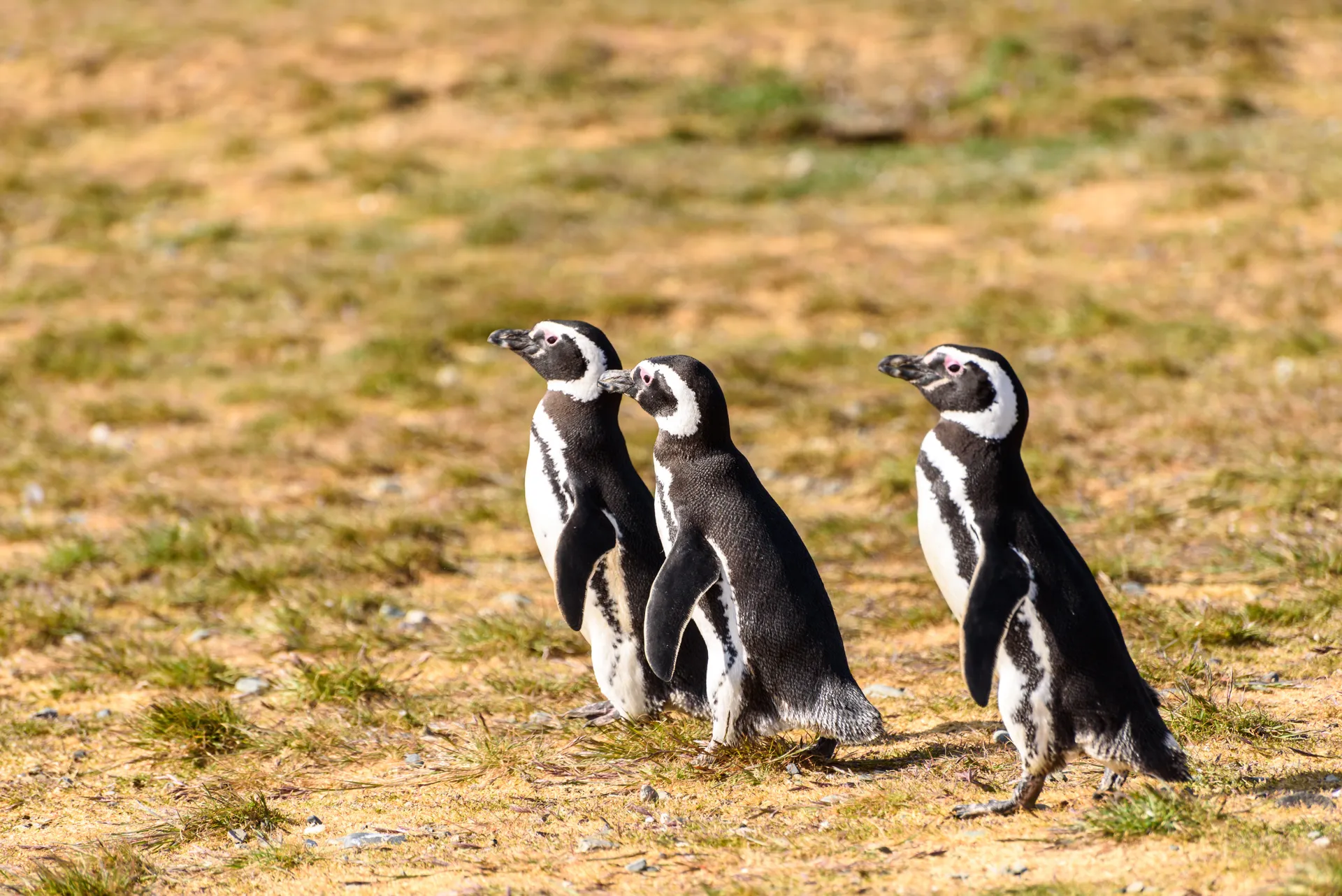
Magdalena Island sits in the Strait of Magellan between Punta Arenas and Tierra del Fuego, a small, flat, wind-battered island that from a distance appears unremarkable — until you draw close enough to see that every square meter of its 85 hectares is occupied by Magellanic penguins. This is Monumento Natural Los Pinguinos, one of the largest penguin colonies in South America, home to an estimated 60,000 breeding pairs that arrive each September to nest, mate, and raise their chicks before departing for the open sea in March.
The experience of stepping ashore on Magdalena Island is overwhelming in the best possible sense. A wooden boardwalk, raised to protect the nesting burrows, leads from the landing beach to the lighthouse at the island's center, and every step of this five-hundred-meter path is accompanied by penguins — penguins waddling purposefully across the trail, penguins peering from their burrows, penguins braying at their mates in the rusty-gate call that has earned them the nickname "jackass penguins." The birds show no fear of humans, often approaching within arm's reach with a curiosity that feels almost companionable.
The lighthouse, built in 1902 and now converted into a small visitor center, marks the island's highest point — a relative term on terrain that barely rises above the strait. From here, the full scope of the colony becomes apparent: a sea of black-and-white bodies stretching to every shore, their guano painting the grass in patches of white and green. Skuas and kelp gulls patrol overhead, looking for unattended eggs, while dolphin gulls and South American terns add their calls to the general cacophony. In the waters around the island, Commerson's dolphins — compact, striking black-and-white cetaceans — are frequently spotted, and Peale's dolphins sometimes ride the bow waves of approaching boats.
The Strait of Magellan itself is a destination of considerable historical and scenic significance. Ferdinand Magellan navigated this treacherous passage in 1520, becoming the first European to connect the Atlantic and Pacific oceans through the southernmost reaches of South America. The strait's shores are flanked by the Patagonian steppe on the north and the mountainous wilderness of Tierra del Fuego on the south, creating a dramatic corridor of wind, current, and austere beauty.
Magdalena Island is designated a "Captain's Choice" destination on many expedition cruise itineraries, meaning the visit is subject to weather and sea conditions in the notoriously unpredictable Strait of Magellan. When conditions allow, ships anchor offshore and ferry passengers by Zodiac to the landing beach. The penguin season runs from September through March, with December and January offering the best combination of penguin activity (chicks hatching and growing) and the most manageable weather. Even in summer, the Strait of Magellan is windy and cold — waterproof layers, warm clothing, and sturdy footwear are essential. Magdalena Island delivers one of the most intimate and joyful wildlife encounters in the Southern Hemisphere — sixty thousand penguins and you, sharing a windswept island at the bottom of the world.

