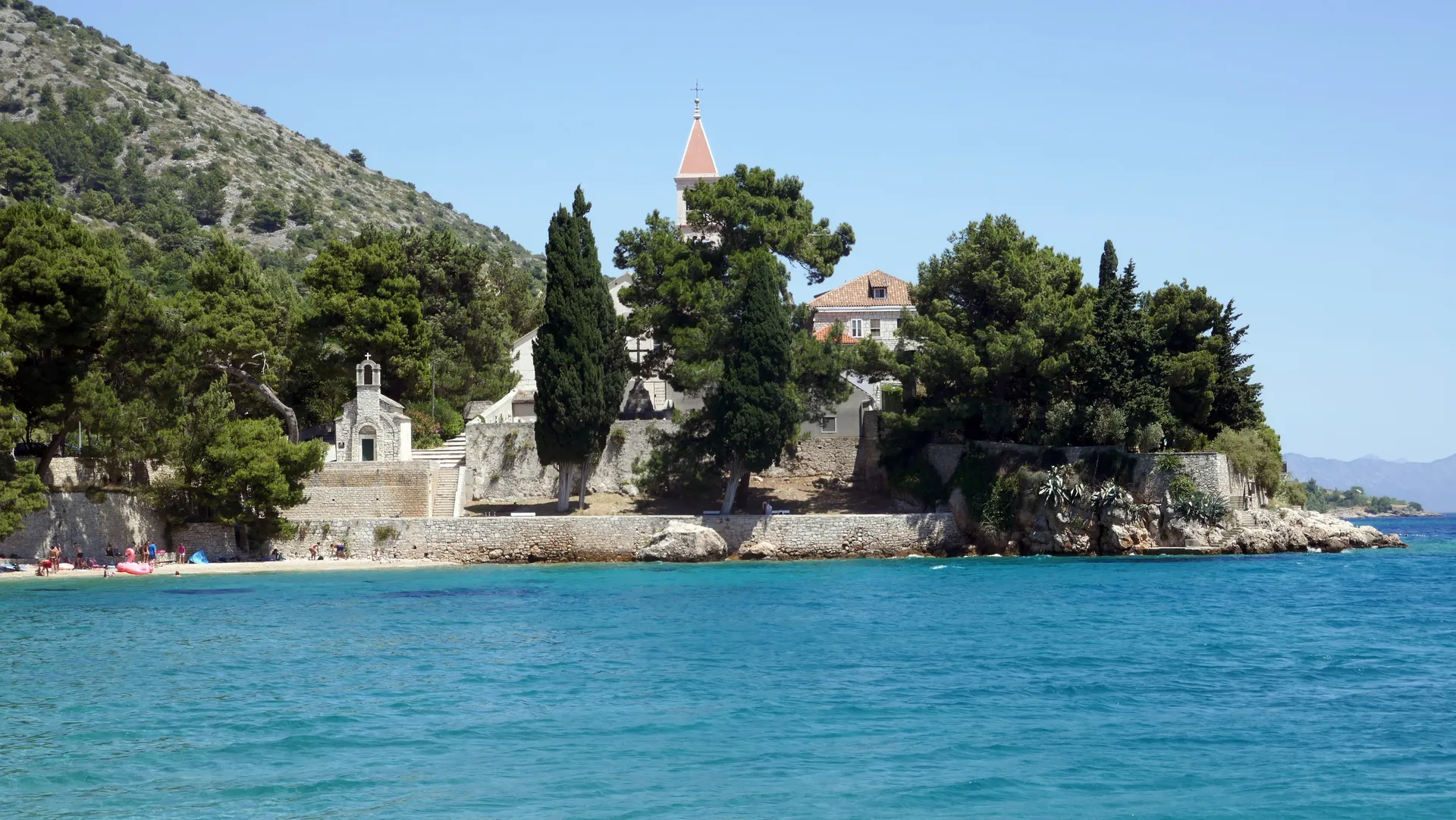
The quarries of Brac have supplied the building stone of empires. The gleaming white limestone extracted from this Croatian island's interior — a stone so fine-grained and luminous that it seems to glow from within — was used to construct Diocletian's Palace in Split, the Hungarian Parliament in Budapest, the White House in Washington, D.C., and the altar of Liverpool's Catholic Cathedral. For over two millennia, the stonecutters of Brac have shaped their island's geology into architecture across three continents, and the masonry tradition remains alive in the Stonemason School at Pucisca, the only institution of its kind in Europe, where young apprentices still learn to carve by hand using tools and techniques that have changed remarkably little since Roman times.
Brac is the largest island in central Dalmatia, a mountainous wedge of karst limestone rising to 780 metres at Vidova Gora — the highest peak on any Adriatic island — before plunging to a coastline of pine-scented coves, fishing villages, and the single most photographed beach in Croatia. Zlatni Rat, the "Golden Horn," extends from the southern shore near the town of Bol in a narrow tongue of fine white pebbles that shifts its angle with the wind and current, pointing sometimes east, sometimes west, in a natural demonstration of coastal dynamics that has made it an icon of Mediterranean beach tourism. The water on either side is a luminous turquoise of such intensity that satellite photographs of the beach are often mistaken for digitally enhanced images.
The interior of Brac is a world apart from the coastal glamour. Stone-walled olive groves and vineyards climb the hillsides in terraces built by generations of farmers whose dry-stone walls — constructed without mortar, using the same limestone that built palaces — are works of vernacular architecture in their own right. The villages of Nerezisca, Skrip, and Lozisca are clusters of stone houses, Romanesque churches, and threshing floors where the rhythms of agricultural life persist with surprising tenacity. Skrip, the oldest settlement on the island, houses the Island Museum in a fortified medieval tower, displaying Roman mosaics, sarcophagi, and olive presses that document 2,000 years of continuous habitation.
Brac's culinary identity is rooted in the Mediterranean triad of olive oil, wine, and bread, enriched by the island's own specialty: vitalac, a traditional dish of lamb offal wrapped in intestines and roasted over an open fire, consumed at Easter and other celebrations. The local olive oil, pressed from the ancient Oblica variety that thrives in Brac's limestone soil, is aromatic and peppery — among the finest in Dalmatia. The wines of Bol, particularly those made from the indigenous Plavac Mali grape on the sun-drenched southern slopes below Vidova Gora, produce reds of surprising depth and structure. At waterfront konobas in Supetar, Milna, and Bol, fresh-caught fish grilled over charcoal and dressed with island olive oil remains the quintessential Brac meal.
Brac Island is visited by Ponant on Adriatic itineraries, with ships anchoring at Bol or Supetar. The prime visiting season runs from May through October, with June and September offering warm seas for swimming at Zlatni Rat, comfortable temperatures for exploring the interior villages, and the luminous Adriatic light that makes this island one of Croatia's most photogenic destinations.

