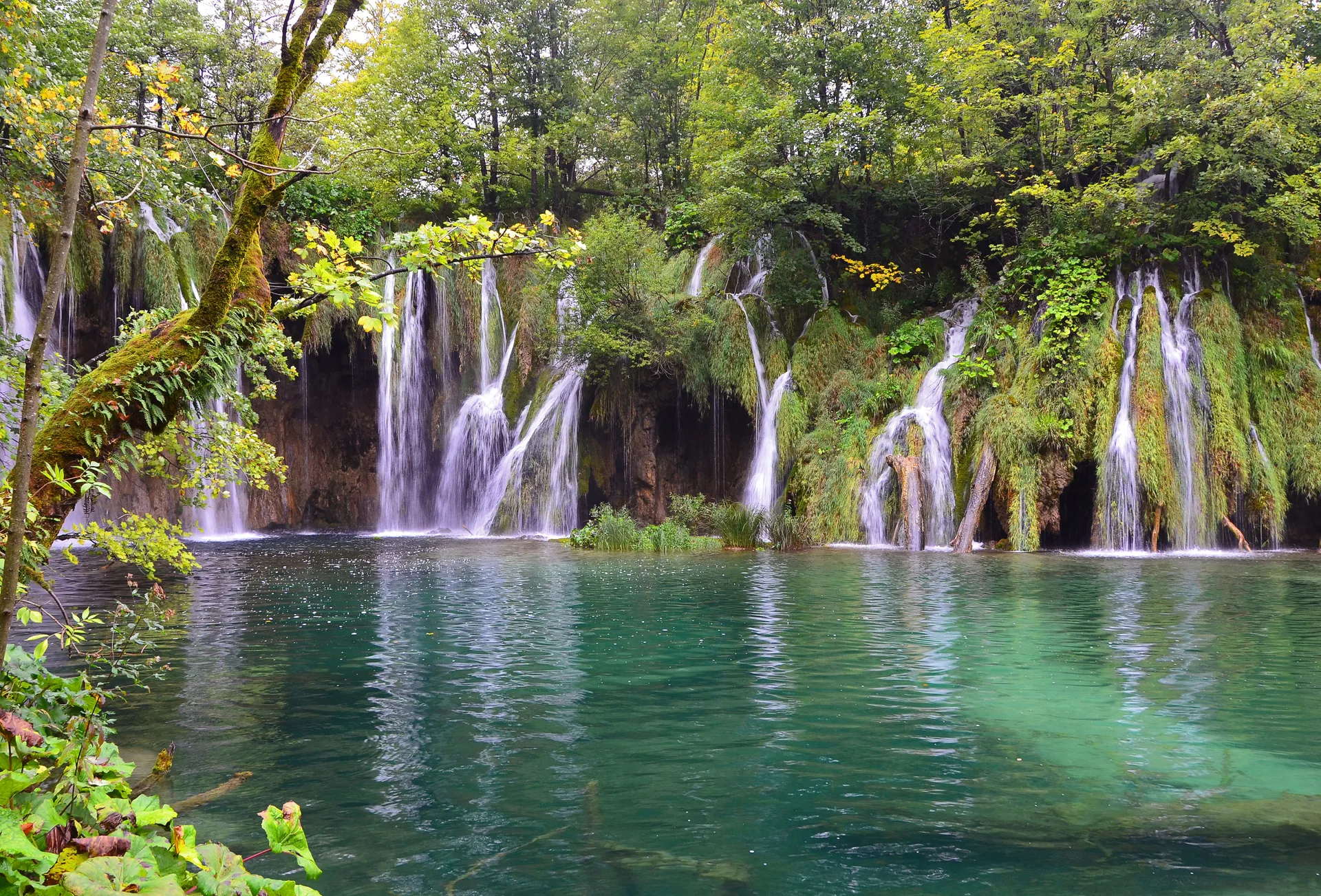
In the mountainous interior of Croatia, where the Dinaric Alps descend through dense beech and fir forests toward the Adriatic coast, the sixteen interconnected lakes of Plitvice cascade through a landscape of such improbable beauty that early visitors believed the formations could not be natural. Established as Yugoslavia's first national park in 1949 and inscribed as a UNESCO World Heritage Site in 1979, Plitvice Lakes occupies a terrain shaped by the constant interplay of water, limestone, and living organisms—a process called travertine deposition, in which calcium-rich water flowing over moss and algae creates the natural dams, terraces, and barriers that give the park its extraordinary stepped-lake morphology.
The character of Plitvice is defined by water in motion. Over ninety waterfalls connect the upper and lower lake systems, ranging from delicate curtains of mist to the thundering seventy-eight-meter drop of Veliki Slap, Croatia's tallest waterfall. The lakes themselves display a chromatic range that shifts between emerald green, turquoise blue, and gunmetal grey depending on the mineral content of the water, the angle of sunlight, and the biological activity within each basin. Elevated boardwalks thread through the park, hovering just above the water's surface and passing through curtains of spray that keep the wooden planks perpetually damp and the air filled with the sound of falling water.
The ecosystems of Plitvice extend well beyond its celebrated waterscapes. The surrounding forests—among the largest intact woodland areas in Southeast Europe—harbor brown bears, wolves, and lynx, though these elusive predators are rarely seen by park visitors. The forest birdlife is exceptional: black and white-backed woodpeckers, Ural owls, and the dippers that bob and dive in the streams provide constant activity for patient observers. The park's butterfly population exceeds 300 species, and the aquatic invertebrates that inhabit the travertine formations are subjects of ongoing scientific study for the insights they provide into freshwater ecology and geochemistry.
The park experience varies dramatically with the seasons, and each period offers compelling reasons to visit. Spring brings snowmelt that swells the waterfalls to their most powerful, while the surrounding forests bloom with wildflowers and the leaves unfurl in luminous shades of green. Summer provides the warmest conditions for the full walking circuit, though visitor numbers peak between June and August. Autumn transforms the beech forests into a blaze of amber, copper, and crimson that frames the turquoise lakes in colors of almost painful intensity. Winter—when the waterfalls freeze into sculptural ice formations and snow silences the forest—offers a magical solitude that is unavailable in other seasons.
Plitvice Lakes is located approximately 130 kilometers south of Zagreb and 250 kilometers north of Dubrovnik, accessible by bus or rental car from both cities. The park operates year-round, with extended summer hours and reduced winter access. Two main entrance points serve the upper and lower lake systems, and a combination of boardwalks, hiking trails, park boats, and shuttle buses allows visitors to customize their route. Advance ticket purchase is required during peak season (June-September), and morning visits before 10 AM are strongly recommended to experience the park before the heaviest crowds arrive. The nearby village of Rastoke, where watermills straddle the Slunjčica River, makes an excellent complementary stop.

