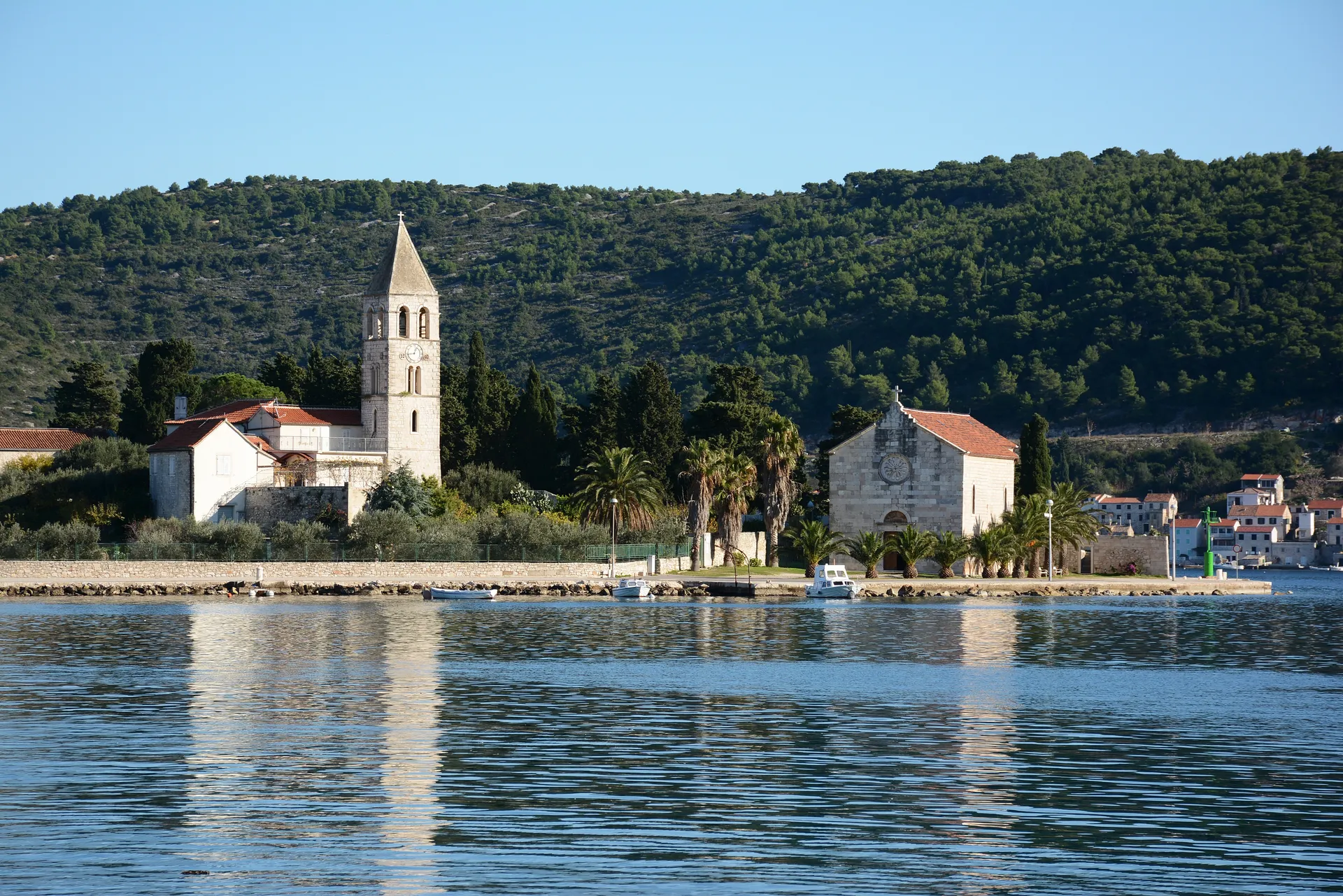
Vis is the most distant of Croatia's inhabited islands, lying some 45 kilometres from the mainland in the open Adriatic — and that remoteness is precisely its gift. Closed to foreign visitors from 1945 to 1989 as a Yugoslav military base, Vis emerged from decades of enforced isolation as the most unspoiled of the Dalmatian islands, a place where the rhythms of fishing, winemaking, and Mediterranean village life continue largely undisturbed by the tourism that has transformed Hvar and Dubrovnik. The two small towns — Vis Town on the eastern coast and Komiza on the western — bookend an island of wild beauty: lavender fields, abandoned military tunnels, vineyards that produce Croatia's most distinctive white wine, and swimming coves so hidden they seem to exist only for the person who discovers them.
Vis Town, built around a deep natural harbour, layers its history in plain sight. The remains of a Greek settlement dating to the fourth century BC — Vis was the ancient colony of Issa, one of the first Greek settlements on the Adriatic — lie beneath and beside the later Roman baths, Venetian fortifications, and Austrian-era barracks. The archaeological museum, housed in a fortress on the harbour, displays a remarkable bronze head of the goddess Artemis recovered from the seabed. The waterfront riva, lined with palm trees and stone houses, fills each evening with a passeggiata that could be taking place in any century.
The cuisine of Vis is Dalmatian island cooking at its purest. Komiza is famous for its komiza pogaca, a bread pie stuffed with salted anchovies, tomatoes, onions, and capers — a recipe that has sustained the island's fishermen for centuries. Fresh fish — grilled, baked under a peka (a domed baking lid covered with hot coals), or served as a simple brudet (fish stew) — is the daily foundation. The island's wine, Vugava — a grape variety found almost nowhere else, producing an aromatic, mineral white — is one of Croatia's most distinctive vintages. Vis is also producing increasingly acclaimed olive oil, and a tasting at one of the small family estates is a highlight of any visit.
The natural attractions of Vis include some of the most spectacular seascapes in the Adriatic. The Blue Cave on the nearby islet of Bisevo — a sea cave where sunlight refracts through an underwater opening to fill the interior with an ethereal, electric-blue glow — is one of Croatia's most famous natural wonders. The military tunnels and submarine pens from the Yugoslav era, carved deep into the island's rock, offer a fascinating Cold War-era counterpoint to the ancient ruins. The beaches of Stiniva — a tiny cove reached through a narrow gap between towering cliffs — and Srebrna are consistently ranked among the finest in Croatia.
Vis is a port of call for Emerald Yacht Cruises, Ponant, and Scenic River Cruises on their Adriatic itineraries. Small-ship cruising is ideally suited to Vis, whose harbours cannot accommodate large vessels. The best time to visit is May through October, with June and September offering the warmest seas and fewest crowds.

