Where the Little Belt narrows between Jutland and the island of Funen, Fredericia stands as Denmark's most deliberately constructed fortress city — a place born not from organic settlement but from royal decree, its streets drawn with military precision across a landscape that had known only farmland and shoreline. Founded in 1650 by Frederick III as a strategic bulwark against Swedish aggression, the town's grid-pattern streets and massive ramparts remain remarkably intact, offering visitors a rare opportunity to walk through a living lesson in seventeenth-century urban planning and the martial ambitions of the Danish crown.
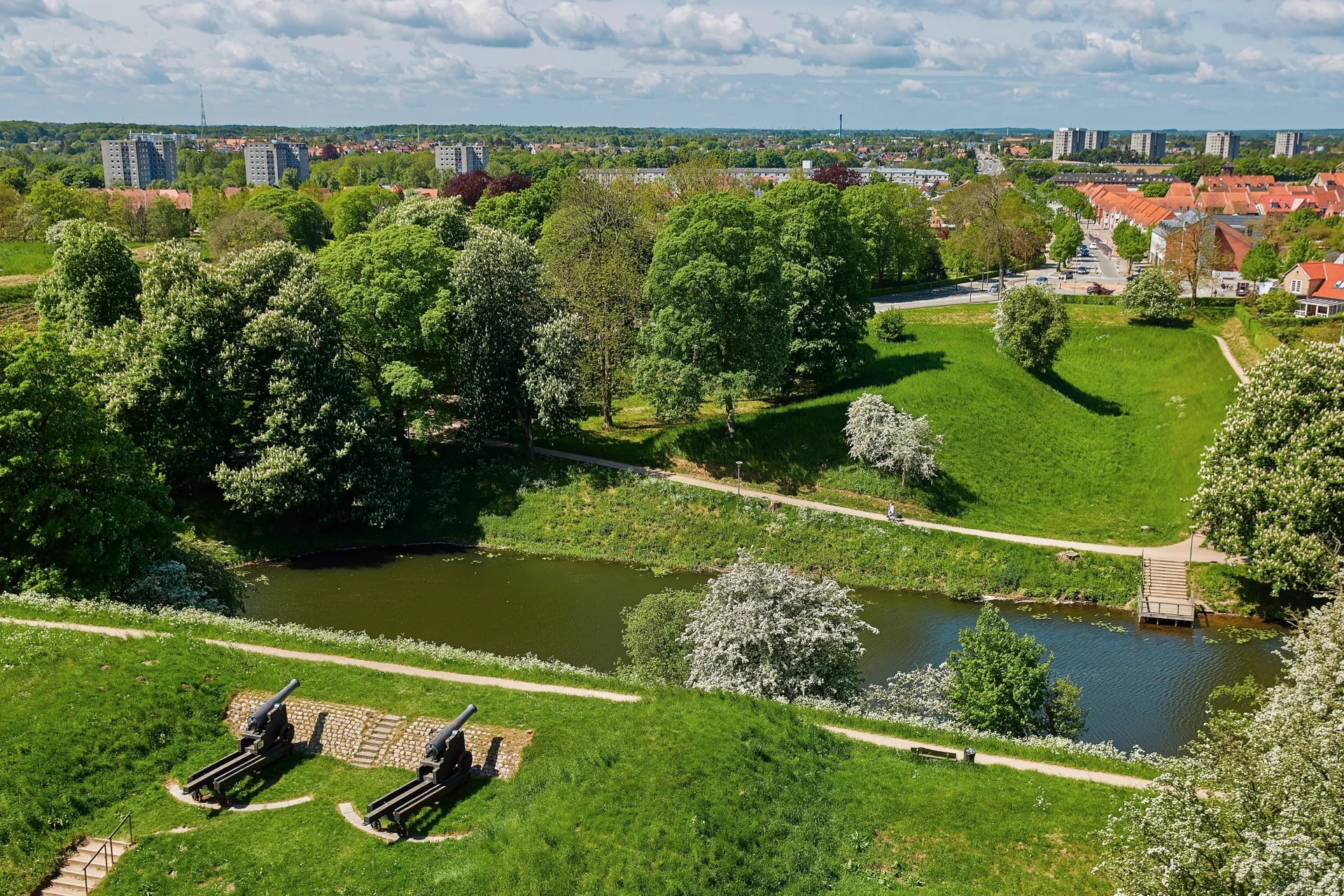
The ramparts themselves are Fredericia's most extraordinary feature. Rising to heights of fifteen meters and extending for nearly four kilometers, these grass-covered earthworks encircle the old town in a continuous embrace, their geometric bastions and deep moats creating a surprisingly beautiful green belt that now serves as the town's most popular walking and jogging route. At the Landsoldaten statue near the King's Gate, Danes pause to remember the Battle of Fredericia on July 6, 1849 — a decisive sortie during the First Schleswig War that has become a cornerstone of Danish national identity. Each year on that anniversary, the town erupts in celebration with dawn ceremonies, parades, and a civic pride that is palpably infectious.
Within the ramparts, Fredericia reveals layers of cultural complexity that belie its military origins. The town was established as a sanctuary city, offering religious freedom and tax exemptions to attract settlers regardless of faith — an extraordinarily progressive policy for seventeenth-century Europe. This legacy is visible in the town's diverse religious architecture: a Catholic church, a Reformed church, a German congregation, and a synagogue once stood alongside the Lutheran parish church, making Fredericia a pocket of tolerance in an otherwise conformist kingdom. The town museum, housed in a former military building, traces this multicultural history with engaging displays and personal narratives.
Modern Fredericia has reinvented itself around the waterfront. The harbor area, once dominated by industrial shipping, is being transformed into a contemporary cultural district with public art installations, waterside dining, and architectural experiments that honor the town's geometric DNA while pushing boldly into Scandinavian modernism. The local food scene draws on Jutland traditions — smoked fish from the Belt, new-season potatoes from the sandy soil, craft beers from microbreweries that have colonized former industrial spaces. The Madsby Park, a beloved family attraction with free admission, offers gardens, a miniature zoo, and playgrounds set among mature trees on the town's western edge.
Cruise ships and river vessels approaching Fredericia navigate the scenic Little Belt, passing beneath the old and new bridges that connect Jutland to Funen. The terminal is conveniently situated near the town center, allowing passengers to reach the ramparts and historic core within minutes on foot. Fredericia is at its finest from May through September, when the rampart walks are brilliant with wildflowers and the waterfront terraces catch the long Scandinavian evenings that seem reluctant to surrender to darkness.

