Cerro Brujo is one of those rare beaches that lives up to its name—Sorcerer's Hill—a sweep of pristine white coral sand on San Cristóbal Island's northeastern coast that casts a spell over every visitor who rounds the headland and sees it for the first time. This is the Galápagos at its most paradisiacal: a crescent of powdery sand washed by turquoise water so clear that sea turtles and rays are visible from the shore, backed by low vegetation where blue-footed boobies perch with characteristic insouciance and Galápagos mockingbirds hop fearlessly around visitors' feet. Cerro Brujo is believed to be one of the first landing points of Charles Darwin during his 1835 visit—a fitting introduction to an archipelago that would change the course of scientific thought.
The beach itself is a masterclass in volcanic geology. The white sand, composed of crushed coral and shell rather than the dark basalt common to most Galápagos beaches, creates a striking contrast with the surrounding lava formations. Tuff cones—consolidated volcanic ash formations—rise behind the beach in eroded, sculptural shapes that explain the "hill" in Cerro Brujo's name. The intertidal zone reveals tide pools populated by marine iguanas, Sally Lightfoot crabs in their vivid red and blue livery, and the occasional Galápagos sea lion pup investigating the shallows. Snorkeling directly from the beach is excellent, with sea turtles, white-tipped reef sharks, and schools of tropical fish visible in the clear, calm waters of the sheltered bay.
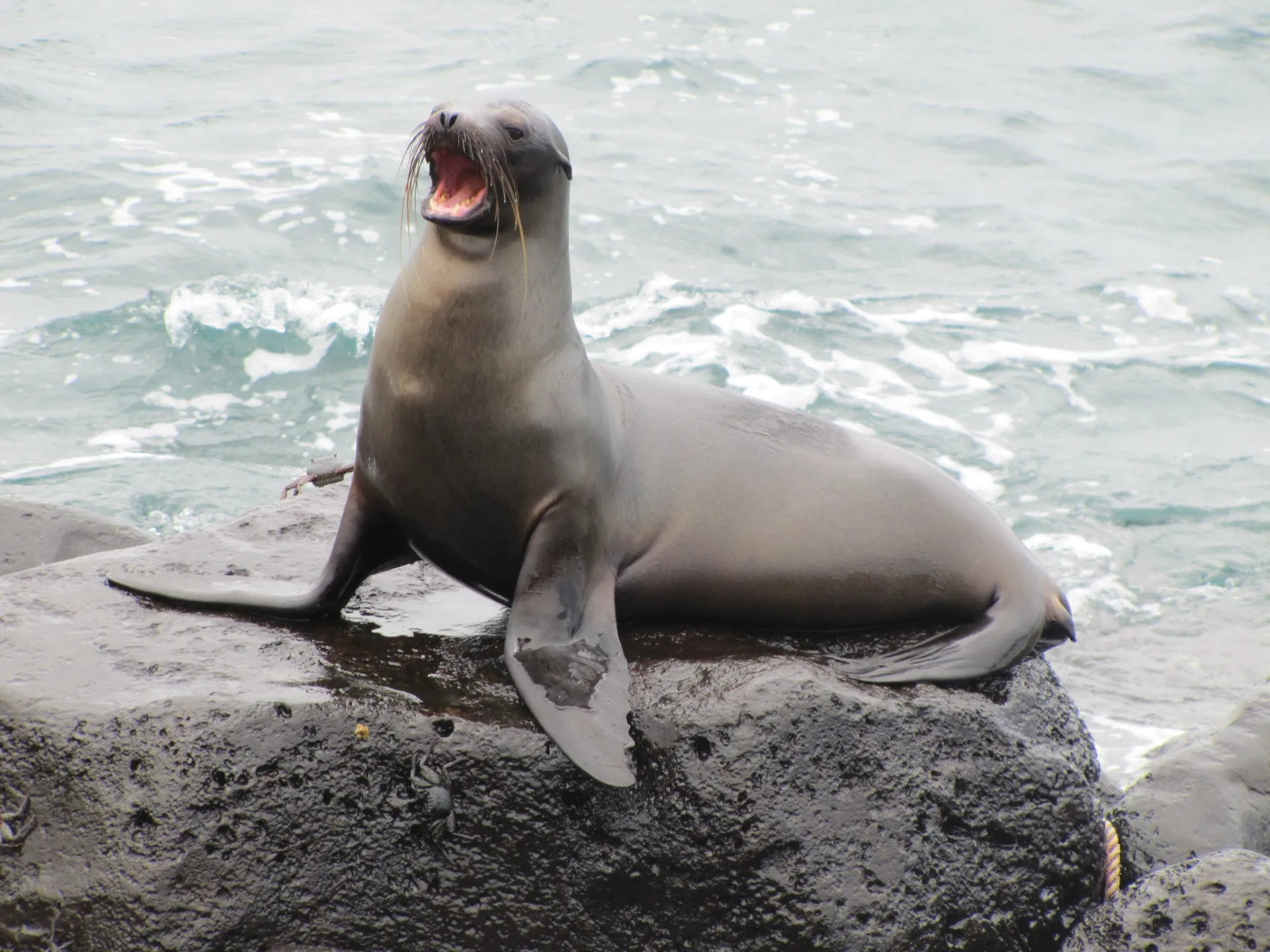
Wildlife at Cerro Brujo is abundant and approachable in the manner that defines the Galápagos experience. Galápagos sea lions are the beach's most prominent residents, lounging on the sand in attitudes of such theatrical relaxation that they seem to be performing for an audience. Blue-footed boobies—the archipelago's iconic species, named for the vivid azure color of their webbed feet—nest in the scrub behind the beach and can be observed at close range performing their comically deliberate courtship dance. Brown pelicans patrol the shoreline, diving into the shallows after fish with dramatic impact. Lava lizards, endemic to the Galápagos, scurry across the rocks, and the occasional Galápagos hawk—the islands' only diurnal raptor—soars overhead, scanning for prey.
The surrounding waters of San Cristóbal support one of the richest marine ecosystems in the archipelago. The convergence of the cold Humboldt Current from the south, the warm Panama Current from the north, and the deep, nutrient-rich Cromwell Current from the west creates conditions of exceptional biological productivity. This same convergence explains why the Galápagos support species from both tropical and temperate marine environments—reef fish alongside sea lions, tropical corals alongside Galápagos penguins. Excursions from Cerro Brujo to nearby Kicker Rock offer encounters with hammerhead sharks, eagle rays, and sea turtles in one of the world's most celebrated snorkeling and diving sites.
Silversea and Tauck include Cerro Brujo on their Galápagos expedition itineraries, typically as a wet landing from Zodiac craft onto the beach. The Galápagos National Park manages visitor access carefully, with guided groups limited in size and duration to minimize impact on the fragile ecosystem. The warm season (January–May) brings warmer water temperatures ideal for snorkeling and the most dramatic skies, while the cool season (June–December) offers calmer seas and more active marine wildlife. Regardless of season, Cerro Brujo delivers what the Galápagos does better than anywhere else on Earth: an encounter with wildlife so unafraid of humans that the experience feels less like tourism and more like acceptance—a brief, magical admission into a world that operates on its own ancient, evolutionary terms.

