Rising from the cobalt depths of the western Galápagos, Fernandina Island stands as one of the most volcanically active and ecologically pristine landmasses on Earth. Named in 1684 by the buccaneer Ambrose Cowley in honour of King Ferdinand II of Aragon — patron of Columbus's first voyage — the island has been shaped by La Cumbre, a shield volcano whose most recent eruption in 2024 sent rivers of molten basalt cascading into the sea. Charles Darwin himself never set foot here during the Beagle's 1835 visit, yet the island's untouched wilderness would have fulfilled his deepest naturalist ambitions.
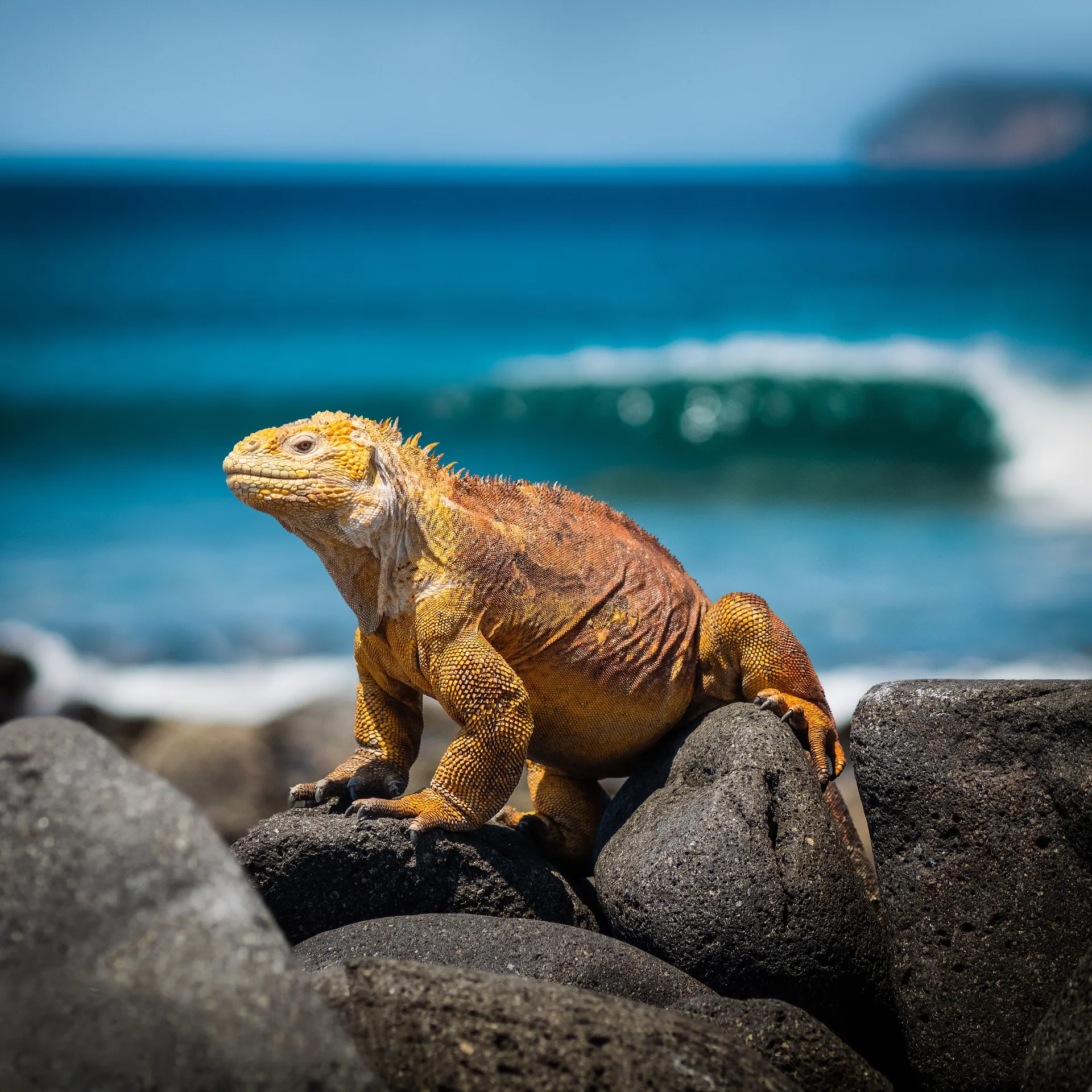
Fernandina possesses no town, no harbour café, no cobblestone promenade — and therein lies its extraordinary power. Punta Espinoza, the sole visitor site, is a dramatic apron of young lava fields and mangrove-fringed tidepools where the largest colony of marine iguanas in the archipelago drapes itself across black rock in tangled, primordial heaps. Flightless cormorants — found nowhere else on the planet — spread vestigial wings to dry in the equatorial sun while Galápagos penguins dart through the upwelling Cromwell Current just offshore. The air carries the mineral scent of volcanic stone warmed by noon, undercut by the salt-spray perfume of a coast that has never known human settlement.
While Fernandina itself offers no dining, expedition vessels serving the western Galápagos present remarkably refined interpretations of Ecuadorian coastal cuisine. Expect ceviche de camarón prepared with plump local shrimp cured in bitter orange and ají pepper, or encocado de pescado — white fish braised in coconut milk with plantain and cilantro, a recipe rooted in the Esmeraldas province. Many ships source green coffee from the highlands of Santa Cruz, and onboard chefs often prepare locro de papas, the hearty Andean potato soup enriched with avocado and fresh cheese, as a warming counterpoint to cool Humboldt Current mornings. These culinary moments become part of the expedition narrative, connecting the volcanic wilderness outside the porthole to the fertile mainland beyond.
The western Galápagos unfolds as a constellation of remarkable encounters. Neighbouring Isabela Island — the archipelago's largest — harbours the brackish lagoons of Las Tintoreras Islet, where white-tipped reef sharks glide through turquoise channels carved into the lava. Puerto Baquerizo Moreno on San Cristóbal offers the closest thing to urban charm in the islands, its waterfront populated by sea lions lounging on park benches with theatrical indifference. For travellers extending their journey to the Ecuadorian mainland, Cajas National Park near Cuenca presents a startling contrast: a high-altitude páramo of glacial lakes and polylepis forest set above three thousand metres, where Andean condors trace slow circles against a sky that feels close enough to touch.
Access to Fernandina is exclusively by expedition vessel, and two operators have distinguished themselves in these waters. HX Expeditions brings its polar heritage to the equator, deploying ice-strengthened ships with intimate capacities and onboard naturalists who hold the archipelago's ecology in scholarly reverence. Lindblad Expeditions, partnered with National Geographic, pioneered expedition cruising in the Galápagos in 1967 and continues to set the standard with hydrophone-equipped Zodiac excursions, underwater specialists, and a deep institutional relationship with the Galápagos National Park. Both operators limit group sizes at Punta Espinoza in accordance with park regulations, ensuring that each landing retains the quality of genuine discovery. Wet landings onto the lava shelf — water lapping at your calves, frigatebirds wheeling overhead — remain among the most exhilarating arrivals in expedition cruising.
Fernandina asks nothing of the visitor but attention. There are no ruins to interpret, no markets to browse, no sunset cocktail terraces. What it offers instead is rarer: an encounter with a landscape still being born, where evolution proceeds at its own unhurried tempo and the only witnesses are creatures that have never learned to fear the human silhouette. To stand on that young black stone, watching a marine iguana sneeze a crystal plume of salt into the equatorial light, is to understand why Darwin called the Galápagos "a little world within itself."

