On the western shore of Santiago Island — known historically as San Salvador, the island where Charles Darwin spent extensive time during the Beagle's 1835 visit — Puerto Egas is one of the Galapagos archipelago's most rewarding landing sites, a place where the volcanic geology, marine biology, and evolutionary drama that made these islands famous converge in a single, walkable coastline. The "port" takes its name from Hector Egas, who attempted to mine salt from a crater lake in the island's interior during the 1960s, an enterprise that failed spectacularly but left behind a trail and a name. What Egas failed to extract from Santiago, nature provides in abundance: a rocky shoreline of tidal pools, lava grottos, and basalt platforms that host one of the most accessible wildlife concentrations in the Galapagos.
The signature experience at Puerto Egas is the walk along the black volcanic coastline to the fur seal grottos — a series of natural pools and caves carved by wave action into the basalt, where Galapagos fur seals lounge in the shade of overhanging rock ledges. These smaller, more reclusive cousins of the Galapagos sea lion were hunted nearly to extinction in the 19th century and have only recently recovered to healthy numbers — making the grottos at Puerto Egas one of the best places in the archipelago to observe them at close range. Marine iguanas, the world's only seagoing lizards, drape themselves across the dark rocks in colonies of dozens, their black bodies absorbing solar heat between feeding dives into the cold, nutrient-rich waters offshore.
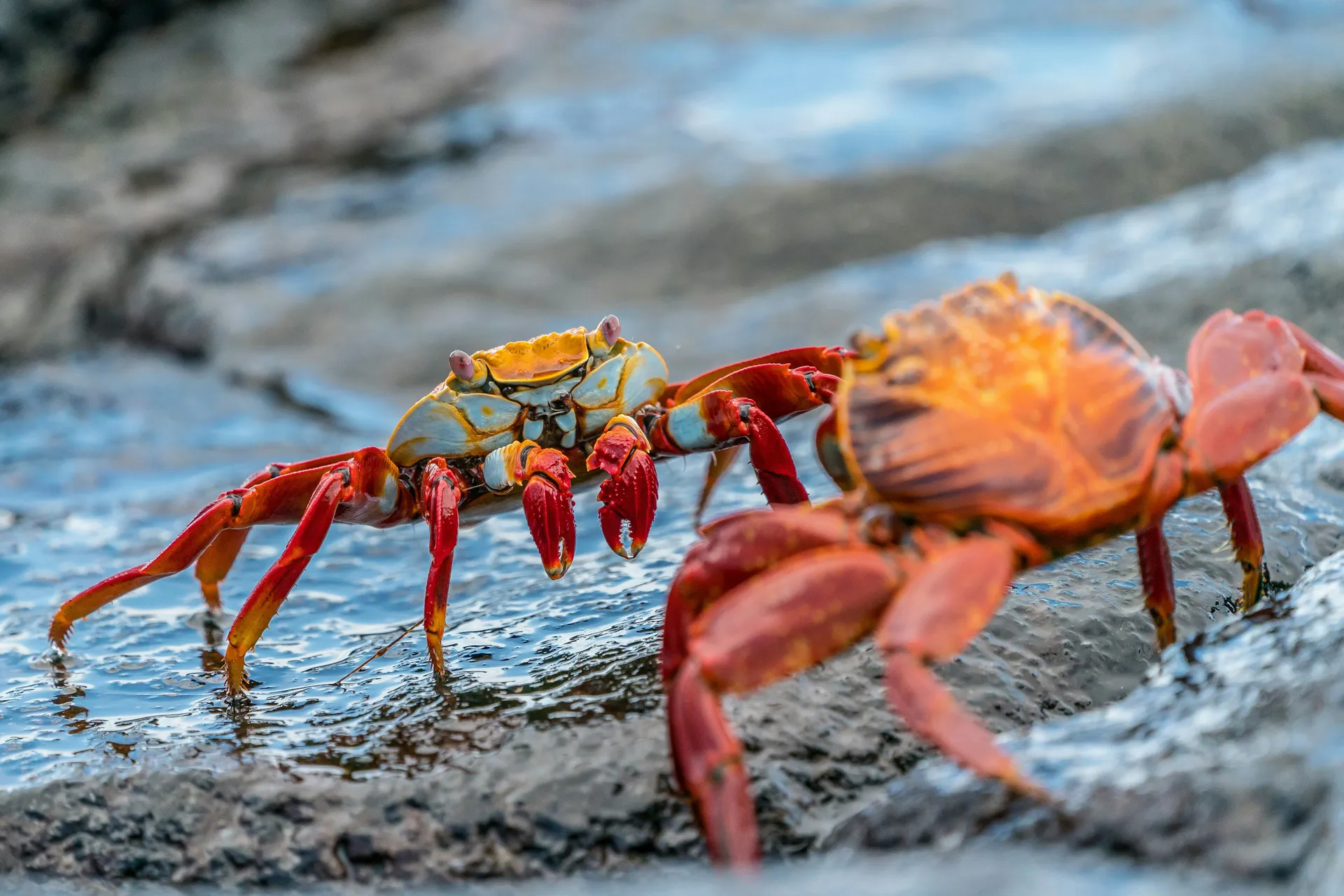
The intertidal zone at Puerto Egas is a natural aquarium. Shallow pools trapped by the receding tide contain Sally Lightfoot crabs — brilliantly red crustaceans that pick their way across the black lava with balletic precision — octopuses, sea urchins, and the juvenile fish that find refuge in these warm, protected basins. Snorkelling from the beach reveals a different world entirely: Galapagos penguins, the only penguin species found north of the equator, hunt schooling fish in the same waters patrolled by sea turtles, eagle rays, and white-tipped reef sharks. The nutrient upwelling from the Cromwell Current, which strikes the western islands with particular force, supports a productivity that makes Puerto Egas one of the richest marine sites in the archipelago.
Inland from the coast, a trail climbs through palo santo forest — the ghostly white trees whose name means "holy wood" for the frankincense-like resin they produce — to a collapsed tuff cone containing a saltwater crater lake. Darwin's finches, the birds whose subtle beak variations helped Darwin develop his theory of natural selection, flit through the branches overhead, while Galapagos hawks — the archipelago's apex avian predator, fearless and curious — perch on trailside boulders and regard passing visitors with imperious calm. The volcanic landscape of Santiago, with its fresh lava flows and cinder cones, provides a vivid reminder that these islands are geologically young, still being shaped by the volcanic forces that created them.
Puerto Egas is visited by Tauck on Galapagos expedition itineraries, with passengers landing by Zodiac on the dark sand beach. As with all Galapagos sites, visits are regulated by the Galapagos National Park, with certified naturalist guides accompanying every group. The most rewarding visiting months are June through November, when the cooler Garua season brings nutrient-rich currents, increased marine life activity, and the best snorkelling conditions, though wildlife encounters are exceptional year-round.

