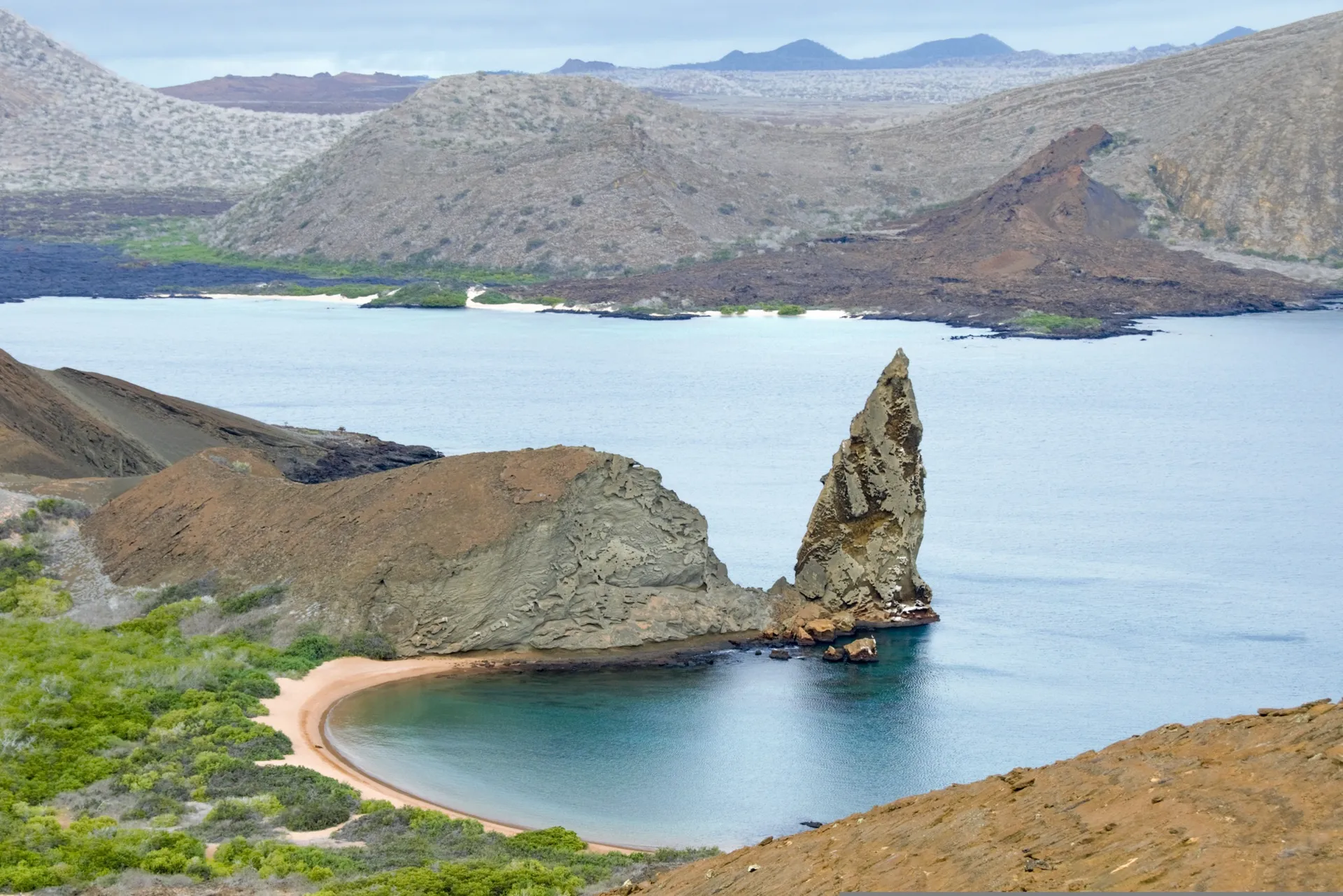
Long before Charles Darwin stepped ashore in 1835 and began sketching the observations that would reshape humanity's understanding of life itself, Santiago Island — known to early Spanish navigators as San Salvador — served as a provisioning stop for buccaneers and whalers who hunted the giant tortoises nearly to extinction. The island's volcanic landscape, forged by eruptions as recent as 1906, bears the scars of both geological violence and human exploitation, yet nature has reclaimed Santiago with a tenacity that feels almost defiant.
Today, Santiago stands as one of the Galápagos archipelago's most compelling studies in resilience. The eradication of feral goats and pigs — a conservation triumph completed in the early 2000s — has allowed native vegetation to reassert itself across the island's 585 square kilometres of lava fields, tuff cones, and sparse highland forests. At Sullivan Bay, visitors walk across a frozen river of pahoehoe lava so pristine it appears to have cooled mere weeks ago, its ropy surface glinting beneath the equatorial sun. Puerto Egas, on the western shore, reveals a different temperament entirely: tide pools carved into black basalt teem with Sally Lightfoot crabs, marine iguanas drape themselves over the rocks like living gargoyles, and Galápagos fur seals — once hunted to near-oblivion — lounge in volcanic grottos with an air of aristocratic indifference.
The Galápagos are not a culinary destination in the conventional sense, yet the flavours of Ecuador's coastal tradition arrive here with remarkable freshness. Ceviche de canchalagua — tiny black clams marinated in lime, red onion, and cilantro — is a local delicacy worth seeking out, as is encocado de pescado, fish simmered in a fragrant coconut sauce that speaks to the Afro-Ecuadorian heritage of the mainland coast. Bolón de verde, a hearty sphere of mashed green plantain stuffed with cheese or chicharrón, appears at nearly every breakfast table, while the simplest pleasure may be a plate of freshly grilled wahoo or yellowfin tuna, caught that morning and served with nothing more than patacones and a squeeze of lime. For those inclined toward spirits, a glass of canelazo — warm sugarcane liquor infused with cinnamon and naranjilla — offers an unexpectedly refined nightcap beneath the Southern Cross.
Santiago's position in the central Galápagos places it within effortless reach of the archipelago's most celebrated landscapes. Isabela Island, the largest in the chain, lies to the west with its five shield volcanoes and the haunting beauty of Las Tintoreras Islet, where whitetip reef sharks drift through crystalline channels between lava formations. To the east, Puerto Baquerizo Moreno on San Cristóbal — the provincial capital — offers a charming waterfront where sea lions commandeer park benches with no apparent regard for human convention. For travellers extending their journey to mainland Ecuador, Cajas National Park near Cuenca presents a startling counterpoint: a high-altitude páramo dotted with over two hundred glacial lakes, its silence broken only by the call of the Andean condor. The contrast between Galápagos shoreline and Andean highland is among South America's most dramatic geographic conversations.
Santiago is accessible exclusively by expedition vessel, and two of the most distinguished names in luxury travel maintain regular itineraries through these waters. Silversea's Silver Origin, purpose-built for the Galápagos and carrying just 100 guests, approaches Santiago with the intimacy the island demands — Zodiac landings at Puerto Egas feel less like excursions than private audiences with the wildlife. Tauck brings its signature all-inclusive philosophy to the archipelago aboard chartered vessels, pairing expert naturalist guides with the seamless logistics that have defined the brand for nearly a century. Both operators ensure that time ashore is unhurried and deeply informed, a necessity in a destination where the difference between glancing at a marine iguana and truly understanding its evolutionary story is the quality of the guide at your side.
What Santiago ultimately offers is not spectacle but intimacy — the chance to stand on young volcanic rock at the centre of an archipelago that changed the course of scientific thought, surrounded by creatures that regard you with neither fear nor interest, and to feel, however briefly, that the boundary between observer and observed has dissolved entirely.

