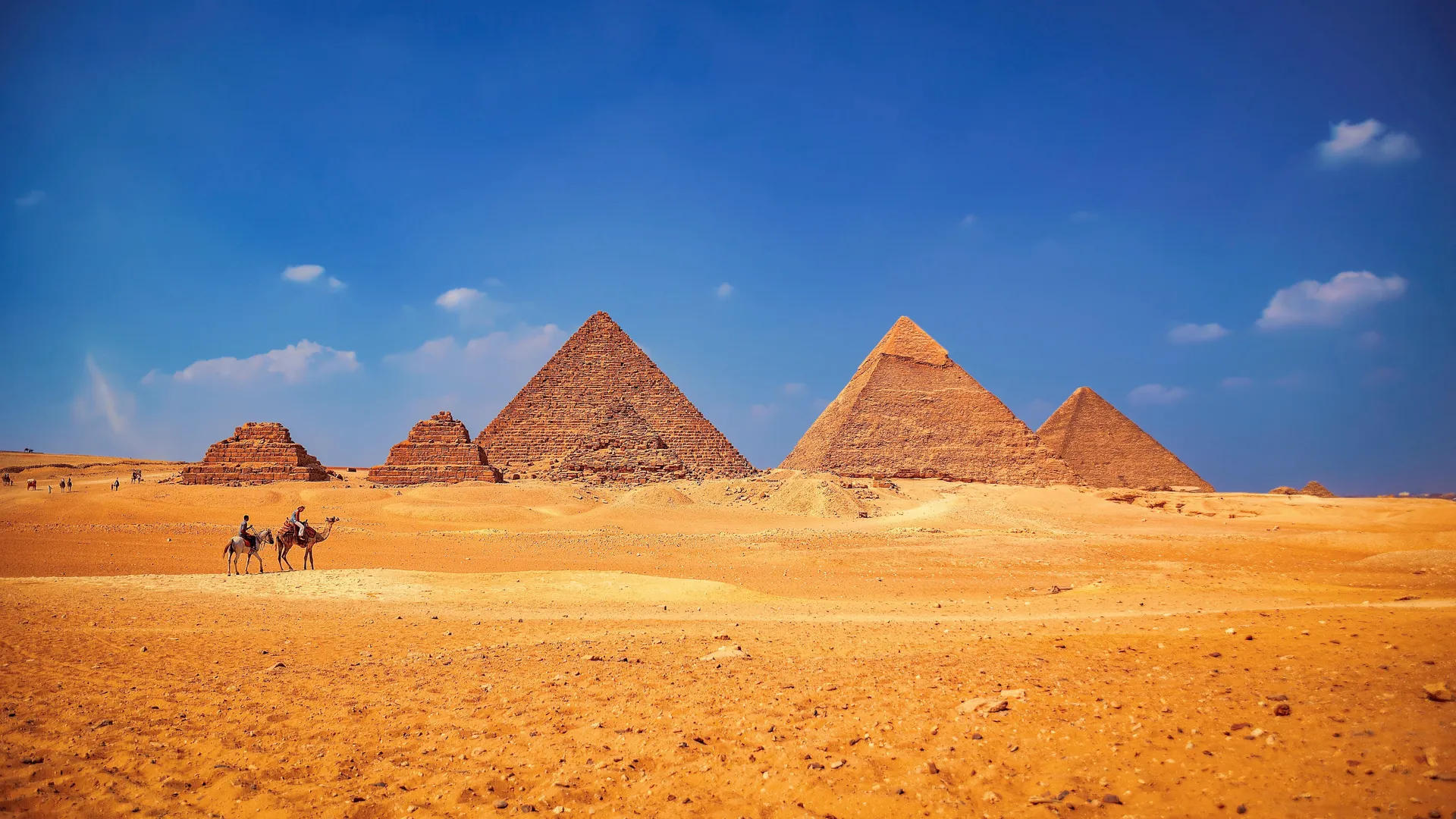
At the edge of the Sahara, where the ancient world's greatest monuments rise from the desert plateau in defiance of four and a half millennia, Giza stands as humanity's most enduring testament to ambition, engineering, and the desire for immortality. The Great Pyramid of Khufu—the sole surviving Wonder of the Ancient World—still commands awe that no photograph can prepare you for: its two-million-plus stone blocks, each weighing more than an automobile, assembled with a precision that continues to challenge modern understanding. Beside it, the Sphinx gazes eastward with an expression that has prompted interpretation for centuries, its lion body and human face embodying the mystery that makes Egypt irresistible.
Cairo, the sprawling metropolis that has engulfed Giza, is itself one of the world's great cities—a place of twenty million souls, deafening energy, and cultural depth that spans pharaonic, Coptic, Islamic, and modern civilizations in a single, magnificent chaos. Islamic Cairo, a UNESCO World Heritage district, preserves mosques, madrasas, and caravanserais from the Fatimid, Ayyubid, and Mamluk dynasties in a density of medieval architecture unmatched in the Muslim world. The Citadel of Saladin commands the skyline, while below it the Khan el-Khalili bazaar has operated continuously since the fourteenth century—a labyrinth of copper, spice, perfume, and textile vendors that overwhelms every sense.
Egyptian cuisine, often overlooked by travelers focused on monuments, is one of the Middle East's most satisfying food traditions. Koshari—a beloved street dish layering rice, lentils, pasta, chickpeas, and crispy onions with spicy tomato sauce—is Cairo's quintessential comfort food, served from dedicated shops where locals queue at all hours. Ful medames, slow-cooked fava beans dressed with olive oil, cumin, and lemon, has sustained Egyptians since the pharaohs. Grilled kofta and kebab, mulukhiyya (a jute leaf stew of ancient origin), and fresh-squeezed mango juice from street vendors compose a culinary landscape as layered as the city's history.
Beyond Giza's pyramids, the cultural excursions available from Cairo are almost impossibly rich. The Grand Egyptian Museum, the world's largest archaeological museum, now houses Tutankhamun's complete treasure and thousands of artifacts spanning thirty dynasties. The Step Pyramid of Djoser at Saqqara, the world's first monumental stone building, predates Giza's pyramids by a century. Memphis, the ancient capital, preserves a colossal fallen statue of Ramesses II. And the Nile itself—mother of Egyptian civilization—flows through the city center, its feluccas and dinner cruises offering the kind of river experience that connects modern visitors to a culture defined by water in the desert.
Scenic River Cruises includes Giza and Cairo in its Nile itineraries, and the combination of river journey and pyramid exploration creates one of travel's most complete experiences. Whether approaching by river or by road, the first sight of the pyramids emerging from Cairo's urban haze produces an emotional response that transcends ordinary sightseeing. For travelers who seek encounters with the foundational achievements of human civilization—the moments that make everything that followed possible—Giza delivers with a power that four and a half thousand years have not diminished.

