Captain Jeremiah Carcass of HMS Penguin charted this island in 1766, and it says something about the Falklands that the most welcoming spot in the entire archipelago bears the name of a man whose ship was called Penguin. Carcass Island, lying off the northwest coast of West Falkland, is a privately owned haven of tussac grass meadows, white-sand beaches, and some of the most approachable wildlife in the South Atlantic. Unlike much of the Falklands, Carcass Island has never suffered the ecological devastation wrought by introduced rats and cats — making it a sanctuary where breeding bird populations thrive in densities that astonish even seasoned naturalists.
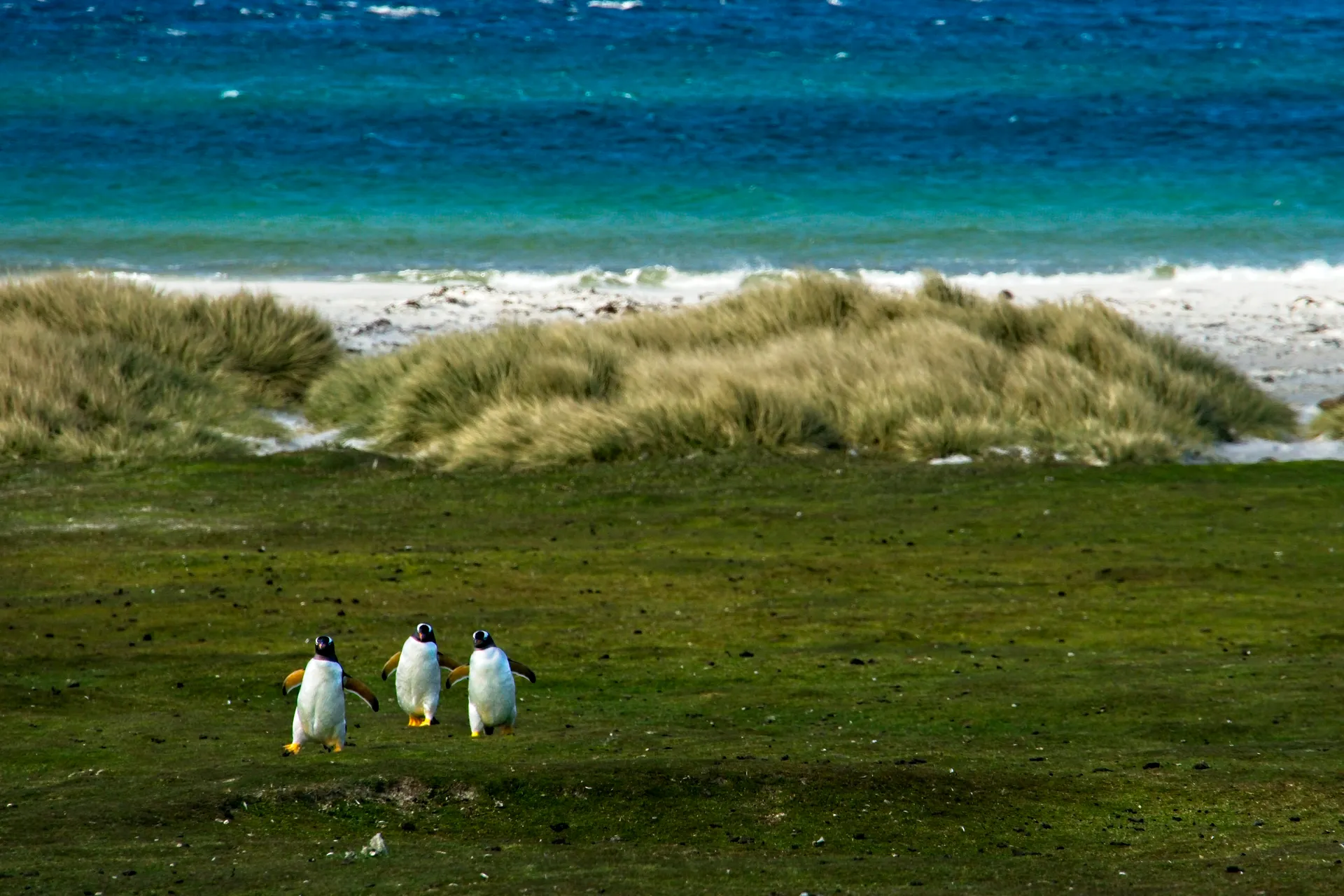
The island spans roughly 20 square kilometres of rolling terrain carpeted in diddle-dee heath and native tussac grass that can grow taller than a person. Two resident families manage the land as a sheep station, but wildlife is the true landlord here. Magellanic and gentoo penguins waddle across the beaches in comical procession, while striated caracaras — intelligent, curious raptors known locally as Johnny Rooks — approach visitors with a boldness that borders on impertinence. Night herons roost in the tussac, upland geese graze the paddocks, and Cobb's wrens, a species found only in the Falklands, flit through the undergrowth at one's feet. The absence of predators has produced an ecosystem where fear of humans simply does not exist.
The settlement on Carcass Island consists of a handful of buildings around a sheltered cove, including the McGill family farmhouse where expedition cruise passengers are traditionally welcomed with homemade cakes and tea — a ritual of Falkland hospitality that feels wonderfully anachronistic in the age of mass tourism. The kitchen table groans under Victoria sponges, fruit cakes, and shortbread, served in a sitting room decorated with family photographs and the quiet memorabilia of five generations of island life. Outside, the garden — improbably lush for latitude 51 degrees south — grows vegetables and flowers in the mild microclimate created by the surrounding ocean.
Walking trails cross the island between the settlement and the northern beaches, where white sand sweeps between headlands of dark quartzite and the turquoise shallows are so clear that kelp forests are visible from the clifftops. Offshore, Commerson's dolphins — small, strikingly black-and-white cetaceans — play in the channels between islands, while southern giant petrels and black-browed albatrosses soar overhead on wingspans that dwarf the passing skuas. The panorama from the island's modest summit takes in the jagged peaks of West Falkland across the strait and, on clear days, the distant outline of Saunders Island and Steeple Jason, home to the world's largest colony of black-browed albatrosses.
Carcass Island is visited by HX Expeditions and Seabourn on their Falklands, South Georgia, and Antarctic Peninsula expedition itineraries. Ships typically anchor offshore and ferry passengers by Zodiac to the beach landing. The visiting season runs from October through March, with November and December being optimal for nesting penguins, wildflower blooms, and the longest daylight hours this far south.

