In the remote western reaches of the Falkland Islands, where the South Atlantic swells crash against tussock-grass coastlines that have never known permanent human habitation beyond a single farming family, New Island presents one of the most extraordinary concentrations of wildlife in the subantarctic. This narrow, wind-sculpted island — just fourteen kilometers long and barely one kilometer wide at its narrowest point — hosts breeding colonies of black-browed albatrosses, rockhopper penguins, and Magellanic penguins in numbers so dense that the hillsides appear to move. The island has been a wildlife sanctuary since 1972, when its owner Ian Strange began the conservation work that would transform it from a struggling sheep farm into one of the Southern Hemisphere's most important seabird reserves.
The black-browed albatross colony on New Island's western cliffs ranks among the largest and most accessible in the world. These magnificent birds, with wingspans exceeding two and a half meters, nest in tightly packed colonies on cliff-edge ledges, their courtship displays — elaborate rituals of bill-clacking, sky-pointing, and mutual preening — providing one of nature's most moving spectacles. The proximity of the nesting birds to designated viewing areas allows extraordinary photographic opportunities; albatrosses accustomed to human observers will continue their activities undisturbed at distances of just a few meters. Alongside the albatrosses, rockhopper penguins scramble up impossible cliff faces with a determination that seems to defy both gravity and common sense, their bright yellow head plumes and red eyes giving them an expression of perpetual punk-rock indignation.
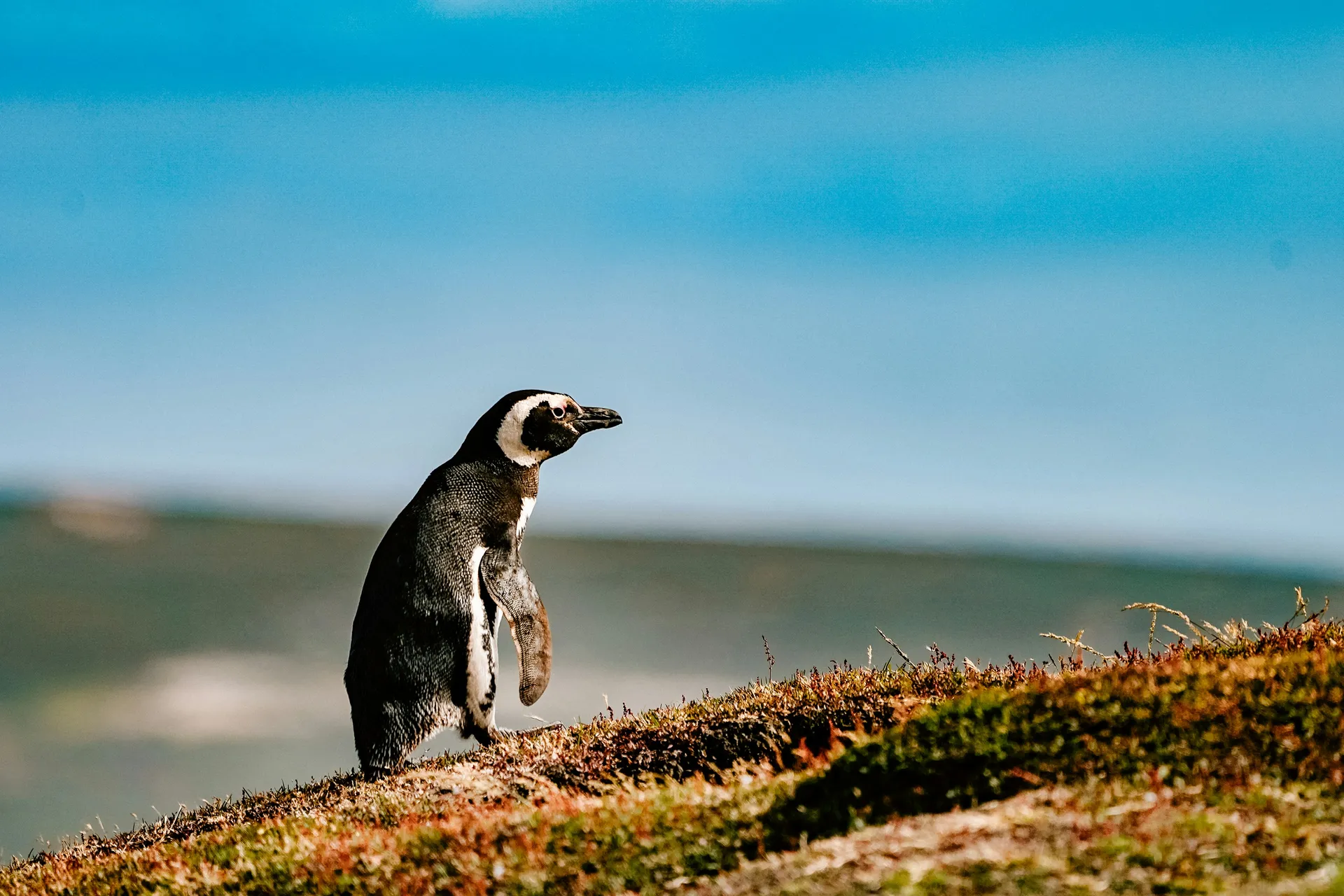
The island's eastern shore, sheltered from the prevailing westerlies, provides a different character entirely. Here, Magellanic penguins nest in burrows dug into the soft peat, their haunting braying calls — which gave them the name "jackass penguins" among early sailors — echoing across the tussock grass in an eerie dawn chorus. Gentoo penguins maintain smaller colonies along the beaches, their bright orange bills and comical waddling gait providing the lightest moments in an island visit that is otherwise characterized by the awe-inspiring scale of the seabird spectacle. South American fur seals haul out on the rocky beaches, while striated caracaras — the bold and intelligent raptors endemic to the Falklands — investigate visitors with fearless curiosity.
The landscape of New Island captures the essential character of the Falklands in concentrated form. The western cliffs drop hundreds of meters to the South Atlantic, where the waves that have traveled unimpeded from South America explode against the rock in towers of white spray. The interior is a rolling moorland of diddle-dee shrubs and stone runs — rivers of broken quartzite that flow down the hillsides like geological glaciers, a phenomenon found almost nowhere else on earth. The sky seems larger here than anywhere — an infinite dome of cloud and light that changes by the minute, providing a backdrop against which the flight of albatrosses assumes an almost spiritual quality.
HX Expeditions, Ponant, Seabourn, and Silversea include New Island in their Falkland Islands and Antarctica expedition itineraries, with Zodiac landings providing the only means of access. The season runs from October through March, with November and December offering the most active breeding behavior and the best conditions for chick observation. Landing is weather-dependent — the island's exposed position means that swells can prevent access on any given day — but when conditions cooperate, the experience of walking among thousands of nesting seabirds on this remote and windswept island ranks among the most profound wildlife encounters available in expedition cruising. Nearby Port Stanley and Steeple Jason Island provide additional Falkland Islands experiences.

