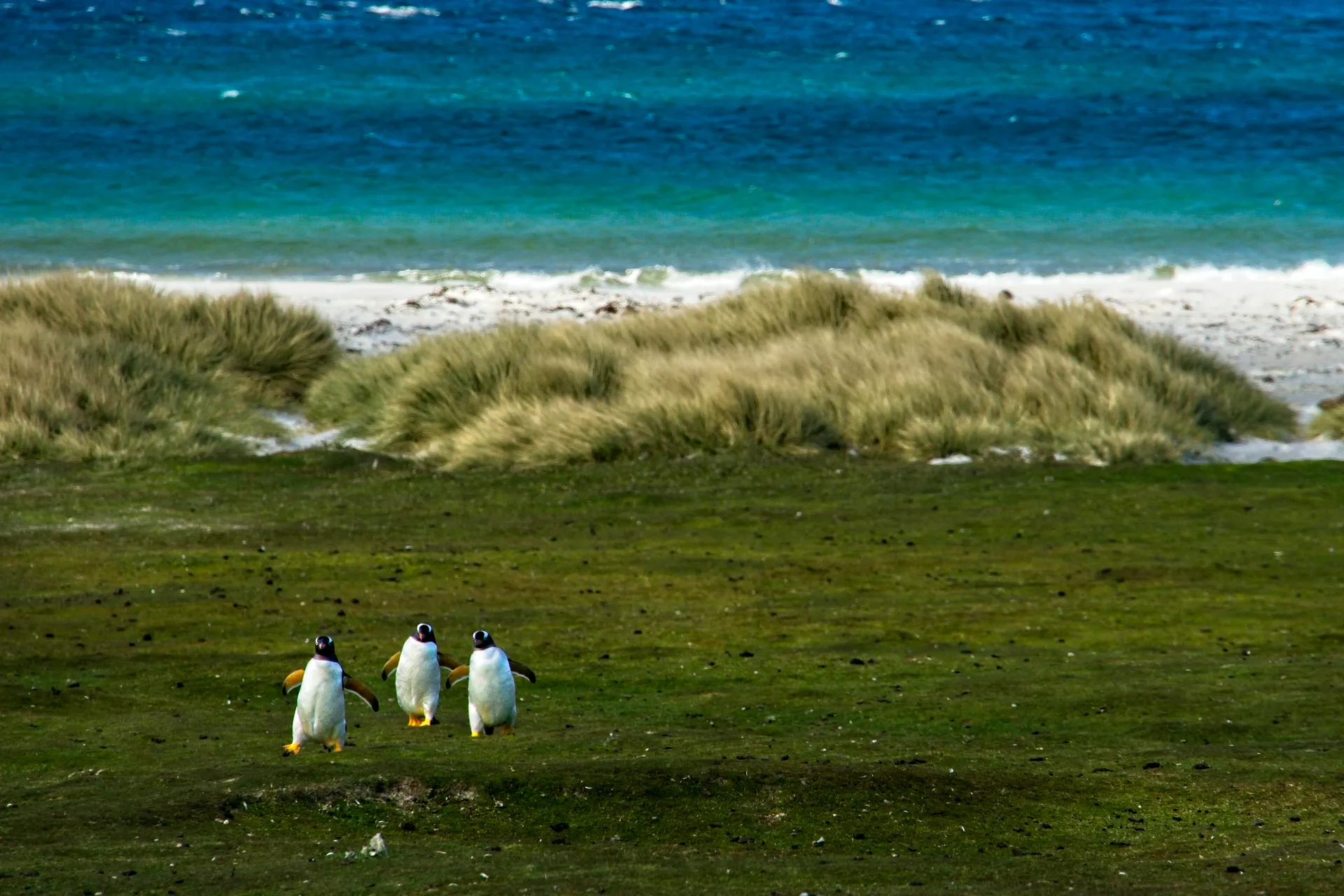
At the northwestern extremity of the Falkland Islands, where the South Atlantic stretches unbroken to the coast of South America, West Point Island presents a landscape of windswept beauty and wildlife abundance that epitomizes everything that makes the Falklands one of the world's last great wilderness destinations. This privately owned island — home to a single farming family who have maintained it with quiet dedication for generations — combines working sheep farm, wildlife sanctuary, and subantarctic hospitality in proportions that create one of the most memorable port calls in expedition cruising. The island is just five kilometers long, but within that modest compass it concentrates colonies of black-browed albatrosses and rockhopper penguins, gardens that bloom with improbable lushness in the teeth of the South Atlantic wind, and a welcome from the resident family that feels genuinely personal rather than commercially choreographed.
Devil's Nose, the dramatic headland at the island's northwestern tip, hosts the wildlife spectacle that draws expedition vessels to West Point. Here, black-browed albatrosses nest in closely packed ranks along the cliff edges, their extraordinary wingspans silhouetted against the grey South Atlantic sky as they launch from and return to the colony with the effortless grace that millions of years of evolution have perfected. Among and between the albatross nests, rockhopper penguins maintain their own colonies in a remarkable example of interspecies coexistence — the two species sharing the same cliff-top real estate with a tolerance that human communities might envy. The walk from the settlement to Devil's Nose crosses rolling moorland that provides increasingly dramatic views as the headland approaches, building anticipation for the moment when the colony reveals itself in all its chaotic, magnificent vitality.
The settlement at West Point Island adds a dimension of human warmth that distinguishes this stop from purely wildlife-focused landings. The resident family opens their home to visitors with a hospitality that reflects the Falkland Islands tradition of welcoming passing sailors — a tradition born of isolation and the understanding that company is precious when the nearest neighbor lives on a different island. Tea and homemade cakes are served in a living room warmed by a peat fire, surrounded by books, family photographs, and the comfortable clutter of a home that has been lived in with genuine contentment. The garden, sheltered from the wind by hedges of gorse and macrocarpa, produces vegetables and flowers with a determination that seems to defy the latitude.
The broader landscape of West Point Island rewards exploration for those with time and energy. The coastline alternates between rocky coves where Magellanic penguins nest in burrows and sandy beaches where sea lions rest in untidy heaps. The island's interior supports populations of Falkland steamer ducks — the flightless species endemic to the archipelago — while thin-billed prions and Cobb's wrens flit through the tussock grass. The light on West Point is constantly changing, the cloud formations of the South Atlantic creating dramatic effects that transform the island's modest topography into something genuinely photogenic. On clear days, the view from the high ground encompasses the neighboring islands of the western Falklands in a panorama of ocean, sky, and wind-scoured land.
HX Expeditions, Seabourn, and Silversea include West Point Island in their Falkland Islands and Antarctica expedition itineraries, with visits typically scheduled in the morning to allow the best light at Devil's Nose. Landing is by Zodiac on the beach near the settlement, and the walk to the wildlife colonies takes approximately forty-five minutes across easy terrain. The season runs from October through March, with November and December providing peak breeding activity. The island's captain's choice designation means that visits are weather-dependent, but when conditions allow, the combination of world-class wildlife, genuine Falklands hospitality, and a landscape of haunting subantarctic beauty makes West Point one of the most cherished stops in any Southern Ocean expedition.

