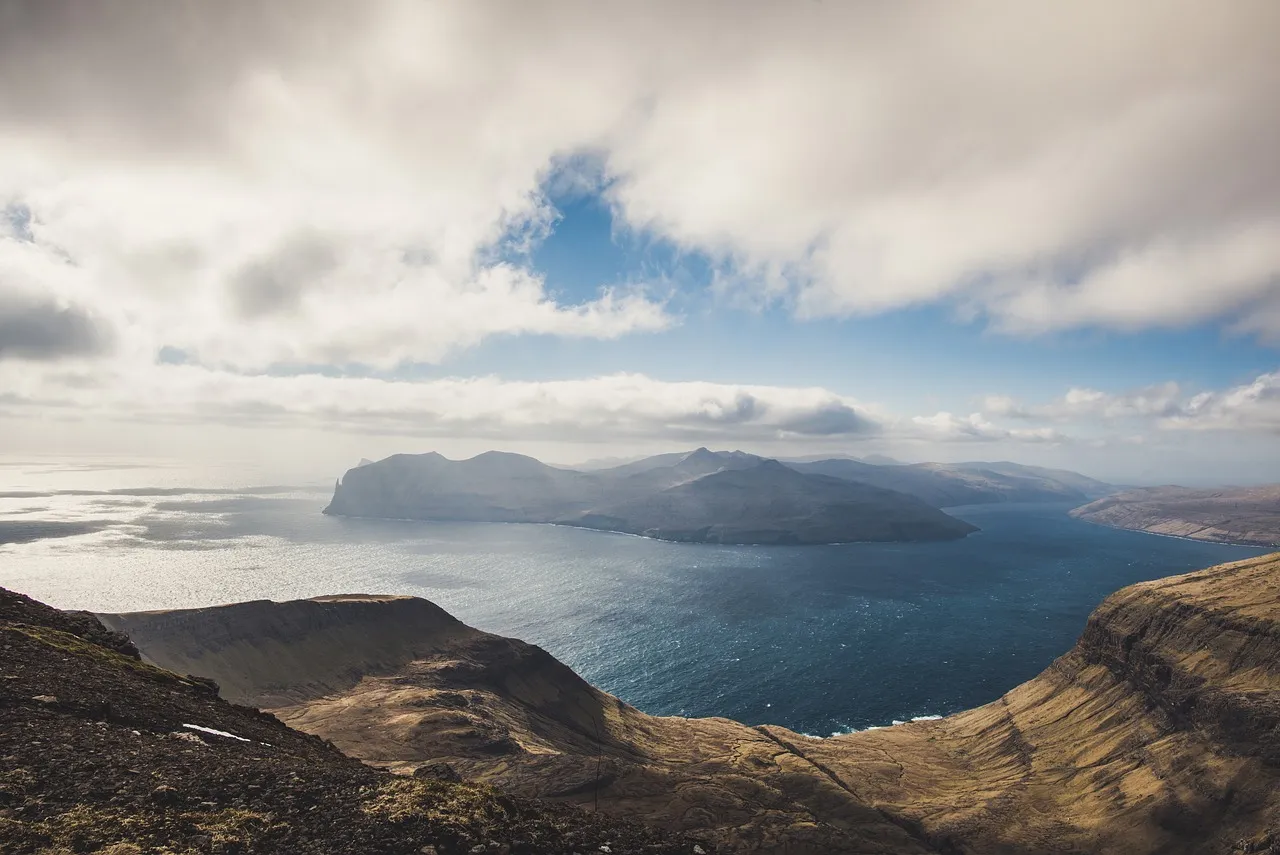
On the eastern shore of Eysturoy, the second-largest of the Faroe Islands, the town of Runavik occupies a setting where the raw drama of North Atlantic geology meets the quiet domesticity of a Faroese fishing community. The town sits at the head of Skalafjoerur, a deep fjord that cuts into Eysturoy's mountainous interior, its brightly painted houses — red, yellow, blue — clustered around a harbour where fishing boats share space with pleasure craft. Above the town, grass-covered mountains rise to peaks that are frequently lost in the clouds that define the Faroese atmosphere, their slopes scored by waterfalls fed by the almost constant rainfall that keeps the islands impossibly green.
The character of Runavik reflects the Faroe Islands' unique position as a self-governing territory within the Kingdom of Denmark — proudly distinct from both Scandinavian and British traditions, yet influenced by centuries of contact with both. The town's modern appearance belies its deep roots: human settlement on Eysturoy dates back to the Viking age, and the surrounding landscape is dotted with ruins of medieval churches, ancient infield walls, and the remains of Norse longhouses. The Faroese language, closely related to Old Norse, is spoken by the town's five thousand inhabitants and connects them to a cultural heritage that stretches back over a millennium.
Faroese cuisine has undergone a remarkable renaissance, and the traditions of Runavik and its surroundings illustrate both the old and the new. Wind-dried mutton — raest — hung in the wooden hjallur drying houses that stand beside every farm, remains the foundation of the traditional Faroese table, its concentrated, intensely savoury flavour an acquired taste that rewards the adventurous palate. Fresh fish — cod, haddock, and the salmon raised in the fjord's aquaculture pens — provides the daily protein. Faroese restaurants have embraced the New Nordic philosophy, combining local ingredients — seabird, whale, lamb, dulse seaweed, wild herbs — with contemporary culinary technique to create a cuisine that is gaining international recognition.
From Runavik, the broader Faroe Islands unfold with a variety that belies the archipelago's compact size. The village of Gjogv, in Eysturoy's far north, is one of the most photographed places in the islands, its natural rock harbour and dramatic cliff setting attracting hikers and photographers. The island of Streymoy, connected to Eysturoy by bridge, holds the capital Torshavn — one of the smallest and most atmospheric capitals in the world — and the soaring sea cliffs at Vestmanna. Mykines, the westernmost island, offers the Faroes' finest puffin viewing and hiking to a lighthouse at the Atlantic's edge. The undersea tunnels connecting the islands by road create a network that makes the entire archipelago explorable from a single base.
Runavik is accessible by road from the ferry terminal at Torshavn or from the airport at Vagar via the undersea tunnel system. Cruise ships anchor in Skalafjoerur and tender passengers to shore. The best months to visit are June through August, when the longest days bring eighteen to twenty hours of usable light and the puffins are in residence on the outer islands. However, the Faroe Islands are a year-round destination: winter brings dramatic storms, the early darkness of the northern latitude, and the cosy intimacy of Faroese hospitality around a table of raest, fresh fish, and strong coffee.

