At the very tip of the Medoc peninsula, where the Gironde estuary — the largest in Western Europe — opens to the Atlantic, Le Verdon-sur-Mer occupies a windswept spit of land that has served as the gateway to Bordeaux since Roman times. Ships heading upriver to one of the world's great wine capitals must first pass this point, and for cruise vessels too large to navigate the 100-kilometre estuary passage to Bordeaux itself, Le Verdon's deep-water terminal provides the access point to a wine region whose very name has become synonymous with excellence. The port is modest — a functional terminal surrounded by pine forest and oyster beds — but what lies up the road is anything but modest.
The Medoc, stretching south from Le Verdon toward Bordeaux, is one of the most hallowed landscapes in the wine world. The route des chateaux — a vineyard road threading through the appellations of Saint-Estephe, Pauillac, Saint-Julien, and Margaux — passes estates whose names read like a roll call of oenological royalty: Lafite Rothschild, Mouton Rothschild, Latour, Margaux, Cos d'Estournol. The chateau buildings range from neoclassical mansions to postmodern wine cathedrals — Cos d'Estournol's pagoda-influenced facade is an eccentric delight — and many offer tastings and tours that provide intimate access to the winemaking process, from the hand-harvested Cabernet Sauvignon grapes to the barrel rooms where new oak imparts the vanilla and spice notes that define the Medoc style.
The culinary culture of the northern Medoc is shaped by the estuary as much as the vine. The Gironde's oyster beds at Talais and Jau-Dignac-et-Loirac produce flat oysters of saline intensity, traditionally accompanied by the tiny, spicy sausages called crépinettes and a glass of cold Entre-Deux-Mers white wine. Lamproie a la bordelaise — river lamprey stewed in red wine, leeks, and the creature's own blood — is the Gironde's most adventurous dish, a medieval preparation that endures in the region's traditional restaurants. Canelés, the caramelised rum-and-vanilla custard cakes that are Bordeaux's signature pastry, owe their origin to the egg yolks left over from the winemaking process, where whites were traditionally used to fine (clarify) the young wine.
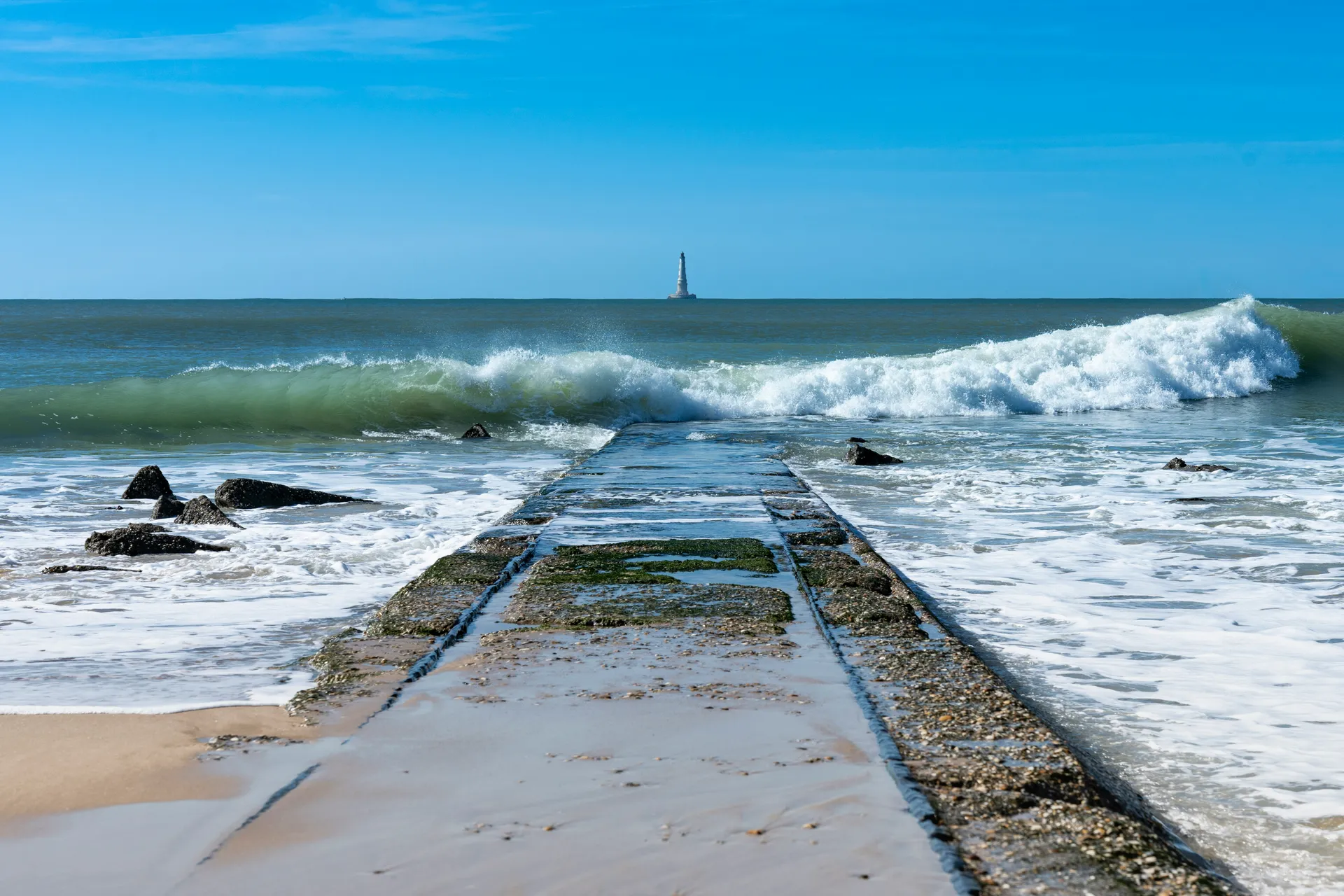
Beyond the vineyards, the Atlantic coast north and south of Le Verdon offers some of France's most impressive coastal landscapes. The Phare de Cordouan, a Renaissance lighthouse standing in the estuary five kilometres offshore, is the oldest functioning lighthouse in France and is sometimes called "the Versailles of the Sea" for its ornate interior, which includes a royal apartment and a chapel with Doric columns. The beaches of Soulac-sur-Mer and Montalivet — broad, Atlantic-facing arcs of fine sand backed by pine forest — stretch south along the Silver Coast toward the towering Dune of Pilat, Europe's tallest sand dune at 110 metres, which overlooks the Arcachon Basin and its famous oyster villages.
Le Verdon-sur-Mer is served by Holland America Line on Bordeaux and Bay of Biscay itineraries, with ships docking at the deep-water terminal. The most rewarding visiting season is April through October, with September and October coinciding with the wine harvest — the vendanges — when the vineyards are at their most atmospheric and the new vintage is the subject of feverish discussion at every table in the Medoc.

