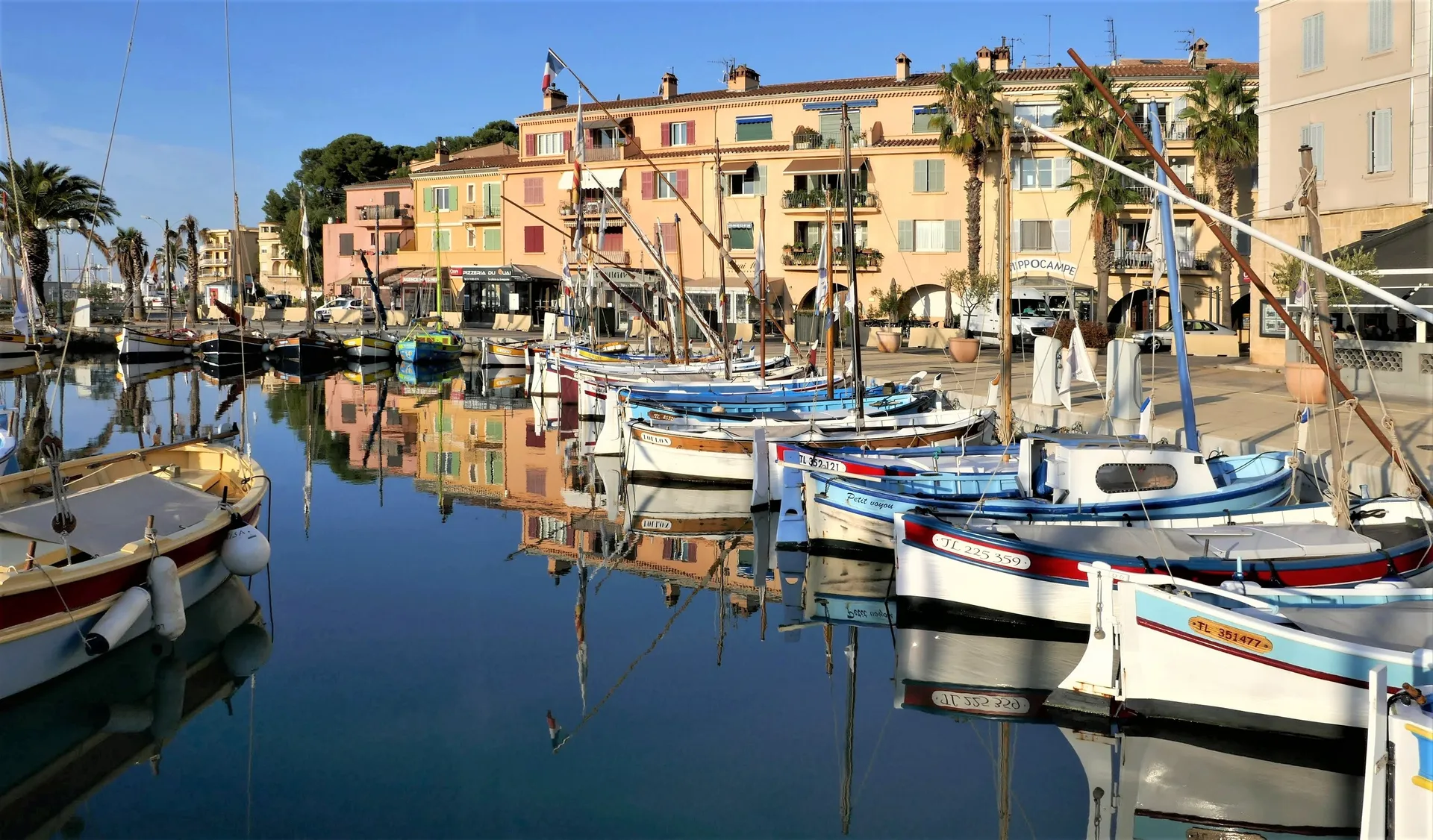
Sanary-sur-Mer is the Provencal fishing port that time has treated with exceptional kindness. Tucked between Toulon and Bandol on the Var coast, this small town of 17,000 preserves the Mediterranean idyll that the broader Cote d'Azur has largely sacrificed to development — a working harbour where colourful pointu fishing boats bob alongside pleasure craft, a waterfront of pastel-painted buildings whose ground-floor cafes fill with the aroma of bouillabaisse at lunchtime, and a Wednesday market that has been drawing crowds since the Middle Ages. Aldous Huxley wrote Brave New World here in 1931, and the town served as a refuge for German exile writers — Thomas Mann, Bertolt Brecht, and Lion Feuchtwanger among them — fleeing the Nazis in the 1930s, a literary history commemorated by plaques on the buildings where they lived and wrote.
The harbour is Sanary's soul. The daily fish market on the Quai Charles de Gaulle, where fishermen sell their catch directly from the boat, is one of the last authentic markets of its kind on the Provencal coast — sea urchins, rouget (red mullet), daurade (sea bream), and the small Mediterranean fish that go into a proper bouillabaisse are laid out on ice as the morning light catches the harbour water. The Tour Romane, a 13th-century watchtower at the harbour entrance, now houses a diving museum that documents the pioneering underwater explorations conducted in these waters by Jacques-Yves Cousteau and Frederic Dumas in the 1940s — the very spot where modern scuba diving was born.
Sanary's culinary scene benefits from its position at the intersection of Provencal and Mediterranean traditions. The restaurants lining the harbour serve bouillabaisse according to strict local protocol — the broth first, flavoured with saffron, fennel, and orange peel, accompanied by garlic-laden rouille and croutons, followed by the fish on a separate platter. Bandol wines, produced in the appellation that begins at Sanary's eastern edge, are among the most serious reds in Provence — dominated by the mourvedre grape, they achieve a depth and complexity that transcends the typical Provencal rose. The Bandol rose itself, however, is no afterthought: dry, mineral, and pale salmon in colour, it is arguably the finest rose wine in France and the perfect accompaniment to the region's Mediterranean seafood.
The coast around Sanary offers a succession of calanques (rocky inlets), sandy beaches, and the pine-scented landscape that defines the Var littoral. The Ile des Embiez, a small island accessible by ferry from the nearby town of Six-Fours, was the final home of Paul Ricard — the pastis magnate — and now houses a marine biology institute and the quiet beaches and walking paths that Ricard preserved from development. The medieval hilltop village of Le Castellet, 15 minutes inland, provides panoramic views across the Bandol vineyards to the sea, while Toulon, the great French naval port to the east, offers the Mont Faron cable car, the naval museum, and the harbourside market of the Cours Lafayette.
Sanary-sur-Mer is visited by Azamara and Windstar Cruises on Western Mediterranean itineraries, with ships anchoring in the bay. The most pleasant visiting season runs from April through October, with May and June offering warm weather, the first rose of the season, and the Provencal light at its most luminous before the full heat of summer arrives.

