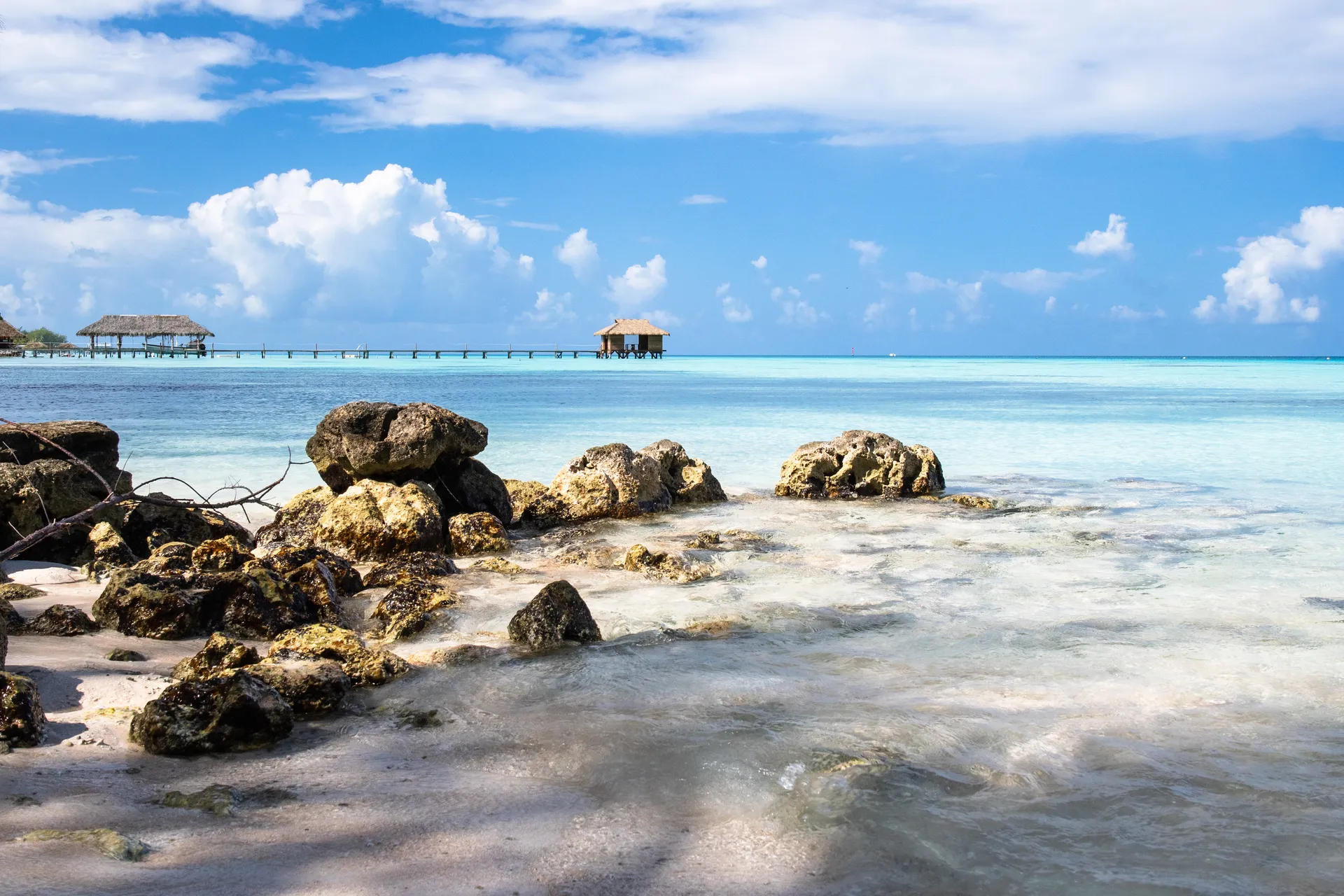
Fakarava is the second-largest atoll in the Tuamotu Archipelago of French Polynesia, and its name — derived from the Paumotu word for "beautiful" — understates its appeal with characteristic Polynesian modesty. This narrow ring of coral, enclosing a lagoon sixty kilometres long and twenty-five wide, is a UNESCO Biosphere Reserve and one of the most pristine marine environments on the planet. The diving here is legendary: the two passes that connect the lagoon to the open ocean — Garuae in the north and Tumakohua in the south — are swept by tidal currents that concentrate an almost hallucinatory density of marine life, from walls of grey reef sharks to manta rays, Napoleon wrasse, and the hammerheads that patrol the deeper water.
Fakarava has fewer than 900 permanent residents, most living in the village of Rotoava near the northern pass. Life here moves to the rhythm of the tide, the coconut harvest, and the pearl farm — Tuamotu black pearls, cultivated in the lagoon's clear, warm waters, are among the world's most prized, their lustrous dark surfaces displaying overtones of green, blue, and peacock that no amount of technology can replicate. The village church, built of coral blocks, and the simple pension-style guesthouses that line the lagoon shore give Fakarava the atmosphere of a Pacific island that the modern world has not yet managed to reach.
The diving at Fakarava is in a class of its own. The Garuae Pass, the largest pass in the Tuamotus, is famous for its "wall of sharks" — a drift dive through the pass during incoming tide that brings divers face-to-face with hundreds of grey reef sharks schooling in the current, along with barracuda, groupers, and eagle rays. The Tumakohua Pass, at the southern end of the atoll, is narrower and arguably even more spectacular: during June and July, hundreds of marbled groupers gather here for their annual spawning aggregation, attracting sharks in such numbers that the scene resembles a nature documentary brought to life. For snorkellers, the lagoon itself offers crystal-clear visibility, coral gardens, and the gentle companionship of blacktip reef sharks that cruise the shallows with benign curiosity.
Beyond the water, Fakarava's allure lies in its radical simplicity. Pink-sand beaches fringe the motu (islets) that form the atoll's rim, each one a private world of coconut palms and crystalline lagoon views. The old village of Tetamanu, at the southern pass, is a near-ghost town of coral ruins and a weathered nineteenth-century church — one of the most atmospheric places in the South Pacific. The night sky over Fakarava, unblemished by light pollution, reveals the Milky Way with a clarity that reminds you how impoverished urban skies have become. Sunset, watched from a motu with nothing but the sound of waves and the rustle of palms, achieves a purity that more elaborate destinations cannot approach.
Fakarava is a port of call for Holland America Line, Paul Gauguin Cruises, Seabourn, Silversea, and Windstar Cruises on their French Polynesia itineraries. Ships anchor in the lagoon and tender passengers to shore, an arrival that sets the tone for the island's unhurried character. The best time to visit is April through November, with June and July offering the famous grouper spawning aggregation and the driest weather.

