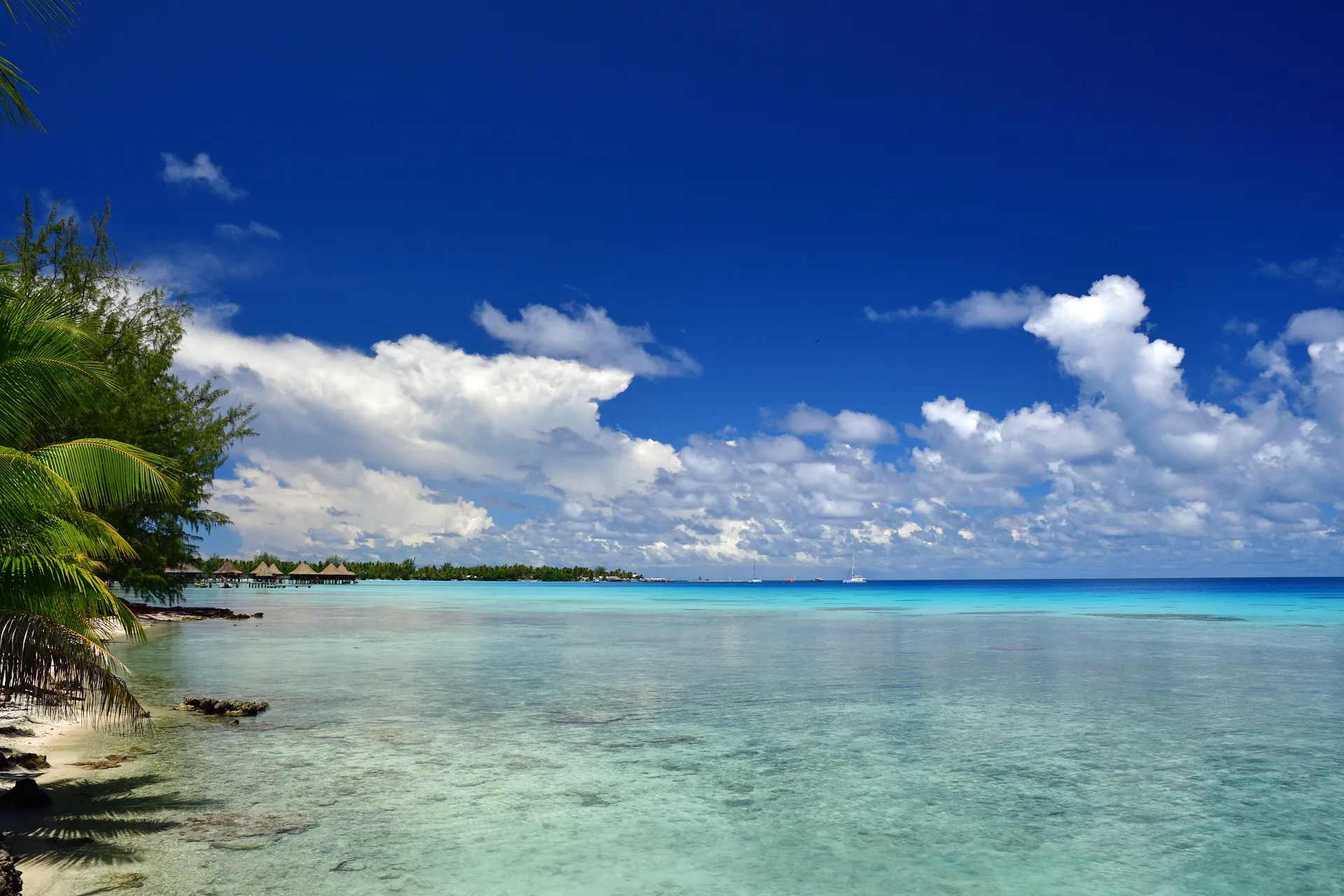
Rangiroa — "endless sky" in the Paumotu language — is the second-largest coral atoll on Earth, a necklace of over two hundred and forty low-lying islets encircling a lagoon so vast that the entire island of Tahiti could fit inside it. Seen from the air, the atoll's geometry is almost incomprehensible: a thin ring of palm-crowned land, rarely more than three hundred metres wide, enclosing seventy-five kilometres of water in shades of blue that seem to multiply beyond the capacity of language. Located in the Tuamotu Archipelago, roughly three hundred and fifty kilometres northeast of Tahiti, Rangiroa has drawn divers, dreamers, and wanderers since the days when Polynesian navigators used its passes as waypoints on transoceanic voyages. Oceania Cruises, Paul Gauguin Cruises, Seabourn, Silversea, and Windstar Cruises bring passengers to this aquatic Eden.
The two navigable passes that breach Rangiroa's reef — Tiputa and Avatoru — create one of the world's supreme diving and snorkelling environments. Twice daily, tidal currents surge through these narrow channels, carrying nutrients from the open ocean into the lagoon and attracting an astonishing concentration of marine life. Drift diving through Tiputa Pass is a bucket-list experience: divers are carried by the current past walls of grey reef sharks, eagle rays, barracuda, and, between January and March, pods of hammerhead sharks that patrol the deep blue beyond the reef edge. Bottlenose dolphins inhabit the pass year-round, and their acrobatic displays in the turbulent currents are a spectacle visible even from shore.
Life on the atoll moves to rhythms profoundly different from those of the modern world. The two principal villages, Avatoru and Tiputa, are connected by a single road that runs along the atoll's northern rim, passing coconut plantations, modest coral-stone churches, and family-run pension accommodations where Polynesian hospitality is expressed through flower crowns, ukulele music, and tables laden with poisson cru — raw tuna marinated in lime juice and coconut milk, the unofficial national dish of French Polynesia. The lagoon itself serves as the community's living room, garden, and highway: children play in its shallows, fishermen harvest its bounty, and the water's ever-changing palette provides a meditation that renders screens and schedules irrelevant.
Rangiroa's lagoon conceals several remarkable phenomena. The Blue Lagoon, a lagoon-within-a-lagoon on the atoll's western edge, traps water over white sand to create a swimming pool of almost supernatural turquoise clarity. The Île aux Récifs, a collection of fossilised coral formations rising from the lagoon floor like a petrified garden, can be reached by boat and explored on foot at low tide — their bizarre, wind-eroded shapes resemble nothing so much as an alien landscape. The Sables Roses (Pink Sands), at the atoll's southeastern tip, is a remote beach where crushed coral fragments create a blush-coloured shore meeting water of impossible blue.
Rangiroa's climate is tropical and warm year-round, with the dry season (May to October) offering slightly cooler temperatures and calmer seas ideal for diving. The wet season brings warmer water and the arrival of manta rays and hammerheads. There is no wrong time to visit, only different shades of paradise. What strikes most visitors is not any single experience but the cumulative effect of immersion in a world reduced to its essentials — sky, water, coral, and the ancient Polynesian understanding that the ocean is not a barrier but a home.

