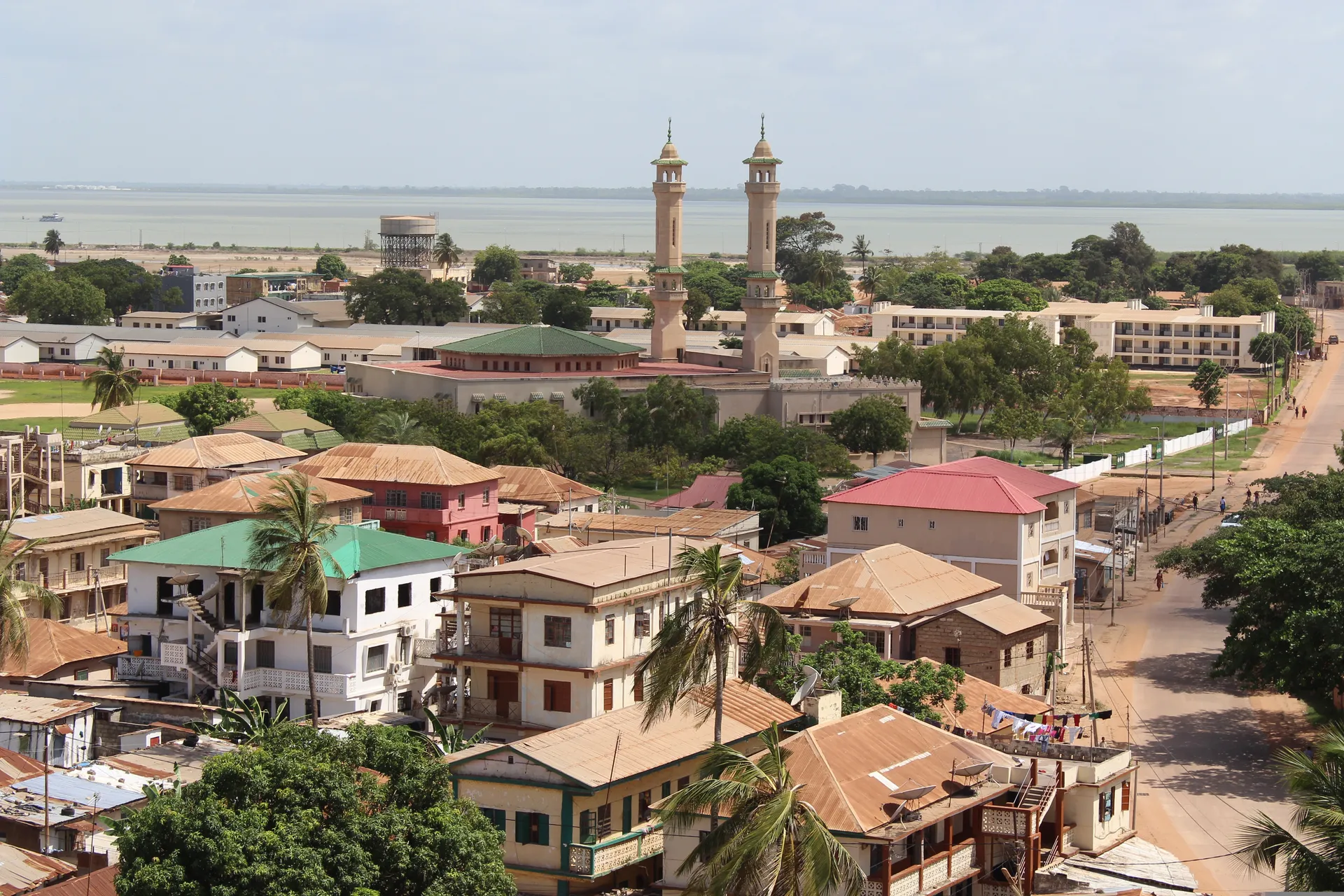
Founded in 1816 by Captain Alexander Grant as a strategic British outpost against the West African slave trade, Banjul rose from a modest settlement on St. Mary's Island to become the capital of The Gambia — one of the continent's smallest yet most captivating nations. The city's original name, Bathurst, honored the Colonial Secretary of the era, and its grid of weathered colonial streets still whispers of that transformative period when commerce, conscience, and empire converged at the mouth of the River Gambia.
Today, Banjul possesses a rhythm entirely its own — unhurried, warmly disarming, and saturated with colour. The Albert Market sprawls through the city centre in a magnificent tangle of indigo-dyed fabrics, hand-carved mahogany, and pyramids of fragrant spices, while traders in embroidered boubous negotiate with an eloquence that turns commerce into theatre. Along Liberation Avenue, faded Art Deco façades stand beside corrugated-iron market stalls, and the Arch 22 monument rises above the skyline, offering panoramic views across the estuary where pelicans drift on thermals above the mangroves. The atmosphere is one of genuine, unperformative hospitality — Gambians refer to their homeland as the "Smiling Coast," and within hours of arrival, the moniker feels less like marketing and more like simple truth.
The culinary landscape of Banjul rewards the adventurous palate with dishes rooted in centuries of Mandinka, Wolof, and Jola tradition. Begin with *domoda*, a rich, slow-simmered groundnut stew ladled over fragrant rice, its velvety sauce perfumed with tomato, bitter tomato leaf, and Scotch bonnet pepper. Seek out *benachin* — often called the original jollof rice — a one-pot masterwork of broken rice, fish, and seasonal vegetables cooked in palm oil until each grain absorbs a deep, smoky sweetness. For something lighter, *tapalapa* bread, baked in cylindrical clay ovens and served warm with green *maafe* sauce or fresh oysters harvested from the mangrove channels of Tanbi Wetland, offers a taste of terroir that no five-star kitchen could replicate. Wash it all down with *attaya*, the ritualistic three-round Gambian green tea ceremony — each pour progressively sweeter, each sip an invitation to slow down.
Beyond the capital, The Gambia's upcountry reveals landscapes of startling, understated beauty. Tendaba Camp, nestled on the river's south bank amid bolong creeks and dense mangrove forest, serves as a gateway to some of West Africa's finest birdwatching — over four hundred species have been recorded in the surrounding wetlands, from the iridescent violet turaco to the imperious African fish eagle. Further upstream, the riverside village of Kuntaur provides access to the Baboon Islands and the Chimpanzee Rehabilitation Project, where rescued primates roam forested islets in semi-wild freedom. River excursions from either destination unfold at the pace of the current itself — a dugout canoe gliding past hippos at dusk, the call of a Senegal coucal threading through the stillness — offering the kind of transformative encounter that lingers long after the journey ends.
Banjul's port, situated on the sheltered southern shore of the Gambia River estuary, welcomes a select roster of distinguished cruise lines whose itineraries prize depth of experience over predictable circuits. Azamara's intimate vessels anchor here as part of their immersive West African voyages, granting passengers ample time to explore both city and river. Cunard, carrying forward its storied legacy of transatlantic and expedition crossings, includes Banjul on select repositioning voyages that trace the coast from the Mediterranean to the Cape. Regent Seven Seas Cruises brings its signature all-inclusive refinement to this port, often pairing Banjul with calls along Senegal and the Cape Verde archipelago. For each line, the appeal is the same: Banjul offers an authenticity — unhurried, unpolished, utterly magnetic — that has become the rarest luxury of all.

