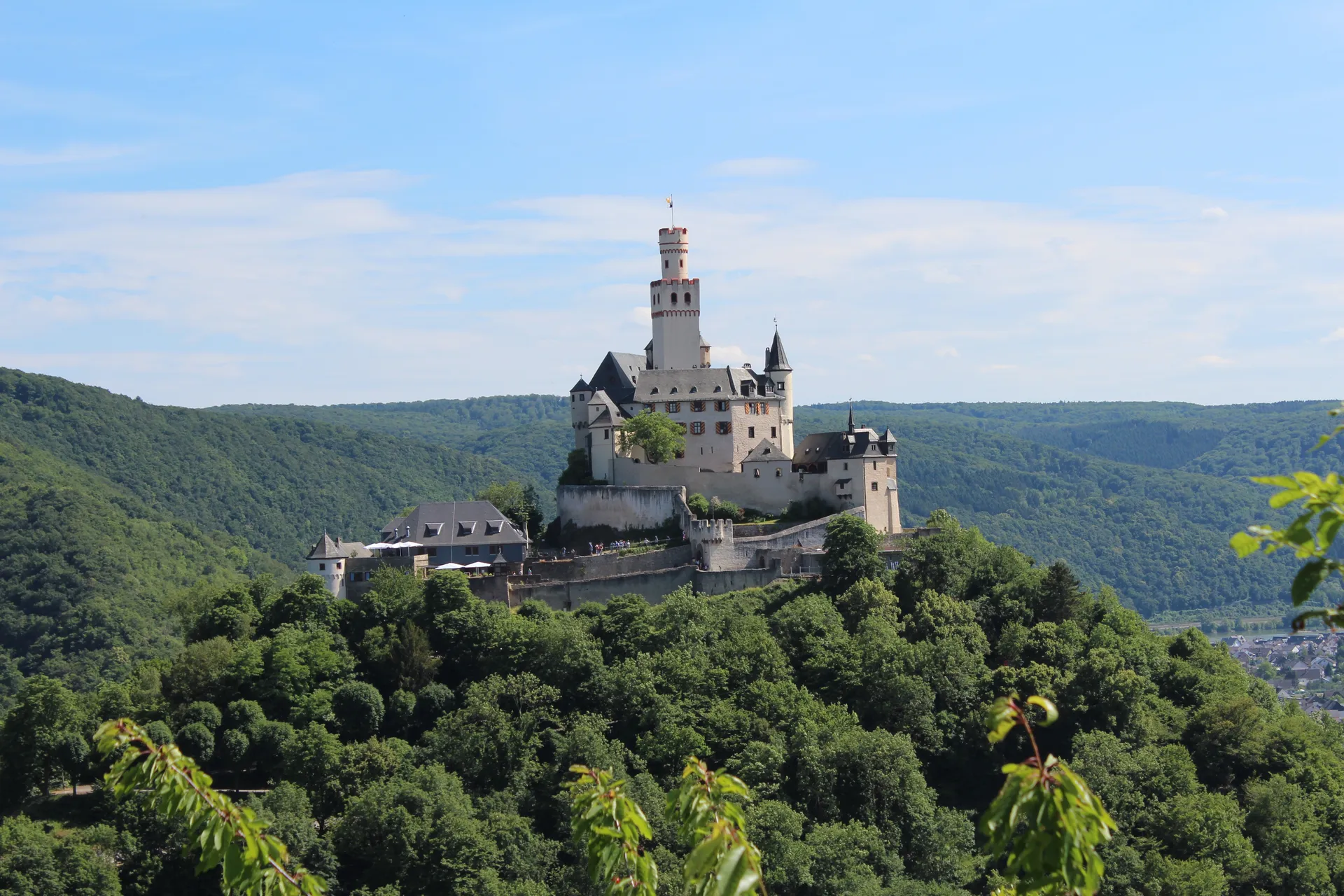
Tucked into a bend of the Middle Rhine, where the river carves through the slate gorge that UNESCO has designated a World Heritage Site, Braubach is a half-timbered village of barely 3,000 souls crowned by one of Germany’s most perfectly preserved medieval castles. Marksburg Castle, perched 150 meters above the Rhine on a volcanic ridge, is the only hilltop castle on the Rhine that has never been destroyed—an unbroken chain of occupation and fortification spanning over 700 years that makes it the definitive example of a Rhineland medieval fortress.
Marksburg’s survival through centuries of Rhineland conflict—the Thirty Years’ War, the French Revolution, Napoleonic campaigns—owes partly to its strategic position and partly to good fortune. The castle’s guided tour reveals remarkably intact medieval rooms: the Gothic hall with its ribbed vaulting, the kitchen with its massive fireplace and spit mechanism, the armory stocked with weapons and armor spanning five centuries, and the herb garden planted with species documented in medieval pharmaceutical texts. The castle’s torture chamber, preserved with chilling authenticity, provides a sobering counterpoint to the romantic castle imagery that the Rhine has fostered.
Braubach village, clustered around the castle’s base, retains the medieval fabric that many Rhine towns lost to wartime bombing or postwar development. Half-timbered houses from the 16th and 17th centuries line narrow lanes that lead to the Barbarakirche, a late-Gothic church whose interior preserves Renaissance-era wall paintings. The town’s Philippsburg, a baroque palace at the riverside, was built by the Landgraves of Hesse as a more comfortable alternative to the medieval castle above—a transition from fortress to residence that mirrors the broader transformation of Rhineland aristocratic life.
The Rhine Gorge surrounding Braubach is the Rhine of legend: castle-crowned hilltops appearing around every bend, terraced vineyards clinging to impossibly steep slate slopes, and the river itself—busy with commercial barges and tourist vessels—flowing through a landscape that inspired the Romantic movement. The nearby Lorelei Rock, where a legendary siren was said to lure sailors to their doom, is a short cruise downstream. Koblenz, at the confluence of the Rhine and Moselle rivers, lies just ten kilometers north and offers the Deutsches Eck (German Corner), the Ehrenbreitstein Fortress, and access to the Moselle wine region.
Scenic River Cruises calls at Braubach, and the combination of the Rhine’s most authentic castle, an unspoiled medieval village, and the World Heritage gorge landscape creates a port call that distills Rhineland romance to its purest essence. The castle’s hilltop position means a steep walk or shuttle ride, but the effort is rewarded with panoramic Rhine views from the battlements. April through October offers the most pleasant weather, with the Riesling grape harvest in October adding a golden, festive dimension to the visit.

