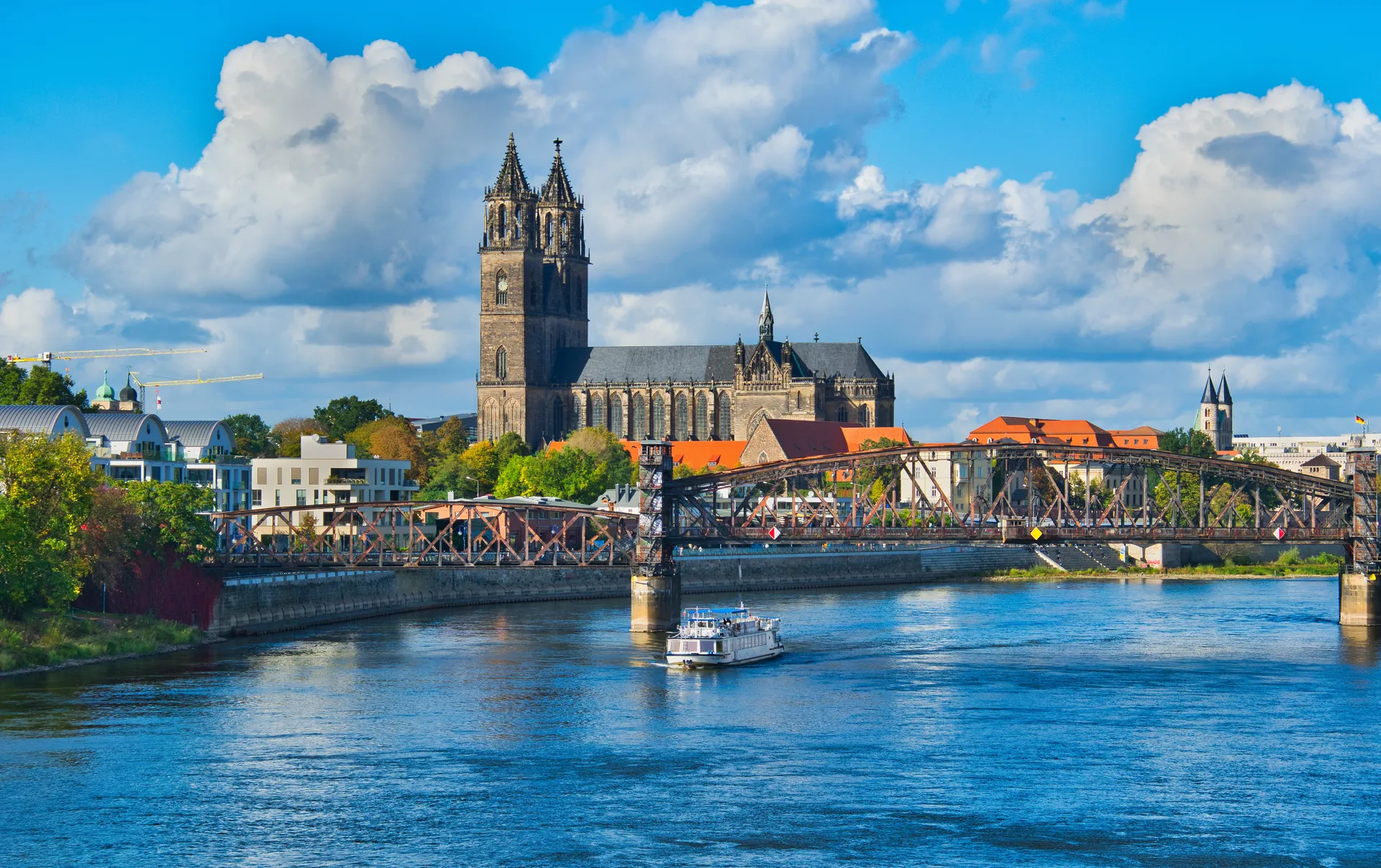
When Otto I was crowned Holy Roman Emperor in 962, he chose Magdeburg as his imperial capital — and for the next century, this city on the Elbe was the political and spiritual centre of European Christendom. Otto's cathedral, begun in 1209 on the site of his original church, was the first Gothic cathedral built on German soil, and its soaring nave remains one of the most impressive sacred spaces in northern Europe, housing the emperor's tomb and a collection of medieval sculpture that includes the Magdeburger Reiter — the oldest freestanding equestrian statue north of the Alps, carved around 1240 and believed to represent Otto himself. That a city of such antiquity sits along the Elbe, accessible by river cruise, is one of the quiet pleasures of Central European waterway travel.
Magdeburg's history since Otto has been one of dramatic destruction and reinvention. In 1631, during the Thirty Years' War, imperial troops under General Tilly sacked the city in what became the most notorious atrocity of that conflict — 20,000 citizens perished in a firestorm that reduced the medieval city to ash and made "Magdeburg" a byword for the horrors of war across Protestant Europe. The city rebuilt, only to be devastated again in January 1945 by Allied bombing that destroyed 90 percent of the old town. The postwar reconstruction under East German rule produced the characteristically broad boulevards and socialist modernist architecture that still define much of the city centre, but recent decades have brought sensitive restoration and imaginative new construction that are giving Magdeburg a surprisingly contemporary cultural identity.
The culinary scene in Magdeburg reflects its position at the crossroads of Saxon, Brandenburg, and Anhalt cooking traditions. Botelknacker, a regional smoked sausage, is the local signature, served at beer gardens along the Elbe promenade with dark bread and mustard. The Magdeburger Borse, a historic restaurant in the city centre, serves elevated versions of regional classics — sauerbraten, Elbe pike-perch, and the hearty lentil and sausage soups that sustain the city through long continental winters. The craft beer scene has blossomed in recent years, with local breweries reviving traditional styles alongside experimental ales that would not be out of place in Berlin.
The Elbe riverfront in Magdeburg has been transformed into one of the most engaging public spaces in eastern Germany. The Grune Zitadelle, a fantastical apartment building designed by the Austrian artist Friedensreich Hundertwasser — all irregular curves, mosaic columns, and rooftop gardens — is the city's most photographed structure and a joyful counterpoint to the surrounding socialist-era blocks. The Elbauenpark, created for the 1999 Federal Garden Show, features the Jahrtausendturm — a wooden tower housing an interactive exhibition on 6,000 years of scientific discovery. The Magdeburg Water Bridge, an engineering marvel that carries the Mittelland Canal over the Elbe in an aqueduct 918 metres long, is the longest navigable water bridge in Europe.
Magdeburg is served by CroisiEurope and VIVA Cruises on Elbe river itineraries connecting Berlin, Dresden, and the Saale valley. The most pleasant visiting season runs from May through September, when the Elbe promenade is at its liveliest and the long summer evenings invite lingering over dinner with views across the river to the cathedral's twin spires.

