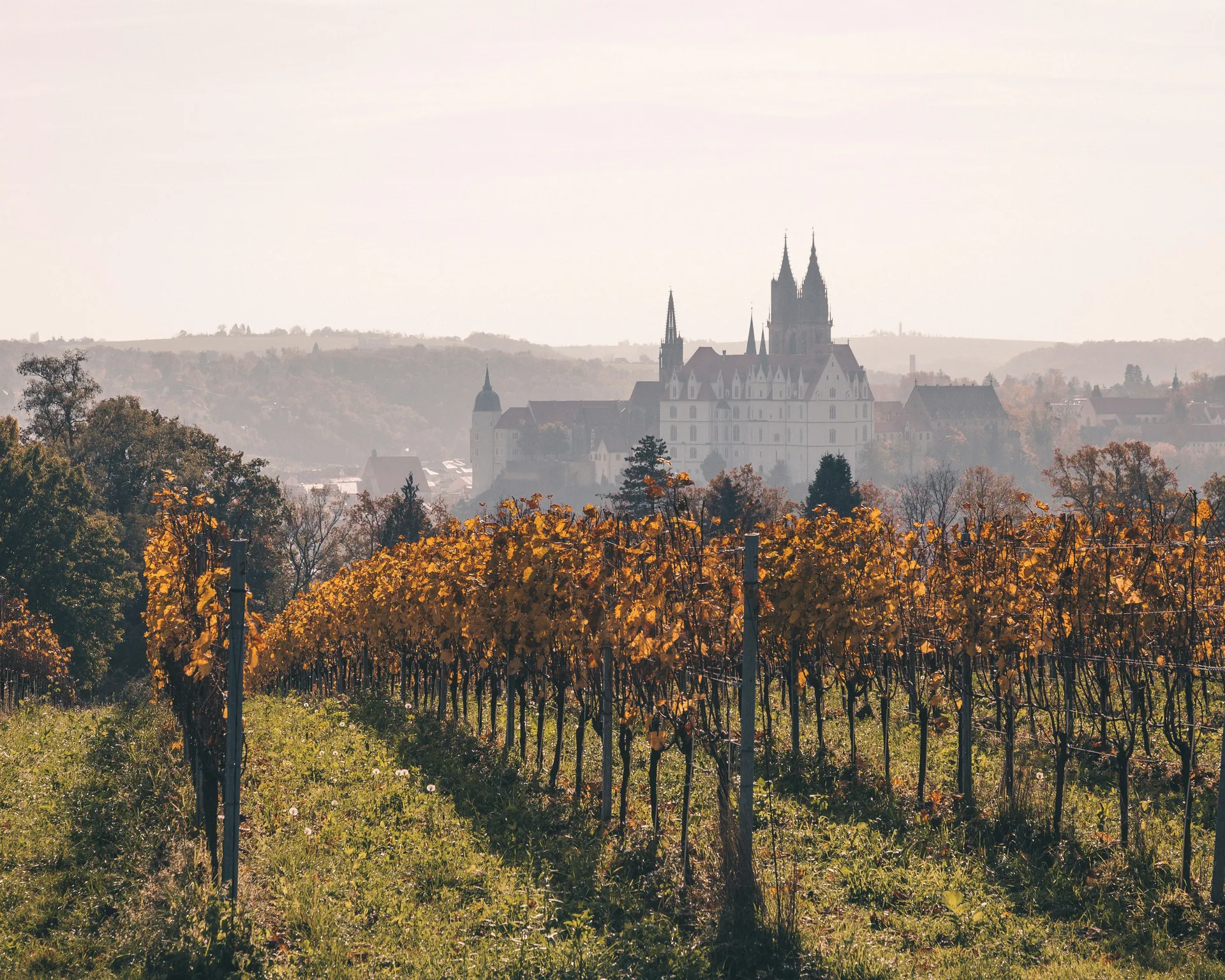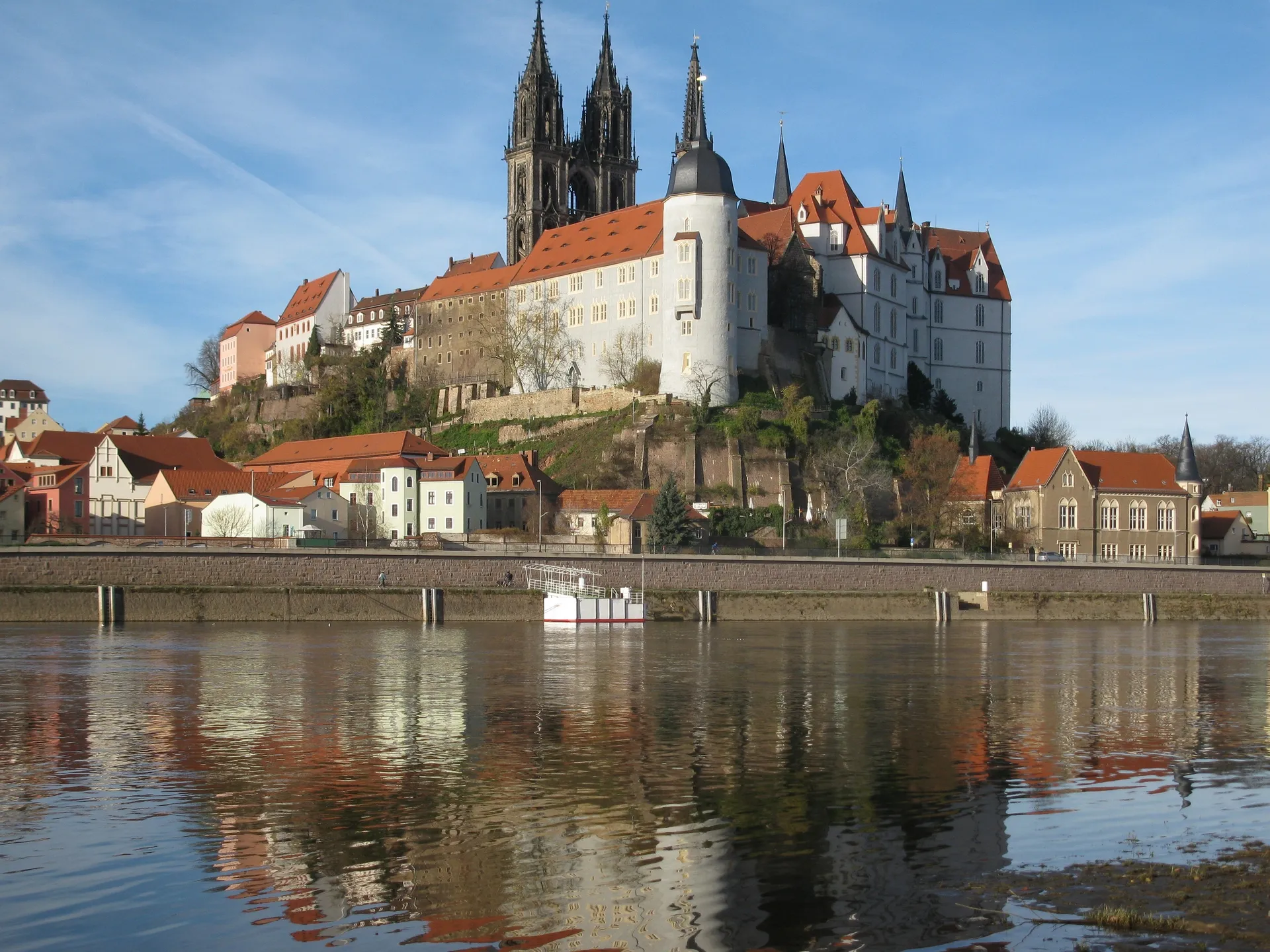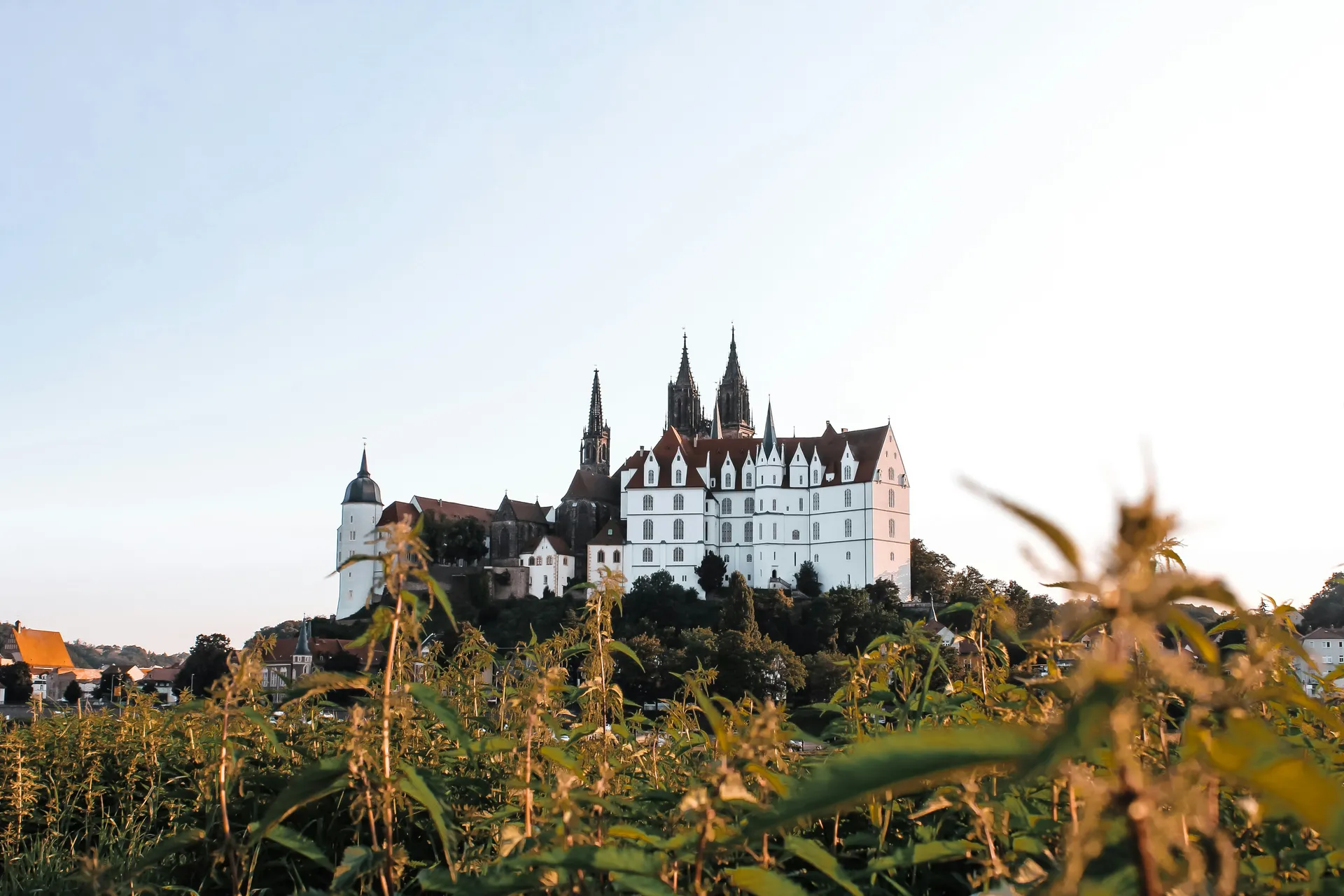
Where the Elbe carves its gentle arc through the Saxon heartland, Meissen rises from the riverbanks like a porcelain miniature brought to magnificent scale. Founded in 929 AD when King Henry I of Germany established the Margraviate of Meissen and built the original fortress atop the granite bluff, this thousand-year-old town became the cradle of European porcelain when Augustus the Strong imprisoned alchemist Johann Friedrich Böttger in the Albrechtsburg castle, where he finally unlocked the secret of hard-paste porcelain in 1708. The crossed-swords trademark of Meissen porcelain — the oldest in continuous use in the world — has adorned the tables of emperors and aristocrats for more than three centuries.
Arriving by river is to witness Meissen as it was always meant to be seen: the Albrechtsburg and the soaring Gothic spires of the Cathedral of St. John and St. Donatus commanding the hilltop, their reflections trembling across the water below. The old town unfolds in a labyrinth of cobblestone lanes lined with patrician houses painted in faded ochre and sage, their timber-framed upper stories leaning companionably toward one another. The Frauenkirche in the market square strikes its hours on a carillon of thirty-seven porcelain bells — the first of their kind, installed in 1929 — each note ringing with an almost crystalline purity that seems to distill the town's obsession with refined craftsmanship. There is a quietness to Meissen that larger Saxon cities cannot replicate, a sense that time moves here at the pace of a kiln cooling overnight.
Saxon cuisine rewards those who arrive hungry and leave their restraint at the gangway. Begin with Meissner Fummel, an impossibly delicate blown pastry so fragile it was supposedly invented to test whether royal couriers had been drinking on the road — if it arrived intact, the messenger was sober. The local Eierschecke, a three-layered custard cake unique to Saxony, pairs magnificently with coffee at one of the market square's intimate cafés. For heartier fare, seek out Sauerbraten with Klöße — vinegar-marinated beef roast served with pillowy potato dumplings — or sample the region's underappreciated wines: Meissen sits at the heart of the Saxonian Wine Route, one of Europe's northernmost and smallest wine regions, where steep Elbe-facing terraces produce remarkably elegant Müller-Thurgau and Goldriesling, a grape variety found almost nowhere else on earth. The Vincenz Richter wine restaurant, housed in a half-timbered building from 1523, remains among the most atmospheric places in Germany to taste these rare vintages.
The Elbe corridor radiates outward into a constellation of rewarding diversions for the river traveler with an appetite for discovery. Upstream, the vine-clad hillsides near Wertheim on the confluence of the Main and Tauber rivers present a postcard of medieval Germany, its ruined castle brooding above half-timbered wine taverns. The Mosel village of Bernkastel, with its impossibly picturesque Marktplatz and the precipitous Doktor vineyard — whose Rieslings have commanded royal premiums since the fourteenth century — offers one of the Rhineland's most seductive afternoons. Further afield, the Rhine-side town of Kehl provides a fascinating gateway to Strasbourg and Franco-German border culture, while the tranquil Elbe-side town of Geesthacht, near Hamburg, marks the river's tidal limit and offers contemplative walks along dike paths where freshwater meets the pull of the North Sea.
Viking positions Meissen as a highlight of its celebrated Elbe itineraries, threading passengers through the cultural heartland of Saxony with the kind of unhurried elegance that suits this refined destination perfectly. Viking's intimate longships dock conveniently for the short transfer into Meissen's old town, and their excursion programming typically includes privileged access to the Meissen porcelain manufactory, where artisans still paint each piece by hand using techniques unchanged since the eighteenth century. For those sailing the Elbe between Prague and Berlin, the Meissen call offers a luminous interlude — a town where the pursuit of perfection was not merely an ideal but an industry, and where the whisper of a porcelain bell across the market square still carries the unmistakable ring of something rare.