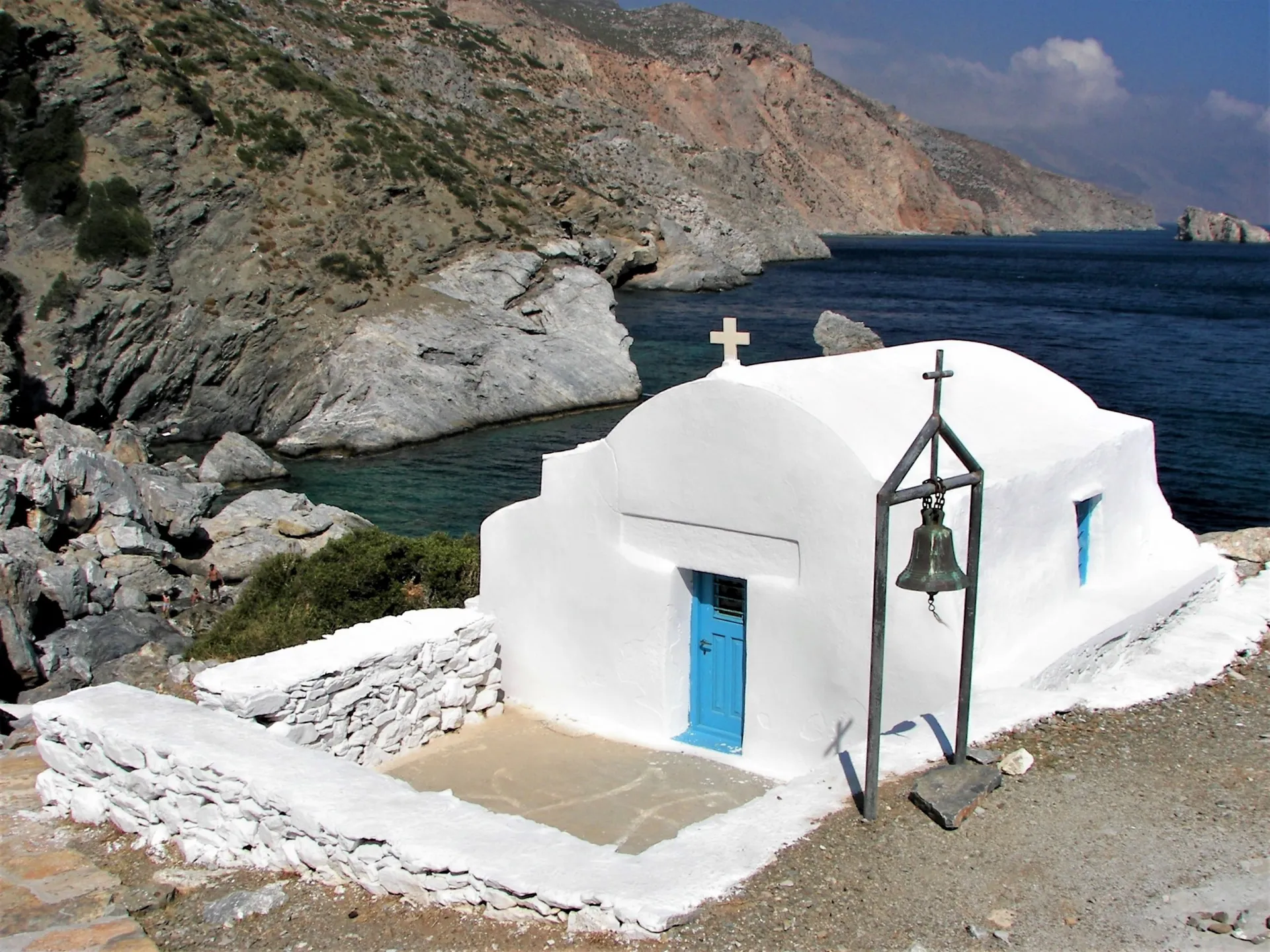
Amorgos is the Cyclades' best-kept secret—the easternmost island of the chain, a slender ridge of limestone and schist rising dramatically from the Aegean, too remote for mass tourism yet endowed with a beauty so arresting that Luc Besson chose it as the filming location for The Big Blue. While Santorini and Mykonos draw millions, Amorgos receives a fraction of those numbers, preserving an atmosphere of genuine Greek island life: whitewashed villages clinging to mountainsides, goat bells echoing across terraced hillsides, and a pace of existence measured by the arrival of the ferry and the setting of the sun.
The island's two principal settlements occupy dramatic perches. Chora, the capital, cascades down a mountainside 400 meters above the sea, its sugar-cube houses and blue-domed churches crowned by a thirteenth-century Venetian fortress. The Monastery of Panagia Hozoviotissa, Amorgos's most iconic sight, is embedded into a 300-meter cliff face above the Aegean like a white slash painted on the rock—built in the eleventh century to house a miraculous icon of the Virgin Mary, its impossibly narrow cells and staircases cling to the cliff in an act of architectural faith that seems to defy both gravity and reason. The monastery's terrace offers views that rank among the most spectacular in the Aegean, with nothing between the viewer and the horizon but sea and light.
Amorgian cuisine is traditional Cycladic cooking at its most honest—shaped by the island's limited agricultural resources and the surrounding sea. Xinomizithra, a tangy fresh cheese made from goat's and sheep's milk, appears in pies, salads, and as a table cheese. Patatato, a slow-cooked stew of goat or lamb with potatoes in a tomato sauce seasoned with oregano and bay, is the island's signature dish. Fresh fish—grilled octopus, fried calamari, and whatever the day boats bring in—is served at waterfront tavernas in Katapola and Aegiali, the island's two port villages. Rakomelo, warm rakí infused with honey and spices, is the traditional welcome drink. Psimeni raki, a spiced digestif, closes every meal. The simplicity of the cuisine is its virtue—every ingredient tastes of sun, salt, and the volcanic soil that gives Amorgian produce its distinctive intensity.
The island rewards hikers with a network of ancient kalderimi (cobblestone paths) connecting villages across the mountainous spine. The trail from Aegiali to Chora traverses the island's highest point and passes through abandoned settlements, Byzantine chapels, and landscapes of wild herb-scented scrub with views across the entire archipelago. The waters surrounding Amorgos are exceptionally clear, and the island's beaches—from the turquoise cove of Mouros to the dramatic black-pebble strand at Maltezi—are uncrowded even in peak season. The shipwreck of the Olympia, the vessel featured in The Big Blue, rests in shallow water at Liveros beach on the island's southern coast, its rusting hull now colonized by marine life and accessible to snorkelers.
Azamara, Ponant, Star Clippers, and Windstar Cruises include Amorgos on their Greek island itineraries, with ships anchoring at Katapola or Aegiali and tendering passengers ashore. The island's compact size means key sights are accessible within a half-day, though the steep terrain requires moderate fitness. May through October offers warm, dry conditions, with June and September providing the ideal balance of sunshine and manageable temperatures. July and August bring the meltemi wind, which can create choppy seas but also keeps temperatures bearable. Amorgos is the Greek island experience distilled to its essence—dramatic landscape, ancient paths, honest food, and the limitless blue of the Aegean stretching to the horizon in every direction.

