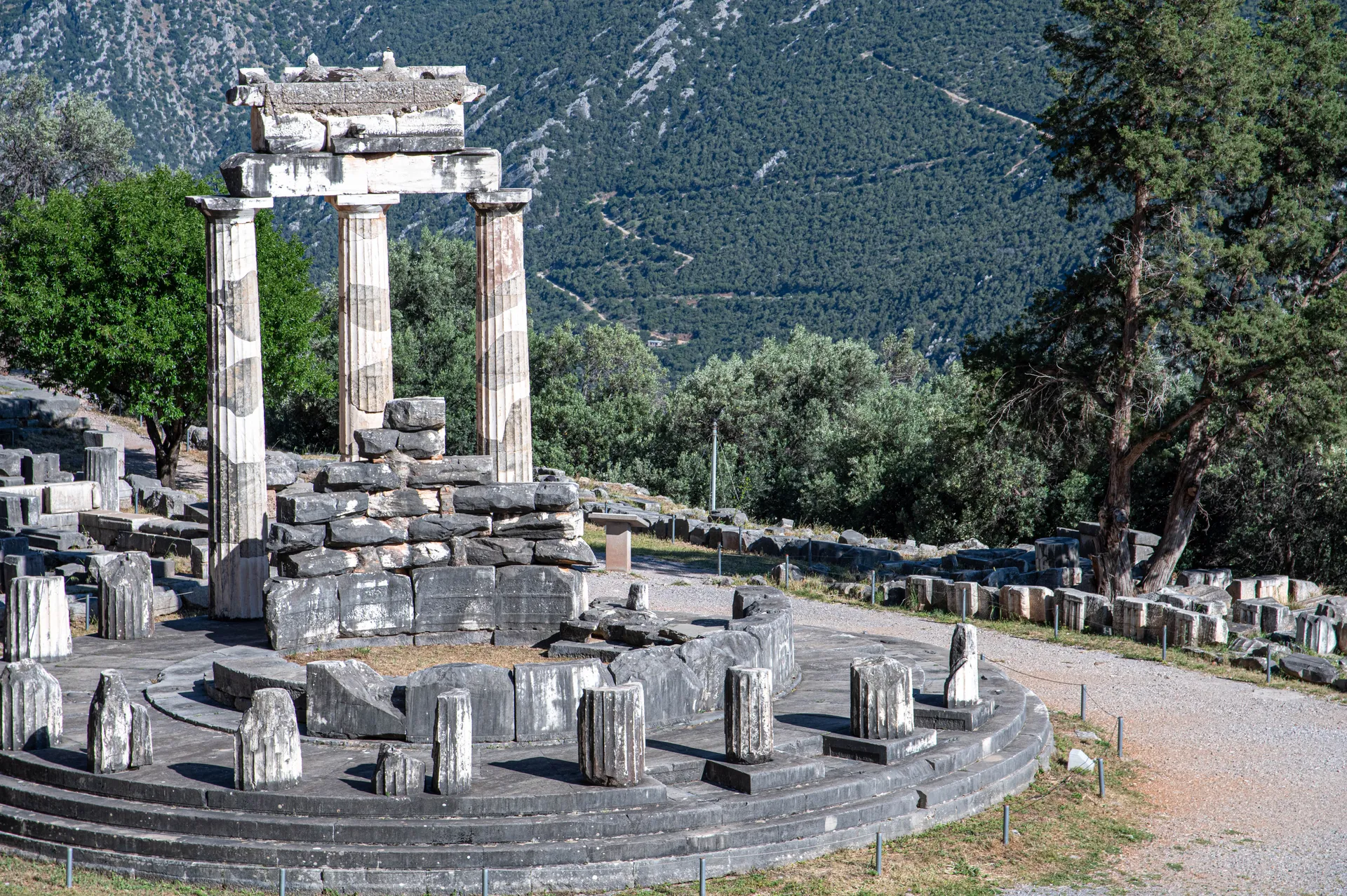
Delphi was the centre of the world — or so the ancient Greeks believed. According to myth, Zeus released two eagles from opposite ends of the earth, and they met here, on a dramatic mountain terrace above the Gulf of Corinth, marking the spot as the omphalos, the navel of the cosmos. For nearly a thousand years, from the eighth century BC to the fourth century AD, pilgrims, kings, and generals climbed the Sacred Way to consult the Oracle at Delphi, the most powerful prophetic voice in the ancient world. The Pythia, a priestess seated on a tripod above a chasm that exhaled intoxicating vapours, delivered enigmatic pronouncements that shaped the course of wars, colonies, and dynasties. Her influence was so immense that no major Greek enterprise — military, political, or personal — was undertaken without her counsel.
The archaeological site at Delphi, a UNESCO World Heritage Site, cascades down the slopes of Mount Parnassus in a series of terraces that are as spectacular for their setting as for their ruins. The Temple of Apollo, where the Oracle held court, survives in a haunting colonnade of re-erected Doric columns framing views of the olive-carpeted Pleistos Valley and the distant glitter of the sea. The Treasury of the Athenians, meticulously reconstructed from its original stones, celebrates Athens' victory at the Battle of Marathon. Above, the well-preserved ancient theatre, seating five thousand, still offers acoustics so precise that a whisper on the stage carries to the highest row. Higher still, the stadium where the Pythian Games — second in prestige only to the Olympics — were contested sits in splendid isolation among the pines.
The Delphi Archaeological Museum, one of Greece's finest, houses a collection that brings the sanctuary's lost grandeur vividly to life. The bronze Charioteer of Delphi, cast around 470 BC to commemorate a chariot-race victory, is among the most celebrated statues of antiquity — his inlaid glass eyes still glinting with unsettling realism after two and a half millennia. The museum also holds the Sphinx of Naxos, the dancing maidens of the Acanthus Column, and an extraordinary trove of gold and ivory votive offerings that testify to the wealth that flowed into the sanctuary from across the Mediterranean world.
Modern Delphi, a small mountain town perched on the cliff above the ruins, offers a thoroughly pleasant base for exploration. Tavernas along the main street serve hearty mountain cuisine — slow-braised lamb with orzo, village sausages with leeks, and robust local wines from the Amfissa and Neméa appellations. The surrounding landscape of Mount Parnassus — at 2,457 metres, the legendary home of the Muses — provides outstanding hiking through fir forests and alpine meadows, and in winter transforms into Greece's most popular ski resort, an unexpected counterpoint to the classical ruins below. The coastal town of Itea, down in the Gulf of Corinth, offers waterfront dining and swimming beaches within a thirty-minute drive.
Delphi is accessible as a shore excursion from several Greek ports and is featured in itineraries by Holland America Line, Tauck, and Windstar Cruises. The typical approach is from the port of Itea on the Gulf of Corinth, from which Delphi is a winding, scenically magnificent thirty-minute drive up the mountainside. Spring (April through June) and autumn (September through November) are the ideal visiting seasons, when the light is crystalline, the temperatures are comfortable for climbing the Sacred Way, and the tour buses are fewer. Delphi is one of those places that justifies every superlative: it is genuinely, breathtakingly, world-changingly extraordinary.

