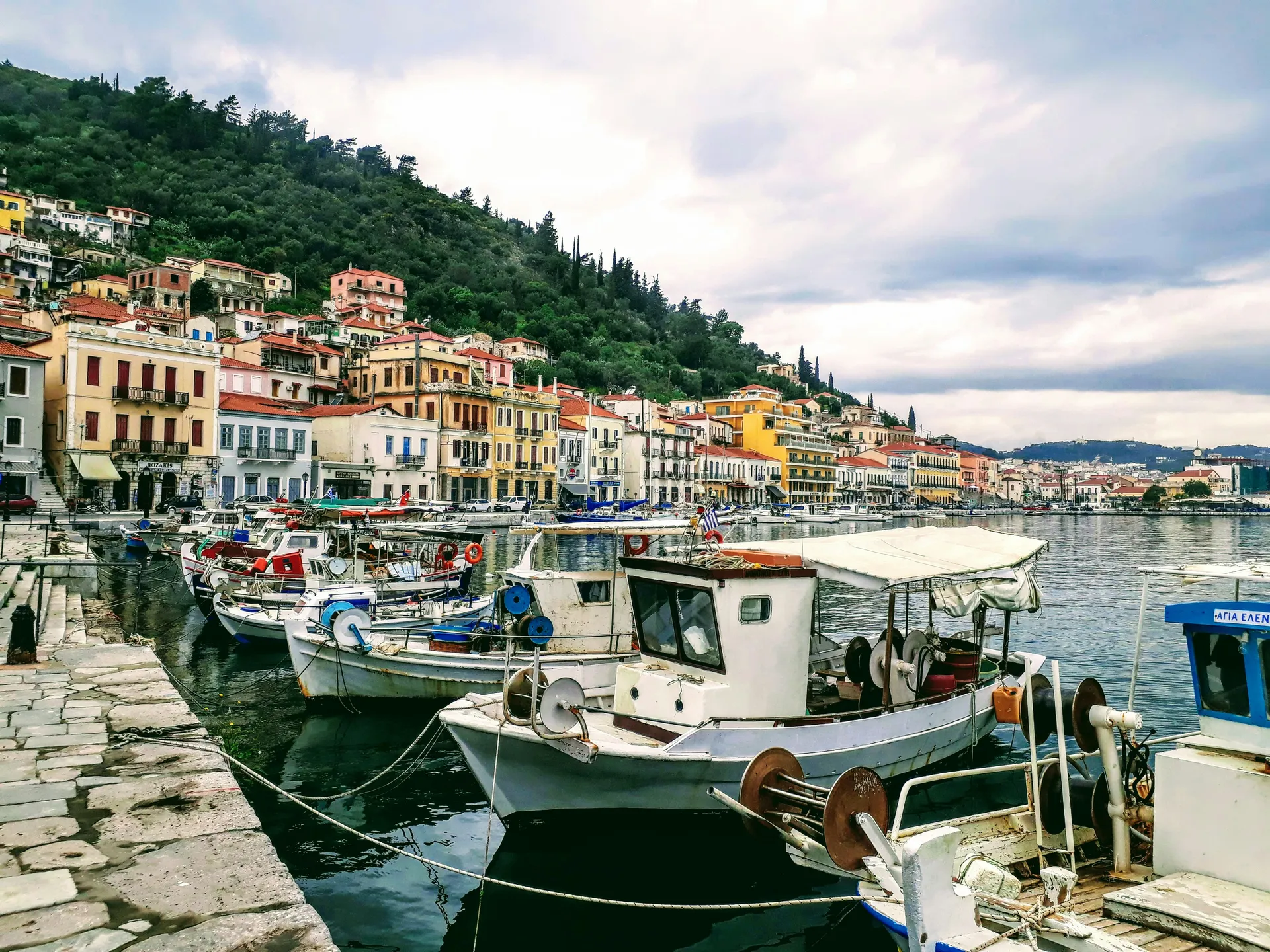
At the foot of the Mani Peninsula, where the Laconian Gulf meets the rugged southern extremity of mainland Greece, Gythio drowses in Mediterranean sunlight with the serene confidence of a town that was ancient when Sparta was young. This was the principal port of Sparta — the harbor from which the martial city-state projected its naval power across the Aegean — and, according to mythology, the place where Paris and Helen spent their first night together after fleeing Sparta, an act that launched the thousand ships of the Trojan War. The tiny island of Marathonisi, connected to the waterfront by a causeway, is traditionally identified as the site of their tryst, and a lighthouse and chapel now occupy the spot where Western literature's most consequential romance is said to have begun.
The waterfront of Gythio presents one of the most charming harbor scenes in the Peloponnese. Neoclassical mansions painted in faded pastels line the curved quay, their ground floors occupied by tavernas and cafés that spill onto the pavement with the relaxed confidence of establishments that have been feeding fishermen and travelers for generations. Fishing boats crowd the harbor alongside occasional yachts, their nets drying in the sun that seems to illuminate Gythio with particular warmth and clarity. The tower houses of the Mani, visible on the rocky headlands to the south, hint at the fierce, clan-based culture of the peninsula that extends below — a landscape of vendettas, Byzantine churches, and stone-built villages that time seems to have bypassed entirely.
The Mani Peninsula, accessible from Gythio, offers some of the most compelling and least visited landscapes in all of Greece. The Outer Mani, between Gythio and Areopolis, presents a coastline of small beaches and fishing villages backed by olive groves and the ever-present tower houses — fortified family residences built during centuries of inter-clan warfare that gave the Mani its reputation as Greece's wildest region. The Deep Mani, south of Areopolis, grows increasingly stark and beautiful, culminating at Cape Tenaro — the southernmost point of mainland Greece — where a path leads to the cave that the ancients believed was an entrance to the Underworld. The Diros Caves, a network of underground lakes and caverns explored by boat, provide one of Greece's most remarkable natural experiences.
Gythio's culinary offerings celebrate the Laconian landscape with typical Greek directness. Olives from the surrounding groves produce oil of exceptional quality, while the local oranges — Lakonia is one of Greece's premier citrus regions — appear in salads, desserts, and the fresh juice served at every breakfast table. The seafood is predictably excellent: grilled octopus, fried calamari, and the small local fish known as marides, eaten whole with a squeeze of lemon. The local wines, particularly the Agiorgitiko reds from nearby Nemea, provide the perfect complement to meals taken on the waterfront as the sun sets behind the Messenian mountains across the gulf.
Ponant, Regent Seven Seas Cruises, and Seabourn include Gythio in their Greek Isles and Peloponnese itineraries, with vessels typically anchoring in the bay and tendering to the harbor. The compact waterfront is entirely walkable, and the surrounding Mani excursions can fill an entire day of extraordinary exploration. The season runs from April through October, with spring bringing wildflowers to the Mani's austere landscape and autumn offering the most comfortable temperatures for cave visits and coastal walks. Gythio's combination of mythological resonance, architectural charm, and access to the Mani's untamed interior makes it one of the most rewarding and least expected ports in the Greek cruising repertoire.

