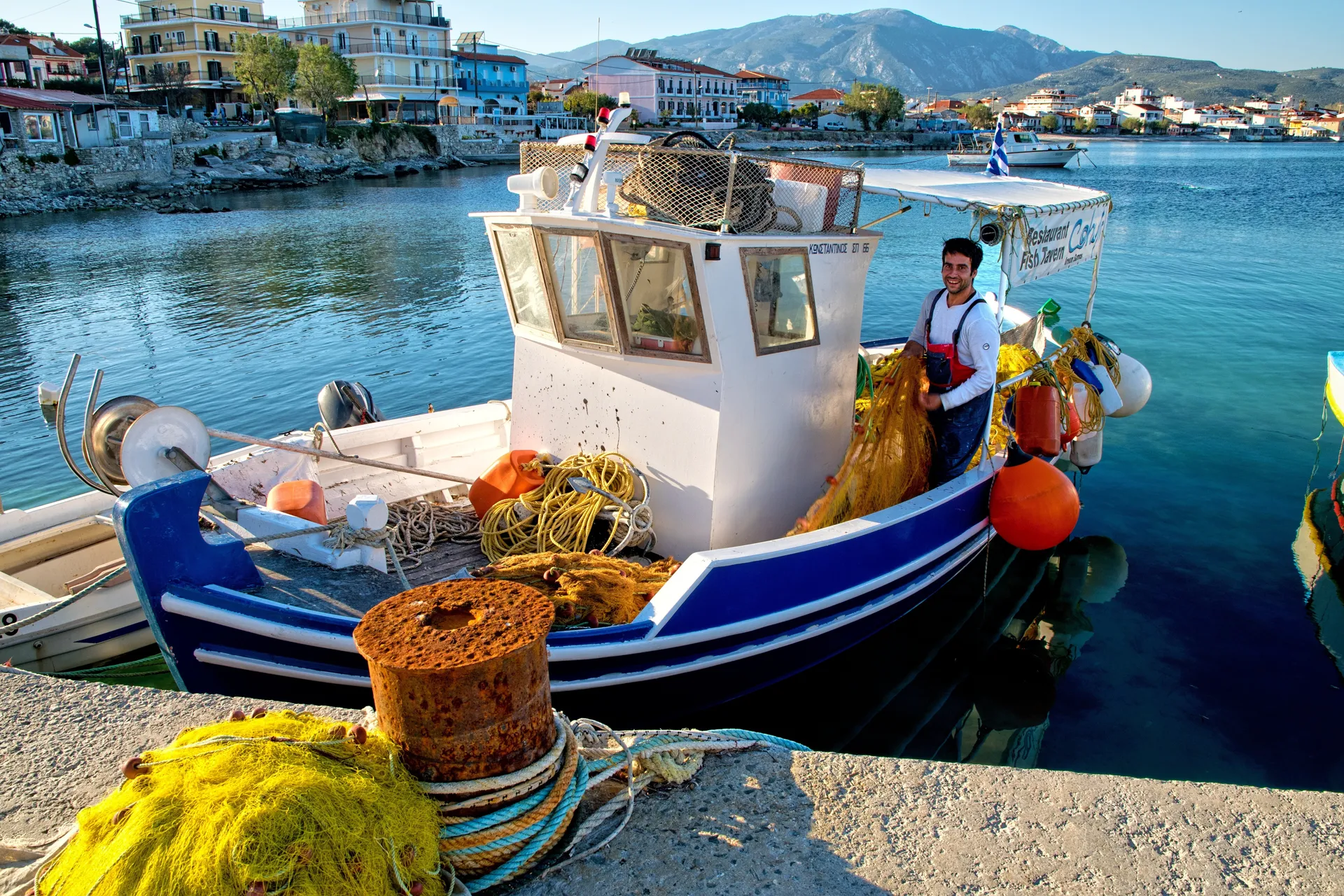
Vathy, the principal town and harbor of Samos, occupies a deep natural inlet on the island's northeastern coast—a crescent of neoclassical mansions, waterfront tavernas, and sun-bleached churches climbing the hillside above one of the most sheltered anchorages in the eastern Aegean. Samos itself, separated from the Turkish coast by a strait barely 1,300 meters wide at its narrowest point, has been a crossroads of Greek and Anatolian civilizations since the Bronze Age, and its contributions to Western culture—from the mathematician Pythagoras to the philosopher Epicurus to the astronomer Aristarchus—are astonishing for an island of its modest size.
The Archaeological Museum of Vathy houses one of the most important collections of Archaic Greek sculpture in the Aegean, including the colossal kouros statue found at the Heraion—a marble figure standing 5.5 meters tall that ranks among the largest surviving Greek sculptures from the sixth century BC. The Heraion itself, the great sanctuary of the goddess Hera located on the southern coast near Ireon, was one of the grandest religious complexes in the ancient Greek world, rivaling Delphi and Olympia in scale and importance. A single reconstructed column from its enormous temple—the largest temple attempted in the Greek world when construction began around 575 BC—stands amid the ruins as a reminder of ambitions that even the ancient Greeks could not fully realize.
The island's landscape is dominated by Mount Kerkis, at 1,434 meters the highest peak in the eastern Aegean, and the slightly lower Mount Ambelos, whose slopes are covered in the pine and cypress forests that give Samos its lush, green character—a marked contrast to the arid islands further south. The wine produced on Ambelos's slopes, particularly the sweet Muscat of Samos, has been celebrated since antiquity—Byron praised it, and the local wine cooperative, founded in 1934, continues to produce dessert wines that regularly win international awards.
Vathy's waterfront is the island's social center—a long promenade of cafés, bars, and restaurants where the evening volta (promenade) transforms the quay into a stage for the relaxed social theater that defines Greek island life. The cuisine is characteristic of the eastern Aegean: grilled fish from the morning catch, mavrodafne-braised octopus, the peppery greens known as horta gathered from the hillsides, and the slow-cooked bean and meat stews that sustain the island's farming communities. The town's tavernas serve these dishes with a generosity and lack of pretension that makes dining in Vathy one of the most genuinely satisfying experiences in the Greek islands.
Cruise ships dock at Vathy's harbor, where the town is immediately accessible on foot. The harbor's excellent shelter makes it a reliable port of call even when wind conditions affect more exposed Aegean anchorages. The best visiting months are May through October, with June and September offering the ideal balance of warm weather, swimmable seas, and manageable tourist numbers. The proximity of the Turkish coast—visible from most viewpoints on the island—adds a layer of geographical interest that underscores Samos's historical position as a cultural bridge between Greece and Asia Minor.

