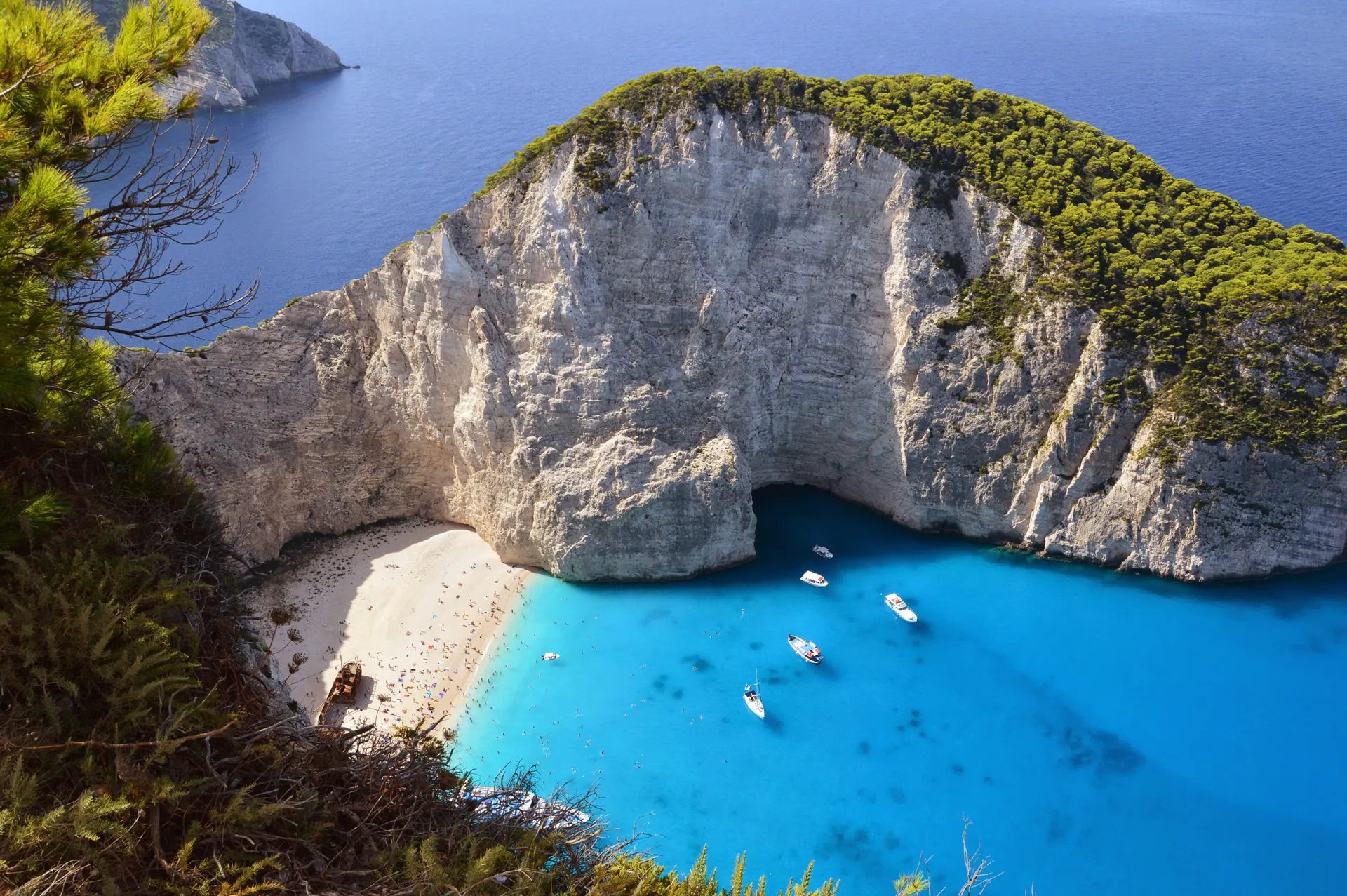
Zakynthos — Zante to the Venetians who ruled it for three centuries, and the inspiration for the Italian expression "Zante, fior di Levante" (flower of the East) — is the southernmost of the major Ionian Islands, a place where the Homeric epithets of "wooded" and "sea-girt" remain accurate descriptions rather than poetic license. The island, approximately 406 square kilometers of limestone, olive groves, and vineyards, drops dramatically into the Ionian Sea on its western coast, where white cliffs of extraordinary beauty have been sculpted by millennia of wave action into caves, arches, and the famous Navagio (Shipwreck) Beach — a crescent of white sand accessible only by boat, sheltered by near-vertical cliffs, with the rusting hull of the MV Panagiotis (a smuggler's ship that ran aground in 1980) providing one of the most photographed compositions in the Mediterranean.
The eastern side of Zakynthos presents a gentler face — low-lying plains, sandy beaches, and the sprawling resort town of Laganas, which occupies the same bay where the endangered loggerhead sea turtle (Caretta caretta) has nested for millennia. The tension between mass tourism and turtle conservation has defined Zakynthos's recent history: the Zakynthos National Marine Park, established in 1999, protects the nesting beaches with restrictions on nighttime activity, boat traffic, and beach infrastructure — a compromise that has allowed both the turtle population and the tourism industry to survive, if not always comfortably. During nesting season (June–August), volunteers patrol the beaches at night, marking and protecting the nests from which hatchlings will emerge and make their moonlit dash to the sea.
Zakynthos Town — Zante Town — rises from the waterfront in a graceful arc of neoclassical buildings, Venetian-influenced bell towers, and arcaded squares that were largely reconstructed after the devastating earthquake of 1953 that leveled most of the Ionian Islands. The Venetian fortress on the hilltop above town, though ruinous, provides panoramic views of the harbor, the town, and across the strait to the Peloponnese. The Museum of Byzantine Art houses a superb collection of Ionian School paintings and ecclesiastical treasures rescued from churches destroyed in the earthquake. Dionysios Solomos, the poet who wrote the Greek national anthem, was born in Zakynthos — his statue in the central square and the museum dedicated to his work testify to the island's contribution to modern Greek cultural identity.
The cuisine of Zakynthos combines Ionian influences with the broader Greek palate. Skordostoumbi — a local appetizer of aubergine, tomato, and garlic — appears on virtually every taverna menu alongside grilled octopus, feta saganaki, and the ubiquitous horiatiki salad. The island's olive oil, produced from the koroneiki variety that thrives in the Ionian climate, has a peppery intensity that distinguishes it from milder mainland oils. Local wines — from the indigenous varieties that survived phylloxera due to the island's isolation — are modest but characterful, and the local mandolato (nougat with almonds) and pasteli (sesame-honey bars) are traditional sweets. Fish tavernas along the harbor in Zakynthos Town serve the daily catch — red mullet, sea bream, swordfish — grilled over charcoal with lemon and oregano in the uncomplicated preparation that defines Greek island cooking.
Zakynthos is served by its own international airport with seasonal flights from across Europe, and by ferry from Killini on the Peloponnese coast (approximately one hour). Cruise ships anchor off Zakynthos Town and tender passengers to the port. The island is at its best from May to June and September to October, when temperatures are warm, the sea is swimmable, and the peak-summer crowds have not yet descended or have already departed. The boat trip to Navagio Beach is the island's signature excursion, best undertaken in the morning before the tour boats multiply. The Blue Caves at the island's northeastern tip, where sunlight refracting through underwater caverns turns the water an electric blue, provide an equally stunning — and less crowded — coastal experience.

