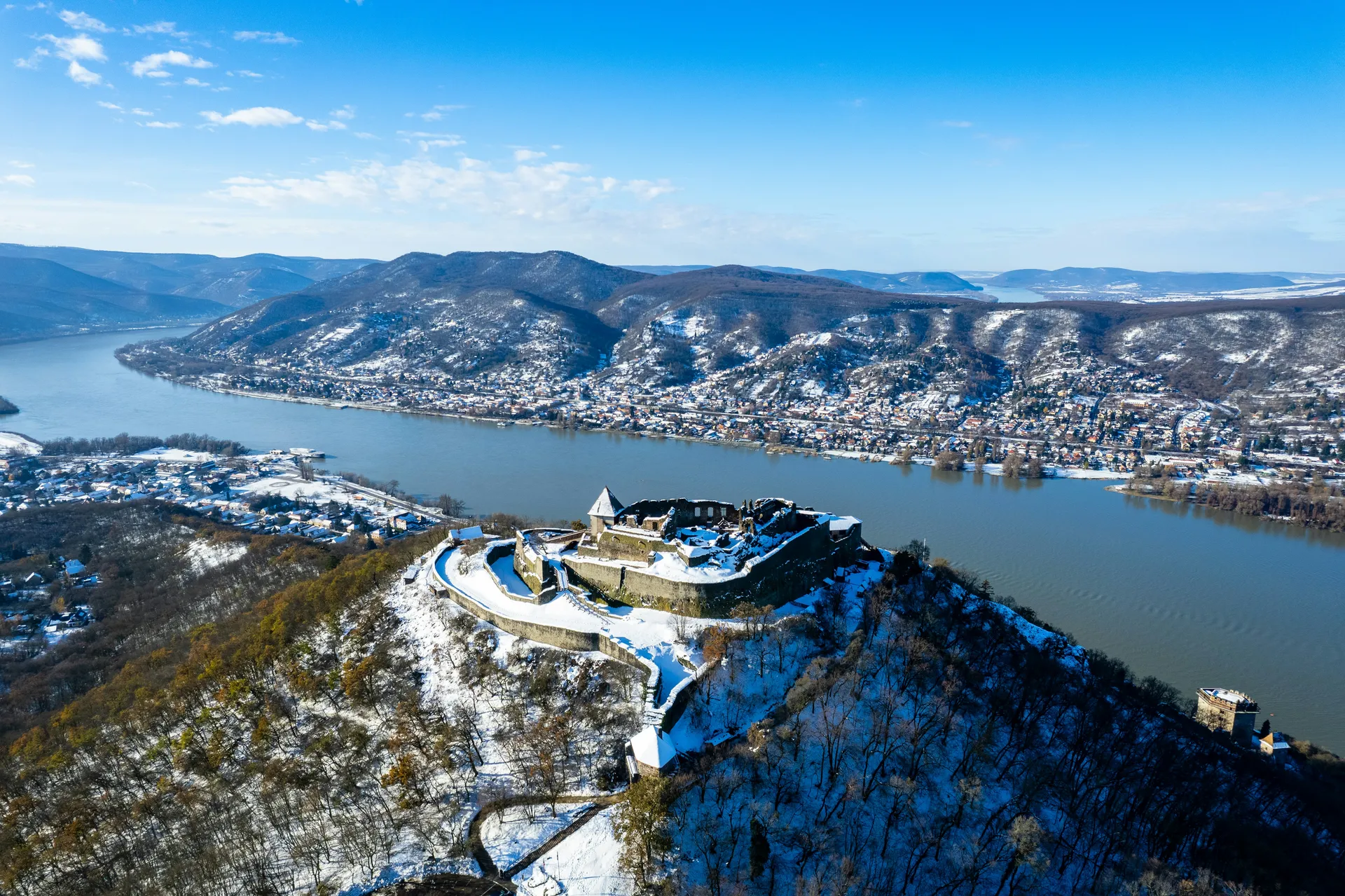
Where the Danube executes its most dramatic gesture in Hungary—a near-right-angle turn known as the Danube Bend—the small town of Visegrád commands the river from a hilltop citadel that has witnessed some of Central European history’s most pivotal moments. This settlement of barely 1,800 inhabitants belies its historical weight: Visegrád served as the seat of Hungarian royal power in the 14th and 15th centuries, hosted the summit that forged a medieval alliance still referenced in modern European politics, and sheltered the Hungarian Crown Jewels in its fortress tower for over two centuries.
The Upper Castle (Fellegvár), perched 328 meters above the Danube, offers panoramic views that rank among the finest on the entire river’s 2,850-kilometer course. From its battlements, the Danube Bend unfurls below in a sweeping curve of silver water flanked by forested hills that compress the river into a gorge before releasing it into the Hungarian plain. The citadel’s tower, where the Hungarian Holy Crown was kept from 1323 to 1529, has been restored to house exhibitions on medieval royal life and the castle’s military history. The climb to the top—whether by foot through the forest or by shuttle road—is rewarded with a panorama that makes the strategic importance of this site immediately, viscerally clear.
Below the castle, the ruins of the Royal Palace reveal the Renaissance magnificence that King Matthias Corvinus (1458–1490) brought to Visegrád. Matthias, the Renaissance king who made Hungary a European cultural power, built a palace here whose red marble fountains, heated floors, and hanging gardens were compared by contemporary visitors to those of Italian courts. The palace, destroyed during the Ottoman period and buried under landslides for centuries, has been partially excavated and reconstructed, offering a tantalizing glimpse of Central European Renaissance splendor. The famous Hercules Fountain—a red marble masterpiece—has been restored to working condition.
Visegrád’s setting within the Danube Bend region places it among Hungary’s most scenic natural areas. The Pilis Mountains, rising behind the town, are laced with hiking trails through oak and beech forests where red deer and wild boar roam. The Danube itself, wide and slow at this point, invites river excursions to the nearby artist colony of Szentendre—a town of baroque churches, Serbian Orthodox heritage, and galleries that has attracted painters since the early 20th century—and to Budapest, whose thermal baths, ruin bars, and grand Parliament building lie just 40 kilometers downstream.
Avalon Waterways includes Visegrád in its Danube itineraries, and the town’s combination of a commanding citadel, a Renaissance royal palace, and one of the Danube’s most photogenic stretches creates a port call that distills Hungarian history and natural beauty into a single, manageable experience. The town’s restaurants serve Hungarian classics—gulyás, töltött káposzta (stuffed cabbage), and lángos (fried dough with sour cream)—paired with wines from the nearby Etyek-Buda wine region. April through October offers the most pleasant weather, with autumn’s golden foliage adding an extra dimension to the already remarkable Danube Bend views.