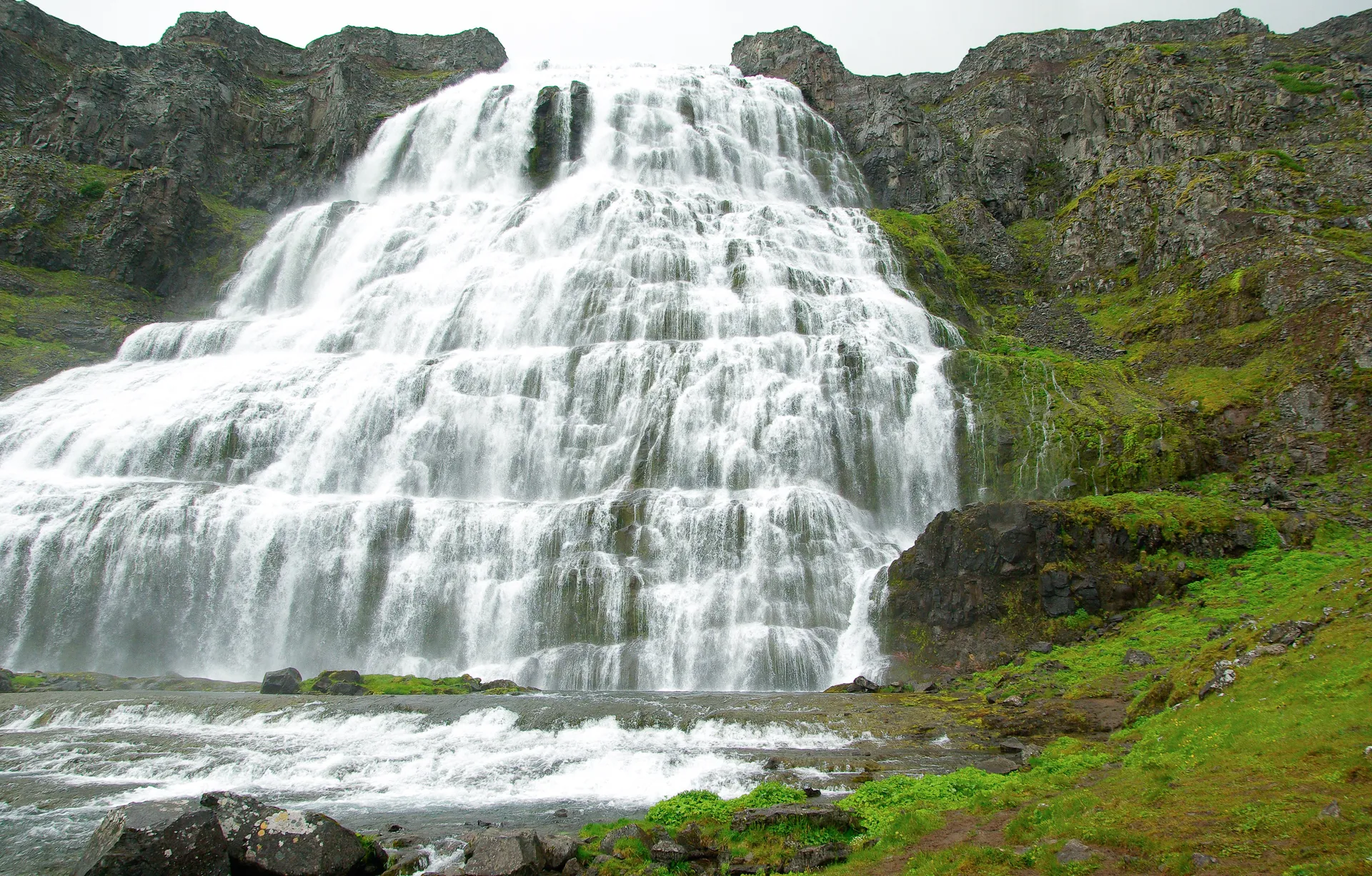
In the remote Westfjords of Iceland, where the landscape achieves a grandeur that makes the rest of the country seem almost tame by comparison, the Dynjandi waterfall cascades down a mountainside in a display of natural architecture that has been drawing awestruck travellers since the saga age. Often called the "jewel of the Westfjords," Dynjandi is not a single waterfall but a series of seven cascades, the largest and most dramatic of which tumbles approximately one hundred meters in a broad, bridal-veil formation that widens as it falls, creating a shape reminiscent of a vast, flowing wedding dress draped across the cliff face.
The approach to Dynjandi is an experience in itself. Whether arriving by ship through the Arnarfjordur — one of the largest and most spectacular fjords in Iceland — or by the winding gravel road that traces the fjord's southern shore, the waterfall reveals itself gradually, its thunder building as you draw closer. The surrounding landscape is classic Westfjords: treeless, wind-sculpted, with mountains rising steeply from the fjord to plateaus dusted with snow even in midsummer. The absence of trees — cleared by Viking settlers a thousand years ago — only amplifies the waterfall's visual impact, allowing it to dominate the entire mountainside.
The six smaller waterfalls below the main cascade each possess their own character and name — Hæstahjallafoss, Strompgljufrafoss, Gongufoss, Hrísvaðsfoss, Kvíslarfoss, and Hundafoss — creating a natural staircase of falling water that visitors ascend on a well-maintained trail. The walk from the base to the main waterfall takes approximately fifteen to twenty minutes, climbing through terrain carpeted with wildflowers in summer: Arctic thyme, moss campion, and the yellow buttercups that seem to appear wherever Icelandic water falls. The spray from the cascades creates localized microclimates where mosses and ferns thrive in luminous green profusion.
The broader Arnarfjordur region surrounding Dynjandi is one of Iceland's least-visited and most rewarding areas. The Westfjords peninsula, connected to the mainland by a narrow isthmus, contains only about seven thousand residents — making it one of the least densely populated regions in Europe. The old fishing village of Flateyri, nestled at the base of steep mountains on the opposite shore of the fjord, preserves the atmosphere of traditional Icelandic fishing communities. The red sand beach at Raudasandur, one of Iceland's most unusual coastal landscapes, stretches for kilometers along the southern coast of the Westfjords — a surreal ribbon of pink and gold sand in a country otherwise defined by black volcanic beaches.
Cruise ships anchor in the Arnarfjordur and tender passengers to a landing near the base of the waterfall trail. The visiting season extends from June to September, with July and August offering the most reliable weather and the most accessible trail conditions. Even in summer, the Westfjords can be cold, windy, and wet — waterproof clothing and sturdy footwear are essential. Dynjandi operates no visitor center and charges no admission fee — it remains, refreshingly, a place where nature presents itself without commercial mediation, offering one of Iceland's most powerful encounters between human insignificance and geological grandeur.

