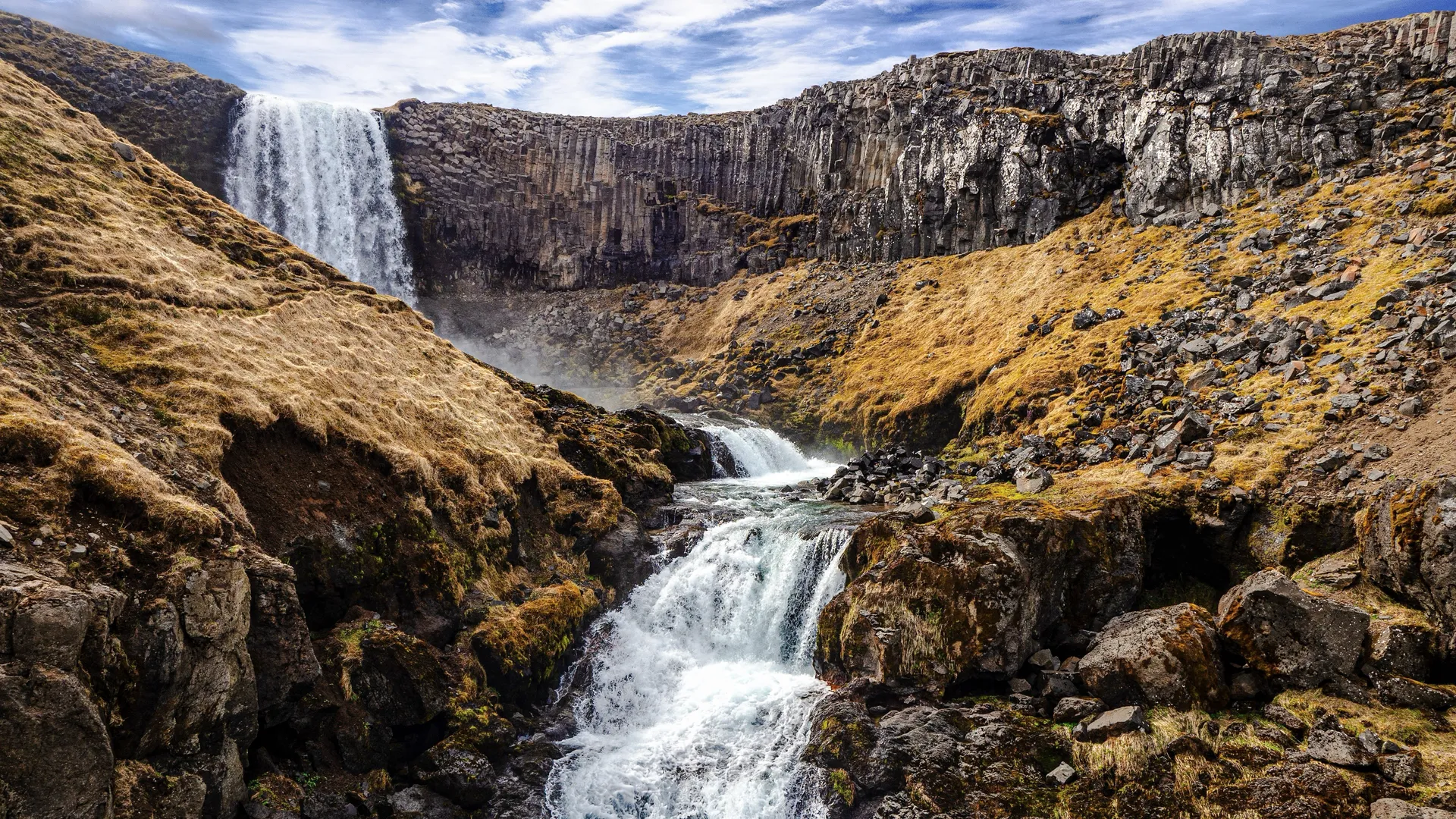
Jules Verne chose the glacier-capped volcano of Snaefellsjokull as the entry point for his Journey to the Centre of the Earth, and standing at the tip of the Snaefellsnes Peninsula on a clear day — with the glacier gleaming above, the North Atlantic stretching to infinity, and the black lava fields of Budir rolling to the shore — you understand why. This slender, 90-kilometer peninsula extending from Iceland's western coast has been called "Iceland in miniature," and the description is apt: within its modest dimensions, Snaefellsnes compresses virtually every landscape the country has to offer — volcanic craters, lava fields, bird cliffs, fishing villages, black sand beaches, and the luminous, otherworldly beauty that makes Iceland unlike anywhere else on Earth.
The peninsula's villages are linked by Route 54, a scenic road that circles the coastline past a succession of remarkable sites. Arnarstapi and Hellnar, twin fishing hamlets on the southern coast, are connected by a dramatic coastal trail that passes lava arches, columnar basalt formations, and sea caves alive with nesting fulmars and kittiwakes. Grundarfjordur, on the northern coast, sits below Kirkjufell — a symmetrical peak that has become the most photographed mountain in Iceland, particularly when the northern lights dance behind it. Stykkisholmur, the peninsula's largest town, is a charming settlement of colorful houses clustered around a natural harbor, with a water museum and excellent seafood restaurants.
The culinary traditions of western Iceland reflect the peninsula's maritime heritage. Freshly caught cod, haddock, and langoustine appear at restaurants throughout the region, prepared with the unfussy skill that characterizes modern Icelandic cooking. Dried fish (hardfiskur), torn into strips and eaten with butter, remains a traditional snack. The Bjarnarhofn Shark Museum offers the opportunity to taste hakarl — fermented shark, Iceland's most infamous delicacy — whose pungent ammonia aroma and oddly pleasant aftertaste divide visitors with reliable drama. Local lamb, raised on the wild herbs and grasses of the peninsula, is among the finest in Iceland.
The natural attractions along the peninsula's coastline are extraordinary in both number and variety. The Djupalonssandur black pebble beach, at the foot of Snaefellsjokull, preserves the rusted remains of a British trawler and four "lifting stones" once used to test the strength of would-be fishermen. The Londrangar basalt sea stacks, rising 75 meters from the ocean, are one of Iceland's most dramatic geological formations. The Raudfeldsgja gorge cuts deep into the mountain behind Arnarstapi, its narrow cleft accessible on foot for those willing to scramble over wet rocks. And at the peninsula's tip, the Snaefellsjokull glacier itself — visible from Reykjavik on clear days, 120 kilometers across the bay — crowns the dormant volcano with a cap of ice that has inspired myths, novels, and spiritual pilgrimages for centuries.
Expedition cruise ships anchor off the peninsula's coast, typically at Grundarfjordur or Stykkisholmur, with tender service to shore. The peninsula is also easily accessible by road from Reykjavik (approximately two hours to the eastern end). The visiting season extends from May to September, with June and July offering near-continuous daylight and the best chance of clear views of the glacier. September brings the possibility of northern lights and the dramatic autumn palette of the tundra. Weather on the peninsula is notoriously changeable — clear skies can turn to fog or rain within minutes — but this variability is part of the experience, constantly reshaping the landscape in new and unexpected ways.

