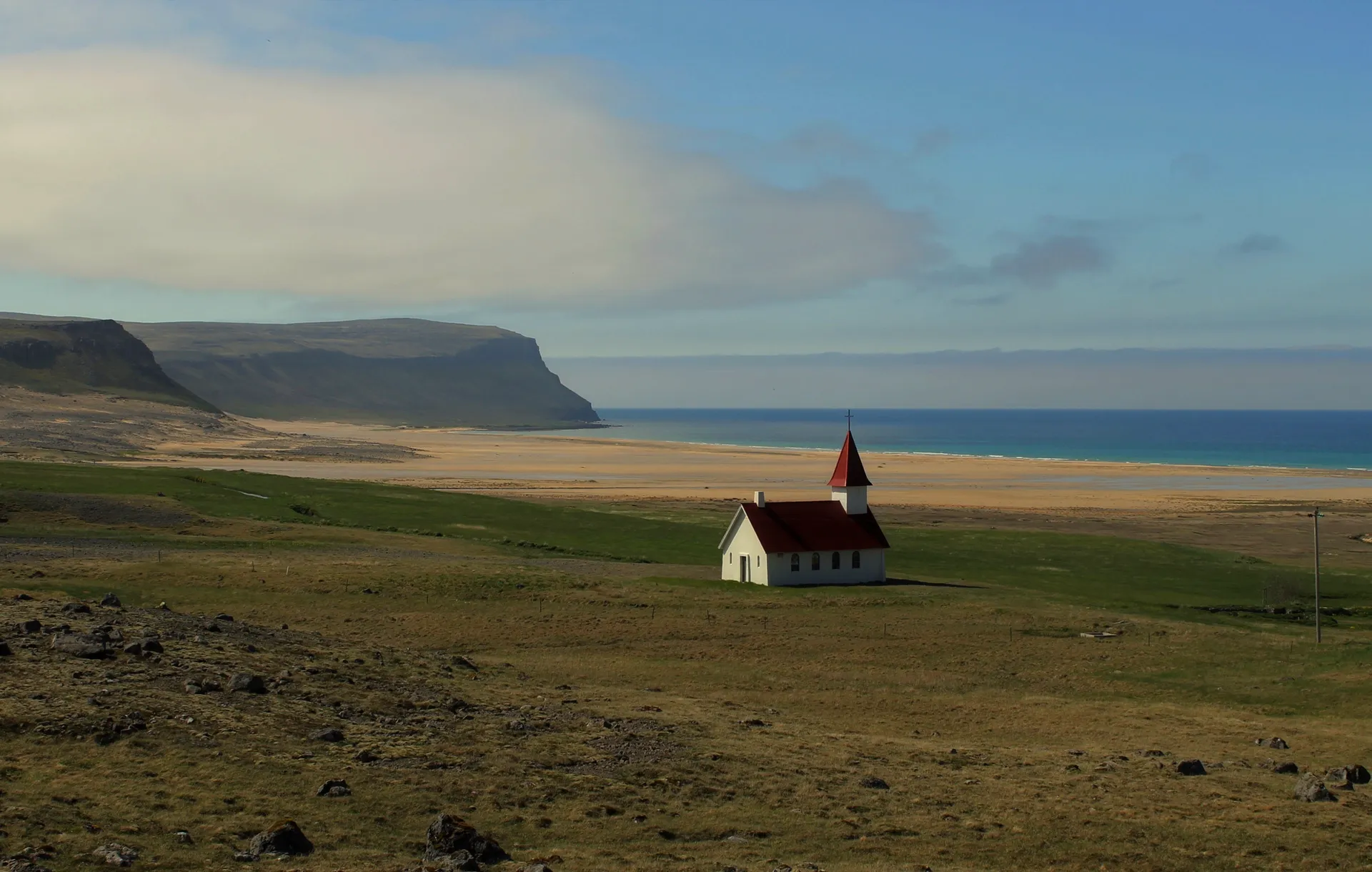
In Iceland’s northwestern extremity, connected to the mainland by a neck of land barely seven kilometers wide, the Westfjords peninsula juts into the Denmark Strait like a gnarled hand reaching toward Greenland. This is Iceland’s oldest geological region—basalt layers dating back 16 million years—and its least visited, home to barely 7,000 people scattered across fishing villages that cling to fjord shores beneath table mountains and sea cliffs of staggering proportion. The Westfjords are Iceland distilled to its essence: raw, remote, and magnificent.
The region’s crown jewel is Dynjandi, a waterfall that descends 100 meters over a series of increasingly wide cascades, creating a bridal-veil effect that has earned it the title of the most beautiful waterfall in Iceland—a significant distinction in a country that collects waterfalls the way other nations collect churches. The hike to the base passes six smaller waterfalls, each with its own character, and the acoustic effect of the main fall—a thunderous white-noise generator echoing off the surrounding cliffs—creates an atmosphere of natural cathedral. The Látrabjarg cliffs, Europe’s largest bird cliff at 14 kilometers long and 441 meters high, host millions of nesting seabirds including puffins so accustomed to human presence that they can be observed from arm’s length.
The Westfjords’ fjords are deeper, narrower, and more dramatically enclosed than those of eastern Iceland. Ísafjörður, the region’s largest town (population 2,600), occupies a spit of flat land at the head of a fjord surrounded by steep mountains that receive among Iceland’s heaviest snowfall. The town’s Heritage Museum, housed in one of Iceland’s oldest buildings, and its Old Hospital cultural center anchor a surprisingly vibrant arts scene. Bolungarvík, a fishing village nearby, preserves an outdoor maritime museum (Osvaldur) with original turf-and-stone fishing huts that illustrate the extreme conditions under which Westfjords fishermen operated for centuries.
The region’s culinary traditions are rooted in preservation techniques born of necessity. Hákarl (fermented shark), dried fish (hardfiskur), and smoked lamb have sustained Westfjords communities through dark winters for over a millennium. Modern restaurants in Ísafjörður and the surrounding villages have begun reinterpreting these traditions, pairing fresh-caught Arctic char and langoustines with foraged herbs and seaweed in dishes that honor the landscape without romanticizing its harshness. The region’s remoteness means ingredients are hyper-local—everything comes from the fjords, the mountains, or the sea.
Lindblad Expeditions ventures to the Westfjords, and the expedition format suits the region perfectly: the coast’s irregular geography, lack of port infrastructure, and abundance of wildlife (seals, whales, Arctic foxes, seabirds) reward the flexibility of expedition-style itineraries using Zodiacs for shore landings. The Westfjords are accessible from June through August, when the midnight sun illuminates the fjords in perpetual golden light and the roads—many unpaved, some requiring river crossings—are passable. This narrow window of accessibility is part of the Westfjords’ appeal: to visit is to earn the experience, and what is earned is nothing less than Iceland at its most honest and overwhelming.

