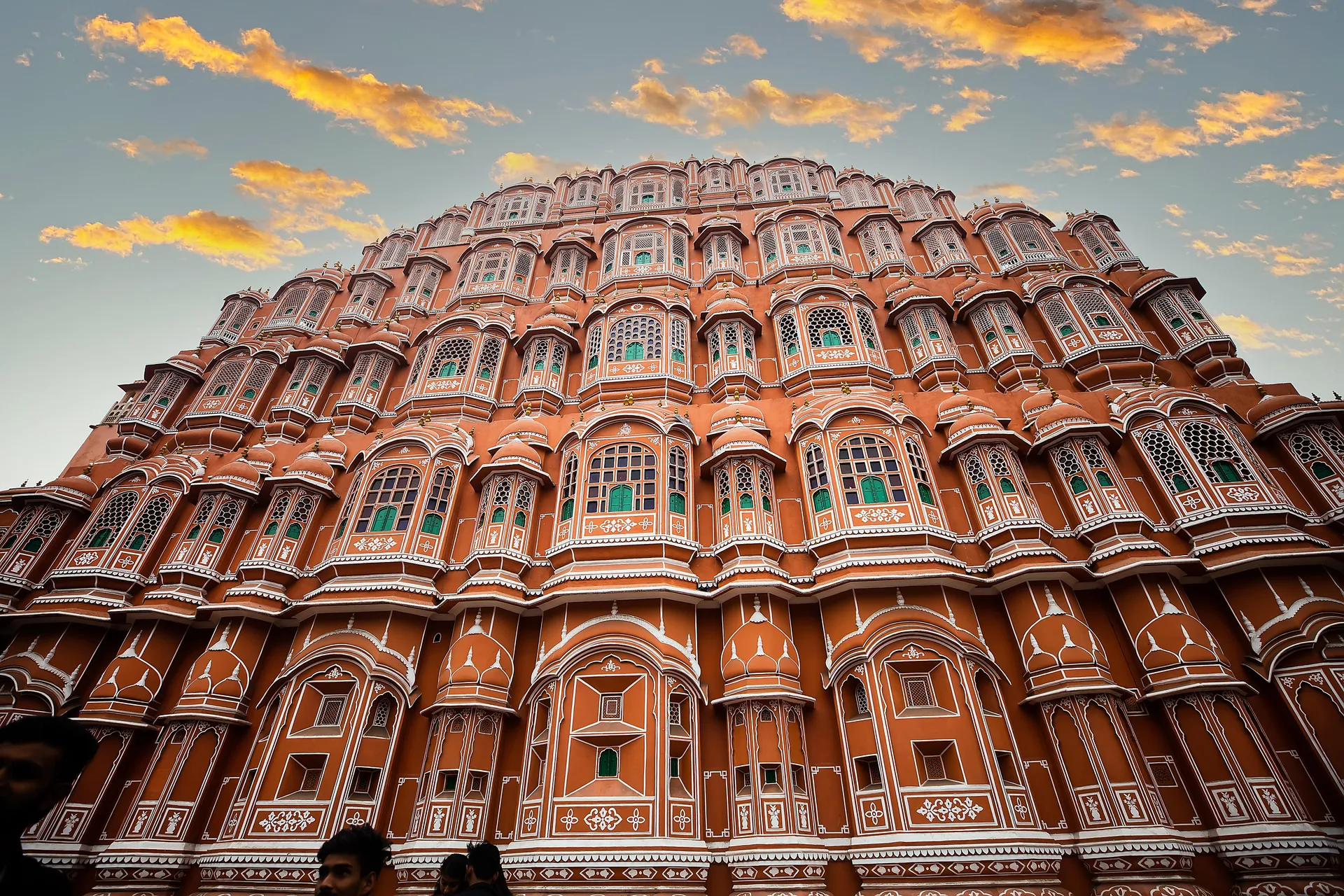
In 1727, Maharaja Sawai Jai Singh II did something no Indian ruler had attempted before: he built a city from scratch according to the principles of Vastu Shastra, the ancient Hindu science of architecture and spatial geometry. The result was Jaipur, a grid-planned marvel of wide avenues, coordinated building heights, and public squares that astonished European visitors accustomed to the organic chaos of most Asian cities. When the Prince of Wales visited in 1876, the entire city was painted pink — the colour of hospitality in Rajasthani tradition — and the name stuck. The Pink City remains one of India's most visually coherent urban experiences, a place where the terracotta-rose facades of the old quarter create a unified streetscape that is both monumental and intimately human.
The Amber Fort, perched on a ridge above Maota Lake 11 kilometres north of the city, is the masterpiece of Rajput military and decorative architecture. Its honey-coloured sandstone walls and red limestone battlements conceal palace chambers of extraordinary refinement: the Sheesh Mahal, or Hall of Mirrors, is encrusted with convex glass fragments that transform a single candle flame into a galaxy of reflected light. The elephant ride up the cobblestone ramp to the fort entrance — controversial though it has become — recalls the processions of maharajas who ascended this path for centuries. Within the city walls, the Hawa Mahal, or Palace of Winds, presents its iconic facade of 953 pink sandstone windows to the main bazaar, designed so that the women of the royal court could observe street life without being seen — an architectural solution to the practice of purdah that is both ingenious and melancholy.
Jaipur's bazaars are among the most rewarding shopping experiences in India. Johari Bazaar specialises in the precious and semi-precious stones for which Jaipur is the world capital — emeralds, rubies, and sapphires are cut, polished, and set by gem traders whose families have practised the craft for generations. Bapu Bazaar overflows with block-printed textiles, blue pottery, lacquered bangles, and the miniature paintings that continue a Rajasthani artistic tradition dating to the Mughal courts. The food markets serve Rajasthani specialities that are unlike anything found elsewhere in India: dal baati churma — hard wheat rolls dipped in ghee and served with lentil soup and a sweet crumble — and laal maas, a fiery red meat curry that is the carnivore's answer to Rajasthan's largely vegetarian cuisine.
Beyond the city, the arid landscape of eastern Rajasthan offers compelling excursions. The Nahargarh Fort, crowning the Aravalli Hills above Jaipur, provides sunset views across the entire Pink City and the desert plains beyond. The Jal Mahal, a pleasure palace appearing to float in the middle of Man Sagar Lake, is one of India's most photographed monuments. Further afield, the abandoned Mughal city of Fatehpur Sikri and the incomparable Taj Mahal at Agra are accessible on overnight excursions, connecting Jaipur to the broader "Golden Triangle" circuit that also includes Delhi.
Jaipur is accessible on Uniworld River Cruises Indian itineraries as an overland excursion component paired with Ganges river cruising. The most comfortable visiting season is October through March, when temperatures are pleasant and the monsoon rains have washed the landscape green. The Jaipur Literature Festival in January and the Elephant Festival during Holi in March bring additional cultural energy to an already vibrant city.

