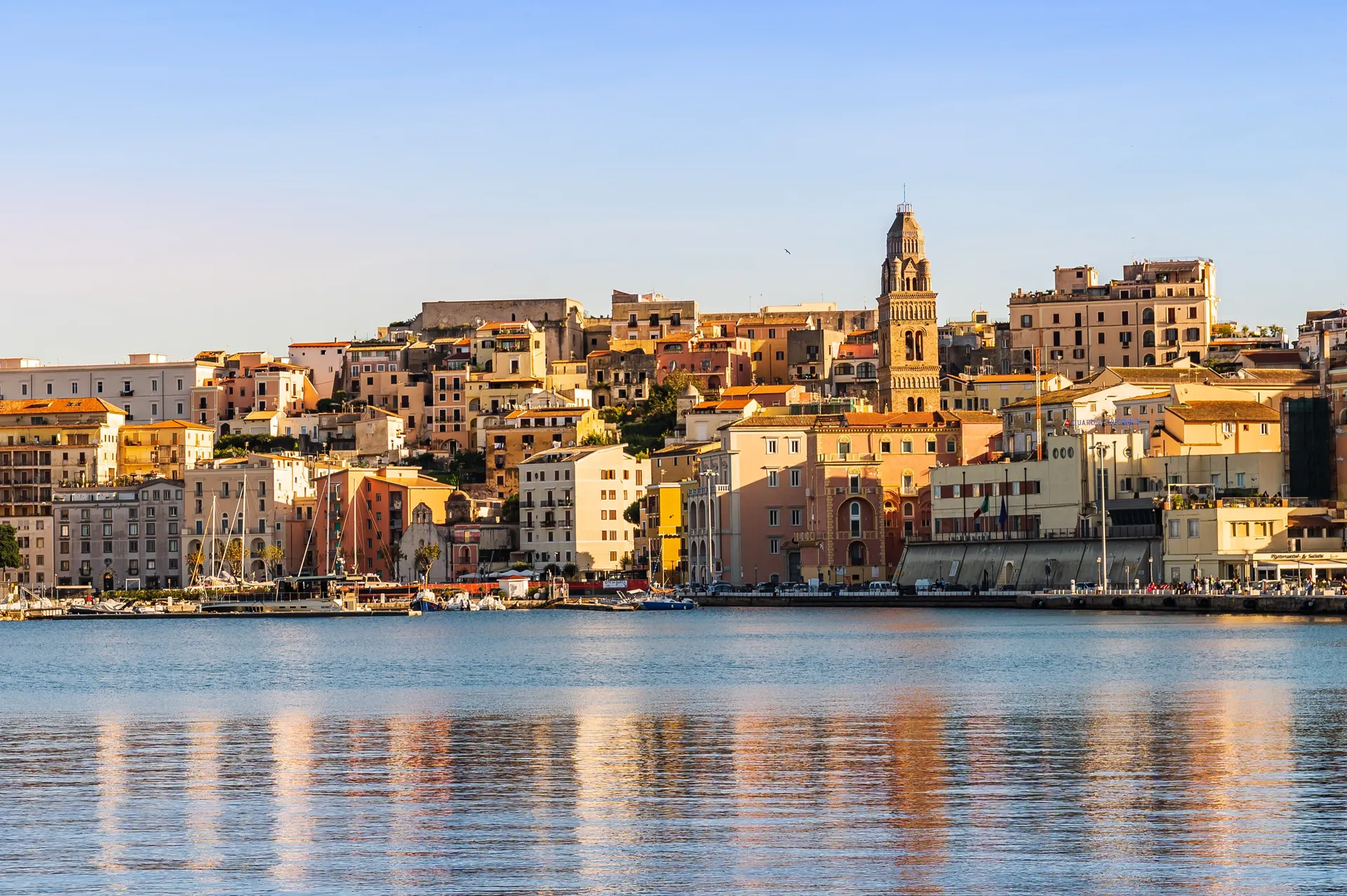
Gaeta occupies one of the most strategically coveted positions on the Tyrrhenian coast — a fortified promontory thrusting into the sea between Rome and Naples that has attracted conquerors, popes, and admirals for over two millennia. The ancient Romans valued it as a port; Emperor Antoninus Pius built a villa here; the medieval Duchy of Gaeta was one of the earliest independent maritime states in Italy; and the Bourbon kings of Naples made the Fortress of Gaeta their last redoubt, holding out against Garibaldi's forces until February 1861 in one of the final acts of Italian unification. This layered history has left Gaeta with a density of architectural and cultural interest that belies its modest population of 20,000.
The old town of Gaeta — the medieval quarter clinging to the Monte Orlando promontory — is a vertical labyrinth of narrow lanes, stone stairways, and vaulted passages that climb from the harbour to the Aragonese-Angevin castle at the summit. The Cathedral of Saints Erasmus and Marcian, built in the 12th century with a soaring Romanesque bell tower decorated with ceramic plates in the Arab-Norman style, contains the Column of the Flagellation — a relic purported to be the pillar to which Christ was bound, displayed in a crypt whose atmosphere oscillates between reverence and medieval wonder. The Sanctuary of the Montagna Spaccata (Split Mountain) — a natural cleft in the rock face of Monte Orlando, according to legend created by the earthquake that followed the Crucifixion — is accessed by a stairway carved into the cliff, its walls touching at points so narrow that the light enters only from above.
The seafood cuisine of Gaeta has been shaped by centuries of fishing in the rich Tyrrhenian waters. Tiella gaetana — a double-crusted pie filled with octopus, olives, tomatoes, and capers — is the town's signature dish, baked in wood-fired ovens and sold at bakeries throughout the old town. Gaeta olives, a small, wrinkled variety cured in brine and prized for their intense, slightly bitter flavour, have been exported across the Mediterranean since Roman times and remain the region's most celebrated agricultural product. The port-side restaurants serve the day's catch with the simplicity that characterises the best Italian coastal cooking — grilled orata (sea bream), spaghetti alle vongole, and the fritto misto that appears on every Tyrrhenian menu but tastes best where the fishing boats unload their nets within sight of the kitchen.
The coastline around Gaeta offers beaches of surprising beauty for a stretch of coast so close to Rome and Naples. Serapo Beach, a wide crescent of golden sand beneath the old town walls, is the most accessible, while the Ariana Beach — reached by a short drive along the coast — provides softer sand and calmer waters. Monte Orlando Nature Park, occupying the wooded promontory above the town, offers hiking trails through Mediterranean maquis to gun emplacements from both world wars and viewpoints overlooking the Pontine Islands — Ponza, Ventotene, and the distant outline of Ischia — floating on the Tyrrhenian horizon.
Gaeta is visited by Emerald Yacht Cruises on Mediterranean itineraries, with vessels docking in the town harbour. The most pleasant visiting season runs from April through October, with May, June, and September offering warm temperatures, swimworthy seas, and the luminous coastal light without the intense heat and crowds of July and August.

