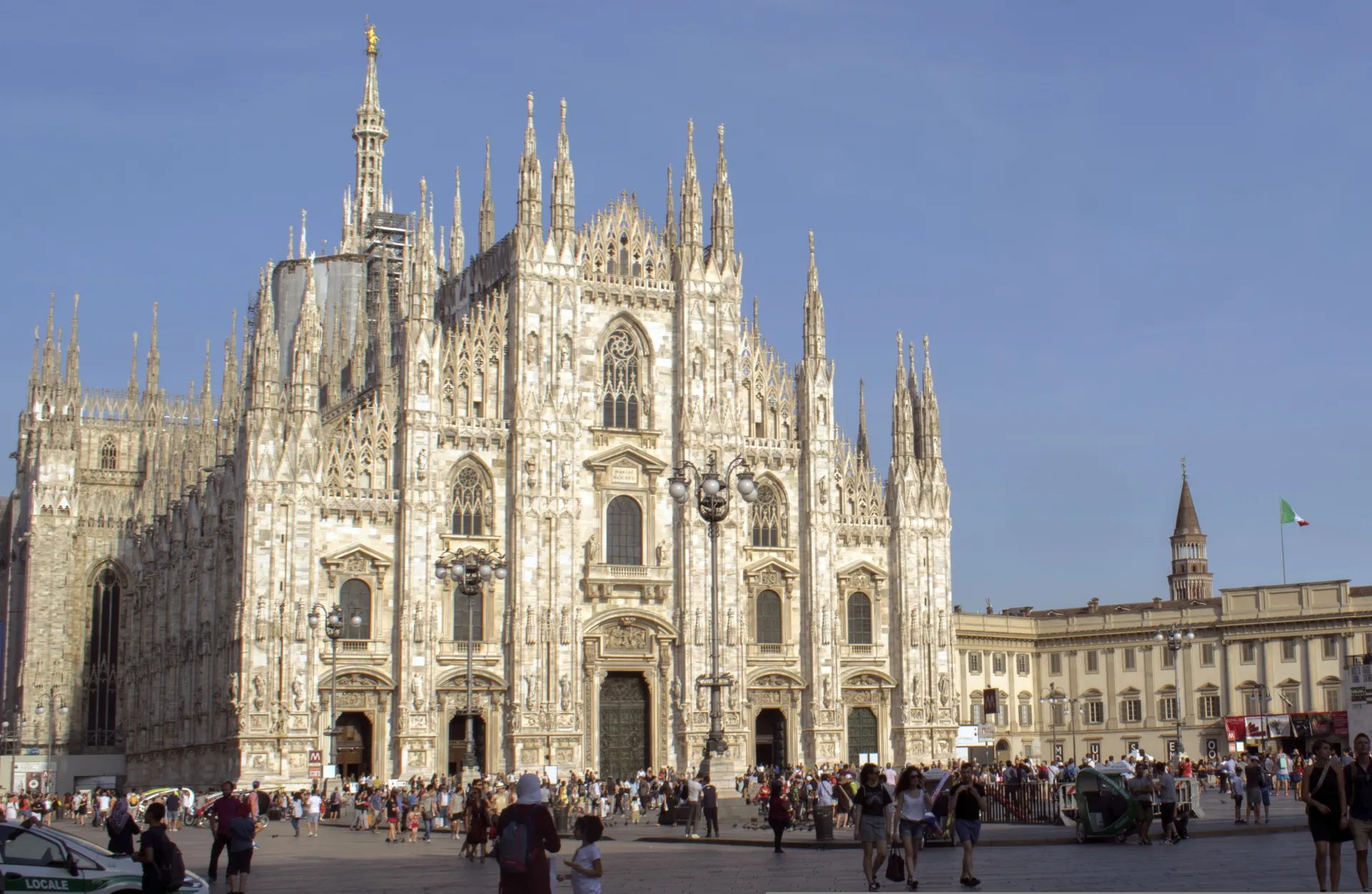
Milan is Italy's engine—the financial, fashion, and design capital of the nation, a city that has always looked forward while the rest of the country savored the past. But Milan's modernity is built on a foundation of extraordinary historical depth: Leonardo da Vinci's The Last Supper, painted on the refectory wall of Santa Maria delle Grazie between 1495 and 1498, is here. The Duomo, a Gothic cathedral of white Carrara marble whose construction began in 1386 and wasn't completed until 1965, is the largest church in Italy and one of the most complex buildings ever created—its rooftop forest of 135 spires and 3,400 statues can be walked upon, providing a view that stretches to the Alps on clear days.
The city's character is cosmopolitan, efficient, and design-conscious in a way that distinguishes it from the more languid rhythm of Rome or Florence. The Quadrilatero della Moda—the fashion district bounded by Via Montenapoleone, Via della Spiga, Via Manzoni, and Corso Venezia—is the global epicenter of luxury fashion, where Prada, Armani, Versace, and Dolce & Gabbana maintain their flagship stores in palazzi of understated elegance. The Galleria Vittorio Emanuele II, a cruciform shopping arcade of iron and glass completed in 1877, is both a functioning luxury mall and an architectural masterpiece—its mosaic floors, painted ceilings, and soaring glass dome create one of the most beautiful interior public spaces in Europe.
Milanese cuisine is sophisticated, butter-rich, and distinct from the olive-oil-based cooking of southern Italy. Risotto alla milanese, made with saffron that tints the rice a vivid gold, is the city's signature primo—a dish of deceptive simplicity that requires twenty minutes of patient stirring and the finest carnaroli rice. Ossobuco, a cross-cut veal shank braised with white wine and vegetables and topped with gremolata (lemon zest, garlic, and parsley), is the traditional accompaniment—together, they form one of the great pairings in Italian gastronomy. Cotoletta alla milanese, a breaded veal cutlet fried in butter, predates the Viennese Wiener Schnitzel (a matter of enduring culinary dispute between the two cities). The pasticcerie of Milan—particularly Marchesi and Cova—produce pastries and confections that reflect the city's connection to Viennese and French traditions.
Beyond the headline attractions, Milan rewards deeper exploration. The Pinacoteca di Brera, the city's principal art gallery, houses one of Italy's finest collections—Raphael's Marriage of the Virgin, Mantegna's Dead Christ, and Caravaggio's Supper at Emmaus among its masterpieces. The Navigli district, centered on the canals that Leonardo da Vinci helped engineer in the fifteenth century, has become Milan's liveliest neighborhood for evening dining and drinking—the aperitivo tradition, in which the price of a cocktail includes access to an elaborate buffet of food, reaches its most generous expression along these canals. The Fondazione Prada, in a converted distillery complex, mounts contemporary art exhibitions of international significance.
Milan is served by three airports (Malpensa, Linate, and Bergamo) and is Italy's primary rail hub, with high-speed connections to Rome (three hours), Florence (two hours), and Venice (two and a half hours). The city is best visited in spring (April–May) and autumn (September–October), when the weather is mild and the fashion weeks (February/March and September/October) add creative energy. Summer can be hot and many locals depart for the coast or mountains. Winter brings the opera season at La Scala—securing a ticket to a performance at this legendary theater is one of the great cultural experiences available in Italy.

