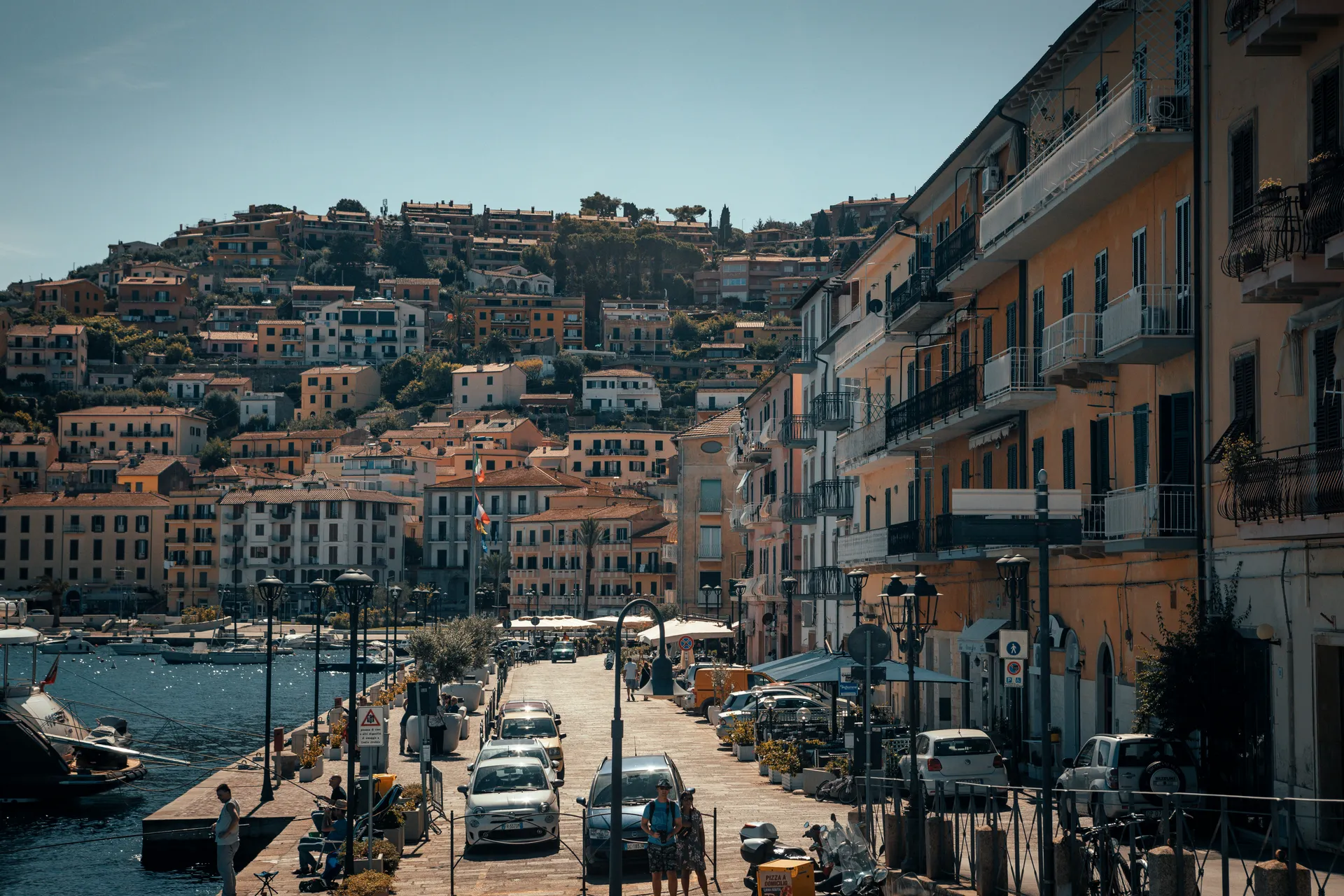
Where the Monte Argentario peninsula connects to the Tuscan mainland by three slender sand tomboli, Porto Santo Stefano gazes across a lagoon of extraordinary beauty toward its twin town of Porto Ercole. Together, they form the Argentario — one of the most coveted stretches of Italian coastline, a place where Roman emperors once kept villas and where, today, the Italian elite moor their yachts alongside weathered fishing boats in a harbor that has barely changed since Caravaggio arrived here, fleeing a murder charge, in the summer of 1610. The town climbs steeply from its crescent port up a hillside of pastel-colored houses, their shutters thrown open to catch the Tyrrhenian breeze.
Porto Santo Stefano possesses the unhurried elegance of a working Italian port town that happens to be extraordinarily beautiful. The Lungomare dei Navigatori, the waterfront promenade, is the stage for the evening passeggiata — families, couples, and solitary fishermen processing along the harbor as the sun drops behind the island of Giglio. The Spanish Fortress, built in the sixteenth century when the Argentario was a strategic prize contested by Spain, France, and the Papal States, now houses a museum of underwater archaeology displaying amphorae and anchors recovered from Roman shipwrecks. The upper town, reached by narrow stepped alleys fragrant with jasmine and bougainvillea, reveals a church-dotted hilltop where the views extend to the islands of Giglio and Giannutri — and, on crystalline days, to the mountains of Corsica.
The cuisine of Porto Santo Stefano is Tyrrhenian seafood at its most sublime. Caldaro dell'Argentario, a fish stew of the local fishermen, simmers whatever the morning catch delivered — red mullet, scorpionfish, squid, mussels — in a broth of tomato, white wine, and wild fennel. The town's ristoranti and trattorias, many perched above the harbor with tables extending over the water, serve crudo di pesce (raw fish platters) that rival anything on the Amalfi Coast without the crowds or the prices. Pair with a glass of Morellino di Scansano, the robust red from vineyards just inland, or the crisp Vermentino that is the Maremma's white wine of choice. For provisions, the morning market on the harbor sells focaccia al formaggio, porchetta panini, and the dense, almond-studded biscotti of the Maremma.
The Monte Argentario peninsula rewards exploration by boat, bicycle, or on foot. The Strada Panoramica, a winding road that circuits the promontory, opens vertiginous views over hidden coves accessible only by sea — Cala del Gesso, Cala Grande, and the jewel-like Cala Piccola, where the water achieves a turquoise luminosity that defies the Mediterranean's reputation for overexposure. The island of Giglio, a forty-minute ferry ride from Porto Santo Stefano, offers unspoiled hiking trails, a medieval hilltop castello, and some of the clearest diving waters in Italy. Giannutri, smaller and wilder, harbors the ruins of a Roman villa and an underwater marine reserve. Back on the mainland, the Maremma Natural Park — Tuscany's wildest coastline — stretches south toward the thermal springs of Saturnia.
Porto Santo Stefano is the principal port of the Argentario, receiving cruise tenders and ferries to the islands. It lies approximately 150 kilometers northwest of Rome (two hours by car) and 200 kilometers south of Florence. The summer months of June through September bring peak yacht traffic and warm swimming waters, while May and October offer mild weather, fewer visitors, and the full intensity of local life — fishing boats heading out at dawn, the market in full swing, trattorias serving only to those who know to ask what's fresh.

