Perched 350 metres above the Amalfi Coast on a mountain terrace that seems to float between sky and sea, Ravello has been intoxicating visitors since the 13th century, when the Rufolo family — wealthy merchants who traded across the Mediterranean — built a palace whose gardens so enchanted Richard Wagner that he declared, "The magic garden of Klingsor has been found." That garden, cascading in terraces of Mediterranean pine, roses, and wisteria toward a view of the Tyrrhenian Sea so vast that it curves at the edges, became the inspiration for the second act of Parsifal — and Ravello has never recovered from the compliment. A century and a half later, the annual Ravello Festival still stages performances of Wagner on an open-air platform suspended above the same precipice that moved the composer to ecstasy.
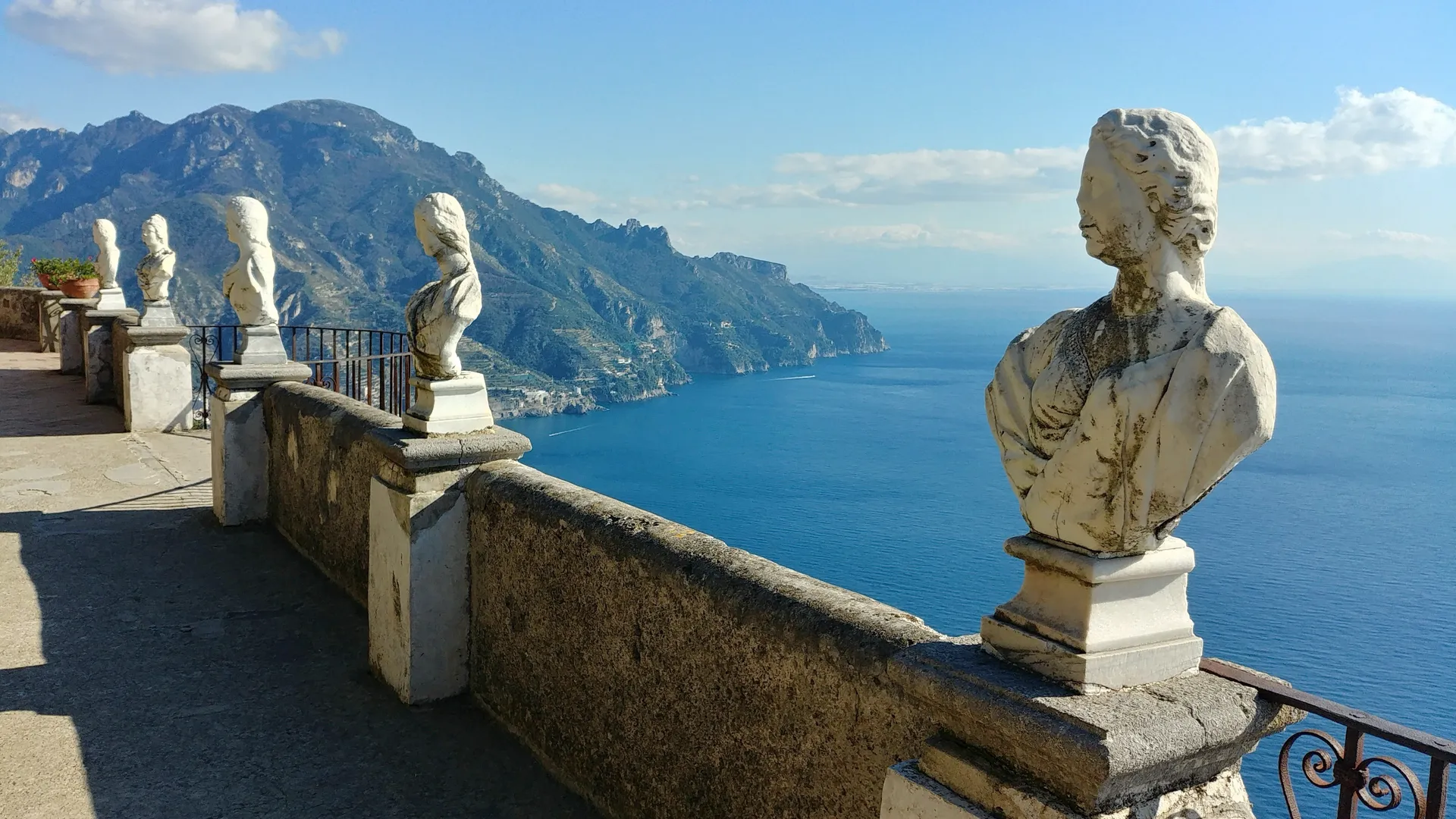
The town itself is impossibly refined — a small constellation of medieval palazzi, Romanesque churches, and artisan workshops connected by stone paths that wind through lemon groves and bougainvillea-covered pergolas. The Duomo, founded in 1086 and dedicated to the town's patron San Pantaleone, contains a 13th-century ambo (pulpit) decorated with Persian-influenced mosaics of birds, lions, and peacocks in gold, blue, and green — one of the masterpieces of medieval Southern Italian art. The Villa Cimbrone, at the eastern edge of the town, culminates in the Terrace of Infinity — a belvedere lined with 18th-century marble busts where the view plunges straight down to the coast through empty air, a panorama that Gore Vidal, who lived in Ravello for decades, called "the most beautiful in the world."
Ravello's restaurant scene, though necessarily compact, achieves a level of refinement that reflects the town's long association with artists, composers, and literary figures. Local produce from the terraced gardens — San Marzano tomatoes, buffalo mozzarella from the Lattari Mountains, lemons the size of softballs whose zest perfumes everything from pasta to pastry — forms the foundation of a cuisine that is both deeply traditional and subtly elegant. Scialatielli ai frutti di mare, fresh flat pasta with shellfish, is a regional classic, while delizia al limone — a dome of lemon-soaked sponge filled with lemon cream — is the coast's most beloved dessert. The local limoncello, made from the enormous sfusato amalfitano lemons that grow on every terrace, is best sipped cold on a garden terrace as the evening light turns the sea from blue to copper.
The position of Ravello high above the coast provides a base for exploring the entire Amalfi peninsula. The mountain roads connecting Ravello to Amalfi and Atrani descend through hairpin turns that offer glimpses of the coast framed by chestnut and lemon trees. The town of Amalfi itself, once a maritime republic that rivalled Venice, preserves an Arab-Norman cathedral and the ancient paper mills that produced the finest writing paper in medieval Europe. Positano, with its cascade of pastel houses falling toward a beach of dark volcanic sand, lies further west along a road of legendary beauty and terror.
Ravello is visited by Tauck on Amalfi Coast itineraries, typically as an excursion from Salerno or Naples. The most enchanting time to visit is late May through June, when the wisteria is in bloom, the lemon groves are heavy with fruit, and the Ravello Festival performances begin on the clifftop stage — or September, when the summer crowds have thinned and the Mediterranean light takes on the golden warmth that makes the Amalfi Coast one of Italy's most painted landscapes.

