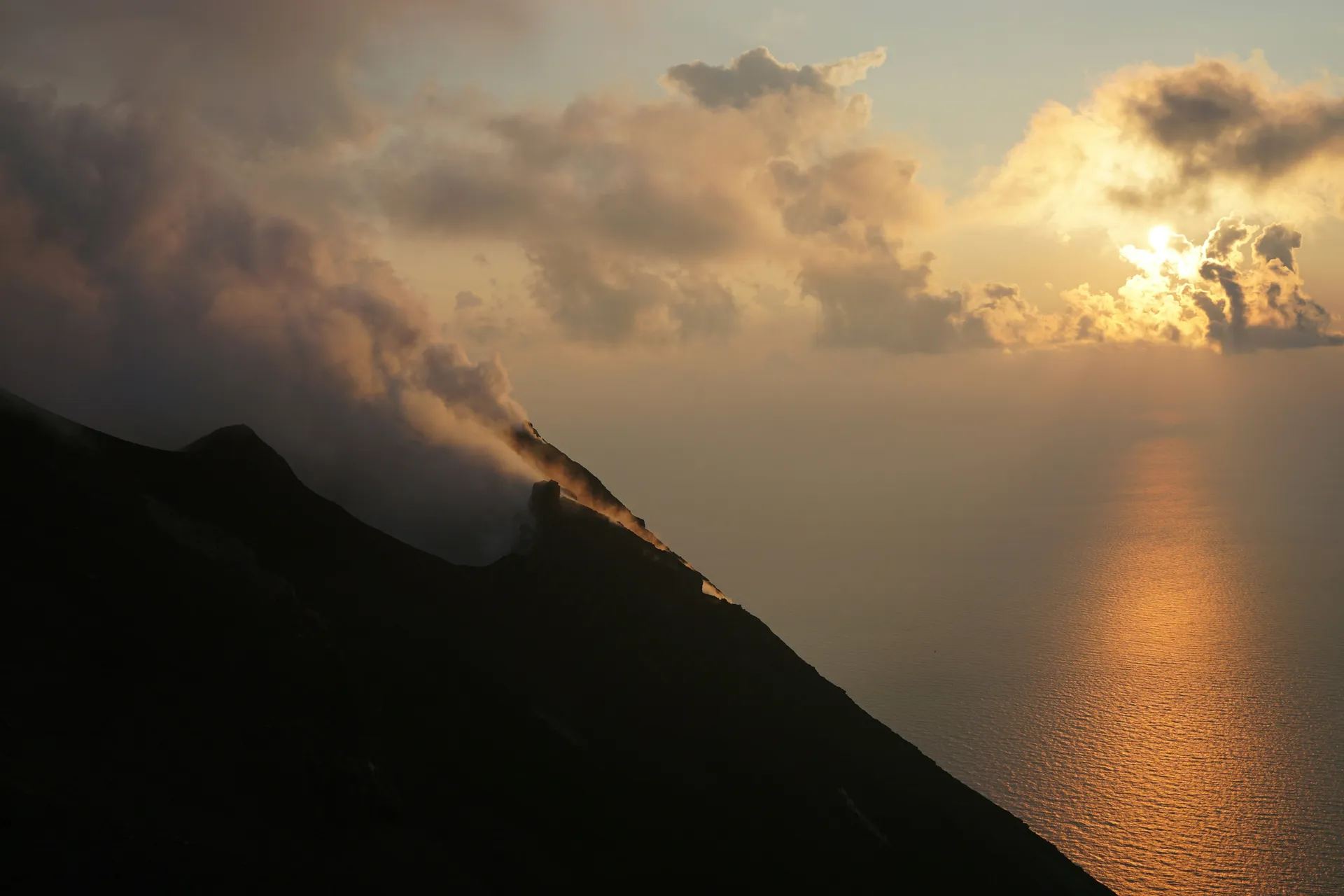
Stromboli has been erupting continuously for at least two thousand years — a feat of geological stamina that has earned it the nickname "Lighthouse of the Mediterranean." This conical volcanic island, the northernmost of the Aeolian archipelago off Sicily's northeastern coast, rises 924 meters from the Tyrrhenian Sea to a summit that belches incandescent lava, glowing rocks, and ash plumes with a regularity so dependable that ancient mariners used it for navigation. To watch Stromboli erupt from the deck of a ship at night — orange fountains of molten rock arcing against a sky of stars — is one of the Mediterranean's most primordial spectacles.
The island's human community is small, beautiful, and defiantly resilient. The whitewashed village of Stromboli, clustered on the island's northeastern slope, is a maze of narrow lanes, bougainvillea-draped walls, and volcanic-stone houses that have been rebuilt after eruptions, earthquakes, and tidal waves with the stubbornness that defines island life. The village of Ginostra, on the western slope, is even smaller — accessible only by sea, it has the smallest harbor in the world: a single mooring point carved into the volcanic rock. Life here moves to rhythms dictated by the volcano: the mountain is not feared so much as respected, an ever-present neighbor whose rumblings are as familiar to the islanders as birdsong.
The cuisine of Stromboli is Aeolian at its most elemental. Capers, gathered from the volcanic hillsides and salt-cured in the Aeolian tradition, flavor everything from pasta to salads to the local pane cunzato (seasoned bread topped with tomatoes, anchovies, and olive oil). Swordfish and tuna, caught in the rich Tyrrhenian waters, are grilled simply and served with lemon. Malvasia delle Lipari, the amber dessert wine produced across the Aeolian Islands from sun-dried grapes, is the perfect accompaniment to a plate of almond granita and brioche — the traditional Sicilian breakfast that has migrated to every island in the chain. Evening meals on Stromboli's restaurant terraces, with the volcano's glow reflecting off the sea, define the concept of dining with a view.
The summit hike — a demanding ascent to the Sciara del Fuoco viewpoint at roughly 400 meters, or the full summit at 924 meters (when conditions permit and with a certified guide) — is the island's signature experience. From the Sciara del Fuoco, the volcano's active vent is visible as a hellish amphitheater of glowing lava and flying rocks, the explosions occurring every fifteen to twenty minutes with a regularity that is both reassuring and terrifying. For those who prefer to observe from sea level, evening boat trips circle the island to view the Sciara del Fuoco from offshore, where the molten lava sliding down the volcano's face hisses as it meets the Mediterranean.
Ponant, Star Clippers, and Windstar Cruises include Stromboli on their Aeolian Islands and Tyrrhenian Sea itineraries, with ships typically anchoring off the village and tendering passengers to shore. The island's lack of large-scale infrastructure makes it particularly suited to smaller vessels. The best time to visit is May through October, when calm seas and clear skies provide the optimal conditions for both the summit hike and the dramatic nighttime eruption viewing that is Stromboli's eternal spectacle.

