Taranto occupies a position of almost mythic significance in the story of the western Mediterranean: founded by Spartan colonists in 706 BC as Taras, it became the wealthiest and most powerful city in Magna Graecia, rivalling Athens itself in cultural sophistication. The city's name gave us "tarantula" (after a local wolf spider) and "tarantella" (the frenzied dance believed to cure its bite), and its harbour witnessed one of history's most consequential naval engagements when the Royal Navy's daring 1940 torpedo attack on the Italian fleet at anchor — the Battle of Taranto — demonstrated that aircraft carriers had rendered battleships obsolete, a lesson studied carefully by the Japanese before Pearl Harbor. Cruise lines including Costa Cruises, P&O Cruises, and Windstar Cruises bring passengers to a city undergoing a remarkable renaissance.
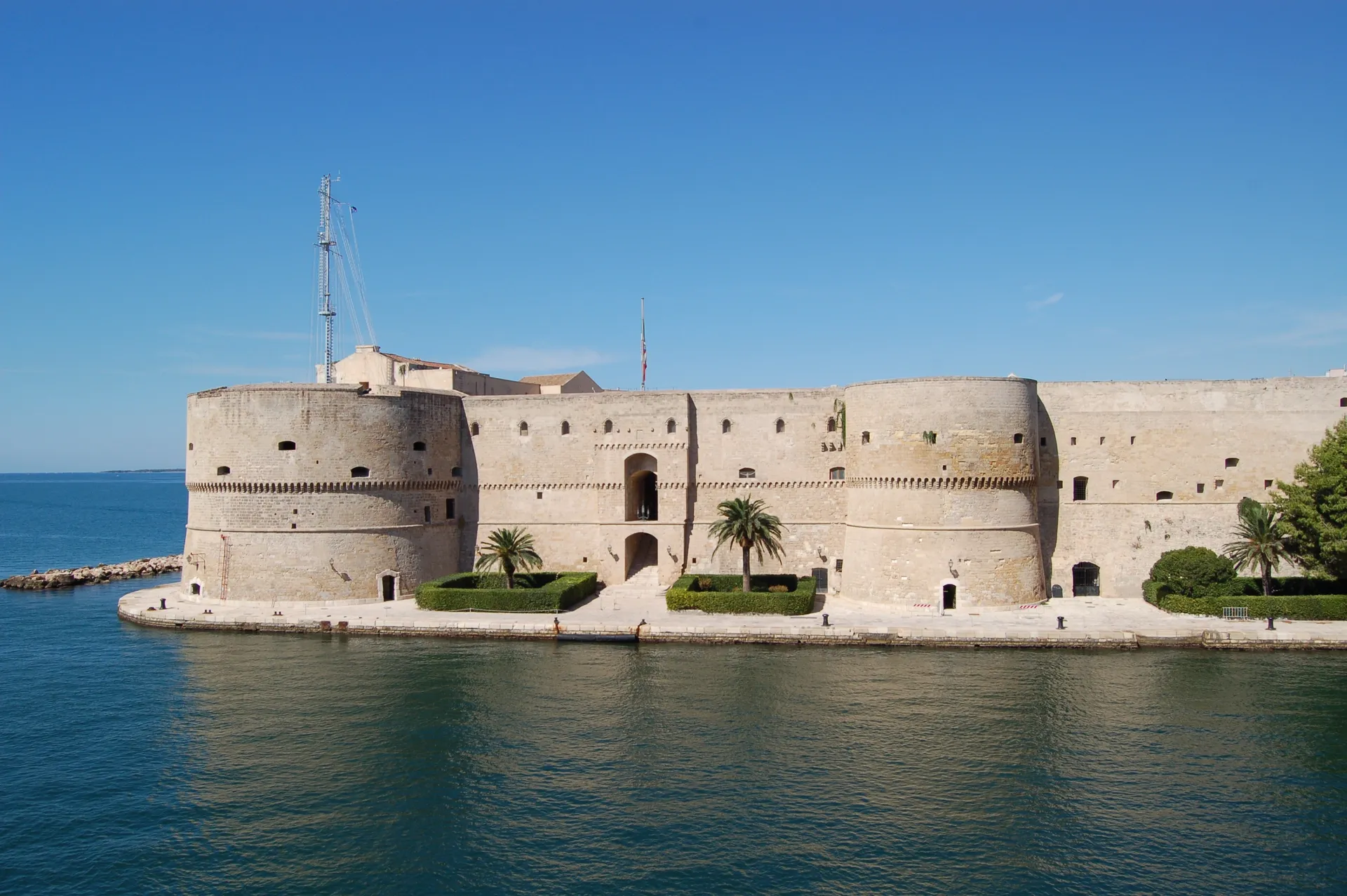
Modern Taranto is divided into three distinct parts connected by bridges and a profound sense of continuity. The Città Vecchia, the old island city, floats between two bodies of water — the Mar Grande (outer sea) and the Mar Piccolo (inner sea) — connected to the mainland by a swing bridge that still opens for naval vessels. Walking these narrow lanes reveals Norman-era churches, Aragonese palaces with crumbling balconies, and the Cathedral of San Cataldo, whose Byzantine mosaic floor and baroque ceiling encapsulate a thousand years of architectural evolution in a single nave. The Aragonese Castle, recently restored and opened to the public, offers panoramic views across both seas.
Taranto's relationship with the sea defines its cuisine with an intimacy found in few other Italian cities. The Mar Piccolo, a virtually enclosed lagoon warmed by underwater freshwater springs, creates ideal conditions for cultivating mussels — cozze taratine are considered among the finest in Italy, plump and intensely flavoured, served raw with lemon, gratinated with breadcrumbs, or in a magnificent zuppa di cozze. The city's fish market, tucked beneath the old city walls, operates in the pre-dawn hours with a theatrical energy that rewards early risers. Pair the seafood with a glass of Primitivo di Manduria, the robust red wine produced from vineyards visible across the Mar Piccolo.
The National Archaeological Museum of Taranto (MArTA) houses one of Italy's most important collections of ancient Greek artefacts, including the legendary Ori di Taranto — an extraordinary assemblage of Hellenistic gold jewellery of almost impossible delicacy. Wreaths, earrings, and diadems crafted with techniques that modern goldsmiths struggle to replicate testify to the astonishing refinement of ancient Tarentine culture. The museum's collection of terracotta figures, Apulian red-figure vases, and Roman mosaics traces the city's evolution from Spartan outpost to Roman municipium.
Taranto is experiencing a cultural awakening, with contemporary art installations appearing in abandoned palazzi, a growing restaurant scene in the Borgo neighbourhood, and ambitious urban renewal projects transforming the waterfront. The best visiting months are May, June, September, and October, when the Puglian light turns the limestone city to gold and the Mar Piccolo glimmers with an almost supernatural calm. This is a city that has survived three millennia of history and is now, at last, learning to celebrate rather than merely endure its extraordinary past.

