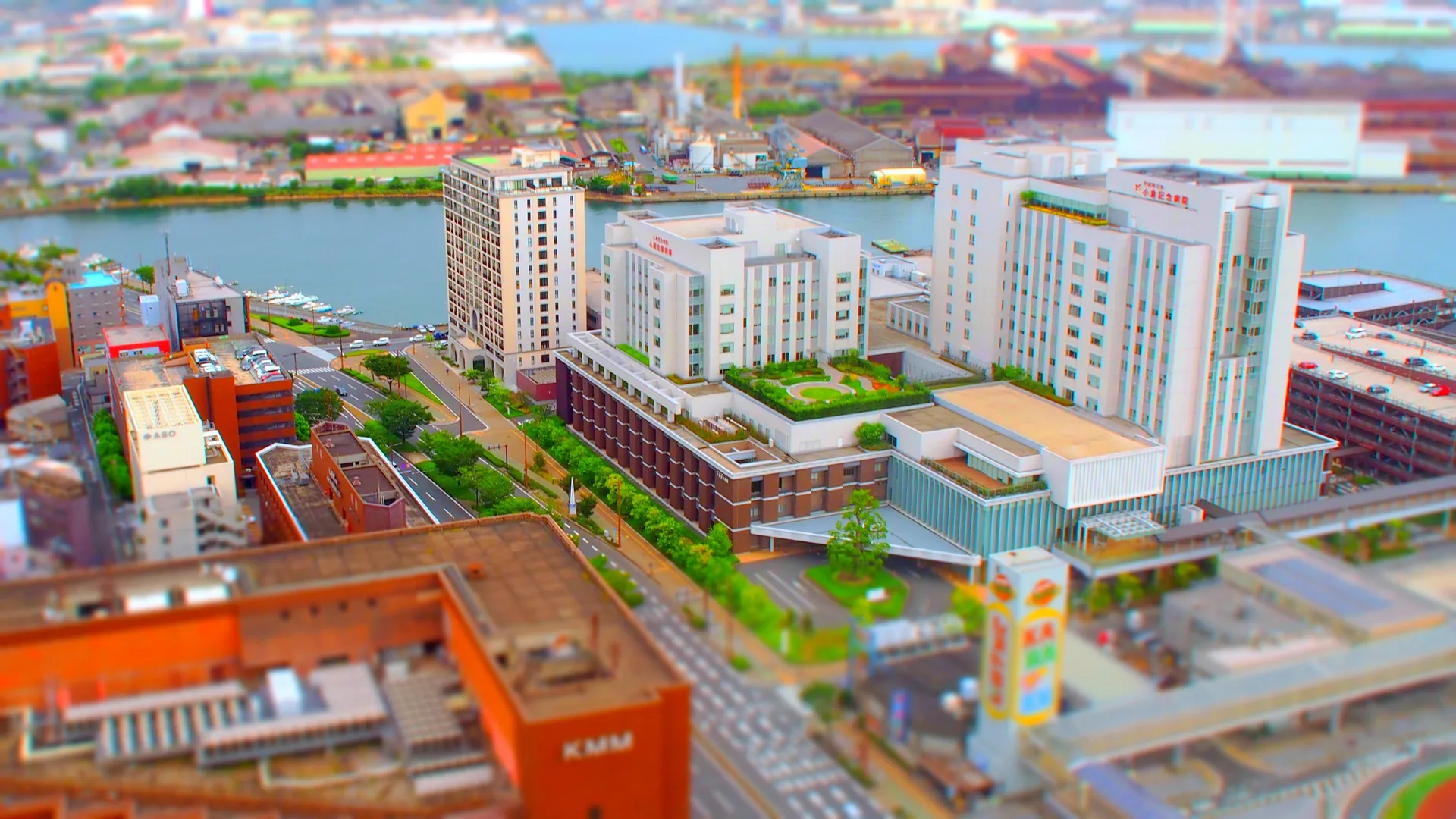
Where the narrow Kanmon Straits separate Japan's main island of Honshu from the northern tip of Kyushu, Kitakyushu stands as a city of remarkable reinvention. Born in 1963 from the merger of five industrial cities — Moji, Kokura, Tobata, Yahata, and Wakamatsu — this metropolitan area of nearly one million people was once Japan's greatest industrial powerhouse, the Pittsburgh of the East, where Yawata Steel (now Nippon Steel) forged the girders that built modern Japan. Today, Kitakyushu has transformed itself from an environmental cautionary tale into a globally recognized model of sustainable urban development, its once-polluted skies now clear, its bay waters clean enough to support dolphin populations.
The Mojiko Retro district, at the easternmost point of Kyushu facing Honshu across the strait, is Kitakyushu's most atmospheric quarter. This former international trading port preserves a remarkable collection of Meiji and Taisho-era Western-style buildings — the former Moji Customs House, the Mitsui Club (where Albert Einstein once stayed), and the ornate Mojiko Station, one of Japan's few wooden railway stations designated as an Important Cultural Property. The waterfront promenade offers views of ships navigating the narrow Kanmon Straits, one of the world's busiest shipping channels, while the Kanmon Pedestrian Tunnel allows visitors to walk beneath the strait to Honshu — a novel experience that takes approximately fifteen minutes through a well-lit underwater passage.
Kokura, the city's commercial center, offers a different character entirely. Kokura Castle, originally built in 1602 and reconstructed in 1959, features a distinctive "karazukuri" style with its top floor extending beyond the lower walls — unique in Japanese castle architecture. The castle grounds include a traditional Japanese garden of refined beauty, particularly during autumn when the maple trees blaze crimson against the castle's white walls. The nearby Tanga Market, operating since 1914, is one of Kyushu's great food markets, its 120 stalls offering an education in the ingredients that define this region's cuisine. Kokura was, incidentally, the original target for the atomic bomb that ultimately struck Nagasaki — a historical footnote that adds a layer of reflective gravity to this otherwise cheerful commercial district.
Kitakyushu's food culture reflects both its industrial heritage and its geographic position at the meeting point of two major islands. Kokura's yakiudon — thick udon noodles stir-fried with a savory sauce, cabbage, and pork — was invented here as a hearty meal for factory workers and has since been elevated to a regional specialty available at restaurants throughout the city. The Kanmon Straits produce exceptional puffer fish (fugu), and Kitakyushu shares with nearby Shimonoseki the distinction of being Japan's fugu capital — the fish is served as translucent sashimi, deep-fried karaage, or in a hot pot. The Tanga Market offers the city's best street food experience, from fresh sashimi to mentaiko (spiced cod roe), which was first developed in this region after the war.
Kitakyushu's cruise terminal at Mojiko provides convenient access to the Retro district within walking distance. The city's excellent public transportation — monorail, bus, and JR train lines — makes independent exploration of Kokura and other districts straightforward. The moderate climate makes Kitakyushu comfortable year-round, though spring cherry blossoms (late March-early April) at Kokura Castle and autumn foliage (November) provide the most photogenic backdrops. A full day allows comfortable exploration of both Mojiko and Kokura. Kitakyushu demonstrates that industrial cities can be reborn — its environmental transformation is as inspiring as its architecture is beautiful.

