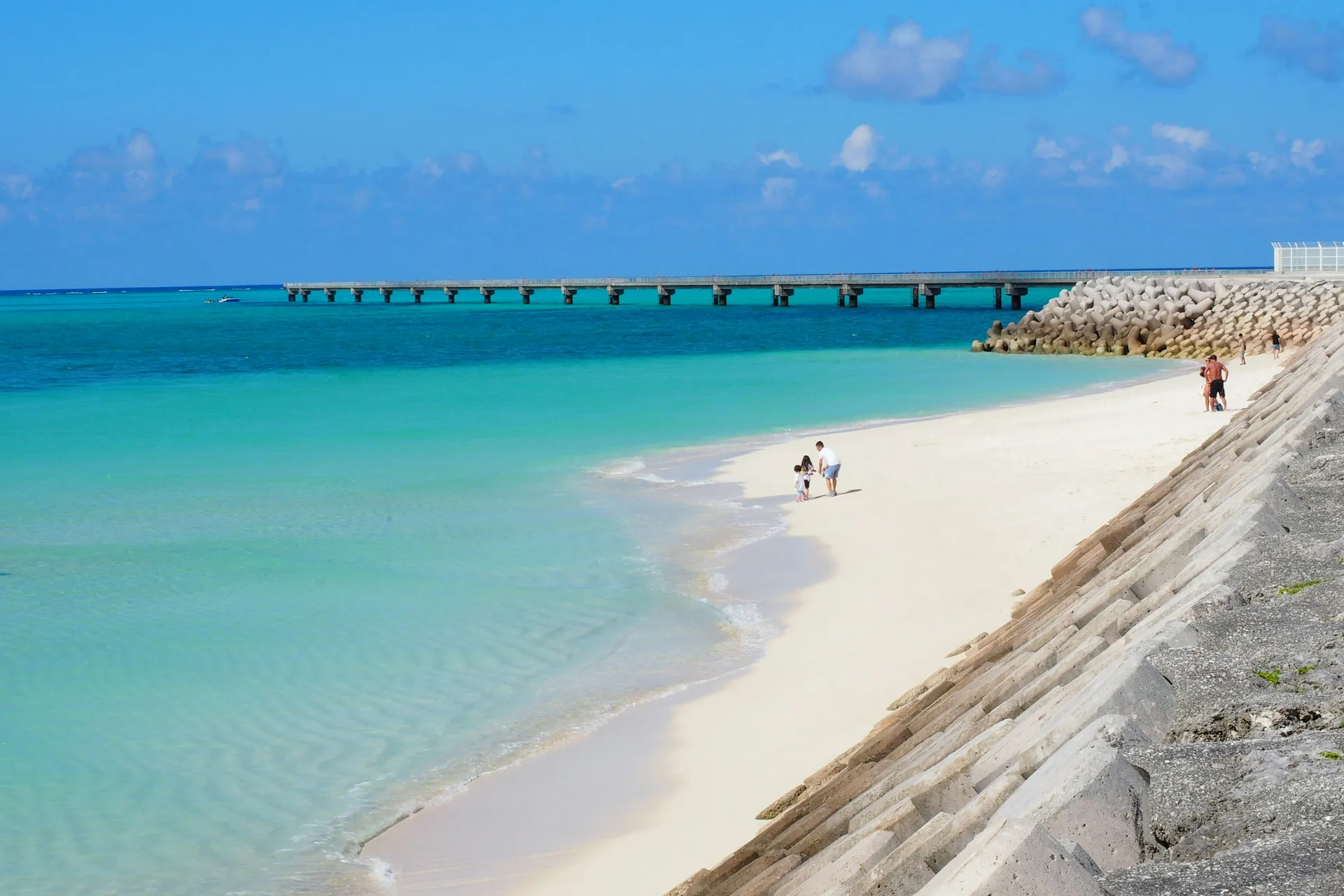
Scattered across the East China Sea roughly 300 kilometers southwest of Okinawa's main island, the Miyako Islands are Japan's answer to the Caribbean — a cluster of low-lying coral islands surrounded by waters of such transparent turquoise that they have earned the designation "Miyako Blue," a color so distinctive it has become a brand and a destination in itself. Unlike the Okinawan main island with its American military presence and urban sprawl, the Miyako group has preserved a character that feels closer to the wider Pacific than to mainland Japan, with its own dialect, its own traditions, and some of the most spectacular beaches in Asia.
Miyakojima, the main island of the group, is remarkably flat — its highest point barely reaches 115 meters — which means the landscape is dominated by sugarcane fields, tropical vegetation, and the ever-present ocean visible from almost everywhere on the island. The beaches are the primary draw, and they are genuinely world-class. Maehama Beach, a three-kilometer sweep of powdery white sand backed by nothing more than sea grape trees and clear sky, routinely ranks among the best beaches in Japan and Asia. Yoshino Beach, on the island's east coast, offers snorkeling directly from shore over coral gardens of exceptional quality, with sea turtles a common sight. Sunayama Beach, accessed through a natural rock arch that frames the ocean like a painting, provides the island's most photogenic swimming spot.
The bridges connecting the Miyako Islands are engineering achievements that have become attractions in their own right. The Irabu Bridge, completed in 2015, stretches 3.5 kilometers across the sea to connect Miyakojima with Irabu Island — it is the longest toll-free bridge in Japan, and driving across its sweeping curves above the turquoise water is an experience of exhilarating beauty. Kurima Bridge and Ikema Bridge connect the other satellite islands, each crossing offering panoramic views across water so clear that the coral formations below are visible from the bridge deck. The connected islands — Irabu, Shimoji, Kurima, and Ikema — each have their own character, from Shimoji's dramatic coastal cliffs to Ikema's traditional fishing village.
The cultural traditions of the Miyako Islands distinguish them from both mainland Japan and the Okinawan main island. The annual Paantu festival, a UNESCO-listed intangible cultural heritage event, features masked figures covered in mud and vines who roam the villages smearing mud on everything and everyone they encounter — a ritual purification ceremony of primal, joyous chaos. The Miyako dialect is so distinct from standard Japanese that it is classified as a separate language by UNESCO. Local cuisine centers on Miyako soba — a noodle soup quite different from mainland ramen or Okinawan soba — and goat meat prepared in various styles, alongside the tropical fruits and fresh sashimi that the islands' climate and waters provide abundantly.
The Miyako Islands can be reached by cruise ship, with anchoring offshore and tender service to the port. The islands are also served by direct flights from Tokyo, Osaka, and Naha. The subtropical climate makes the islands visitable year-round, though the period from April through June and October through November offers the best combination of warm weather, calm seas, and lower humidity. The summer months bring the clearest water for snorkeling but also typhoon risk. The Miyako Islands represent a Japan that most visitors never imagine — a tropical paradise where the precision and courtesy of Japanese culture meets the laid-back rhythm of island life.

