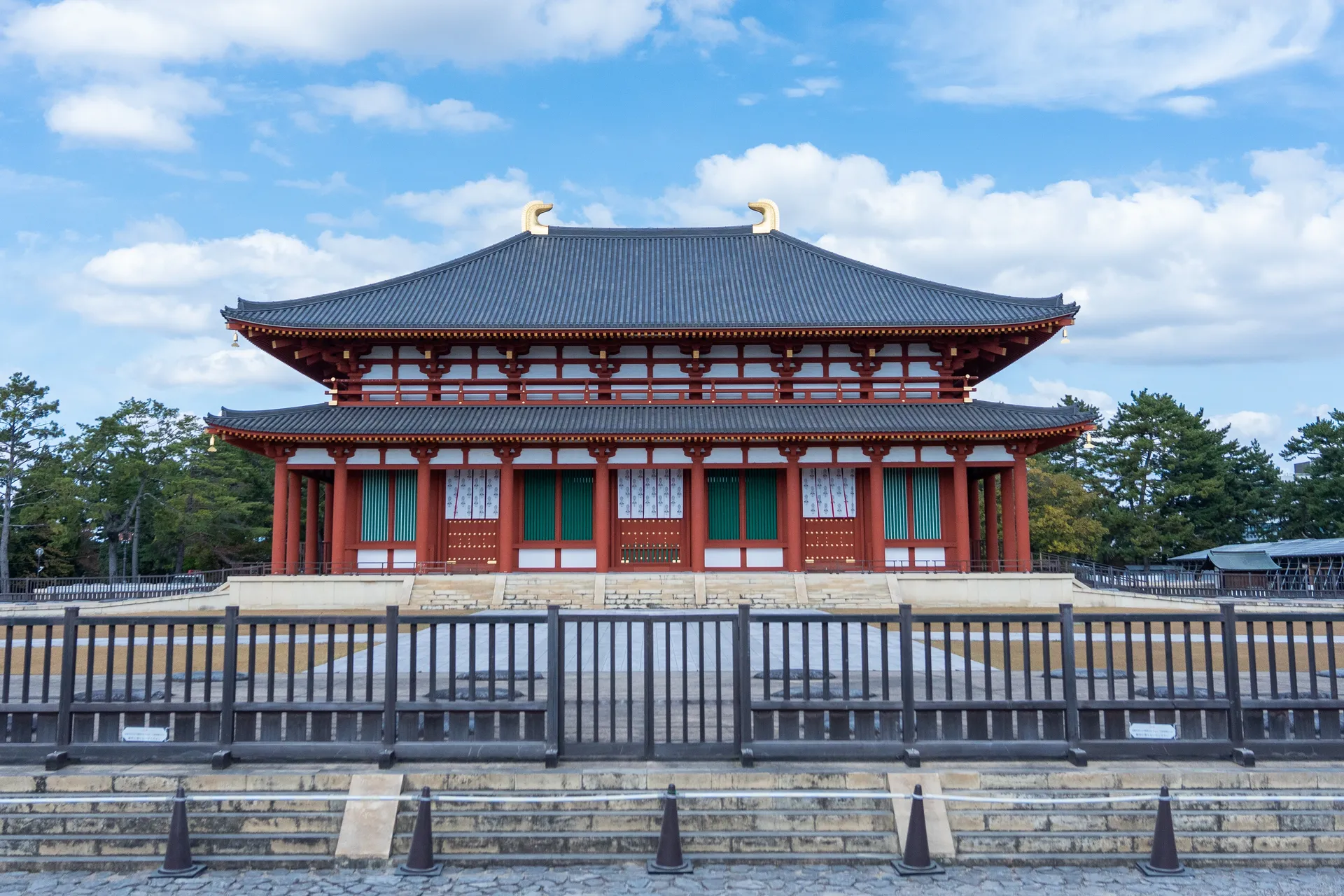
Before Kyoto, before Tokyo, there was Nara — Japan's first permanent capital, established in 710 AD as Heijo-kyo, a city modeled on the Chinese Tang dynasty capital of Chang'an. For seventy-four years, Nara served as the seat of Japanese imperial power, and during this brief but extraordinary period, it became the eastern terminus of the Silk Road, a cosmopolitan center where Chinese, Korean, Indian, Persian, and even Byzantine influences converged to shape the foundations of what would become Japanese civilization. The great temples built during this era still stand, their massive wooden halls housing some of the most important works of Buddhist art in existence.
Todai-ji, the "Great Eastern Temple," dominates Nara both physically and spiritually. Its main hall, the Daibutsuden, is the largest wooden structure in the world — and even at its current size, it is only two-thirds the scale of the original eighth-century building. Within it sits the Daibutsu, the Great Buddha: a bronze figure of Vairocana Buddha standing 15 meters tall and weighing approximately 500 tons, cast in 752 AD in an effort that consumed most of Japan's copper supply and required contributions from across East Asia. The scale is intentionally overwhelming, designed to awe worshippers into an appreciation of Buddhist cosmological infinity. The experience of entering the Daibutsuden — of passing through those massive doors into a space occupied by a seated bronze figure the size of a small building — remains one of the most powerful architectural encounters in the world.
The deer of Nara are as iconic as the temples themselves. Over 1,200 sika deer roam freely through the city's parks and temple grounds, regarded in Shinto tradition as divine messengers of the gods. They bow politely for the deer crackers (shika senbei) sold throughout the park, though their politeness has limits and their assertiveness around food-bearing tourists provides reliable entertainment. The deer lend Nara an atmosphere of gentle magic — the sight of them resting beneath the lanterns of Kasuga Taisha, the great Shinto shrine founded in 768 AD, or picking their way through the morning mist in Nara Park, creates scenes that feel suspended between the temporal and the sacred.
Kasuga Taisha, nestled in the primeval forest at the park's eastern edge, is a masterpiece of Shinto architecture that has been ritually rebuilt at twenty-year intervals for over a millennium. Its approach through an avenue of nearly 2,000 stone lanterns — donated by worshippers over the centuries and lit twice a year during the Lantern Festivals in February and August — is one of Japan's most atmospheric pilgrim paths. Nearby, the Kofuku-ji temple complex preserves a five-story pagoda that has defined Nara's skyline since the eighth century, while the Nara National Museum houses a collection of Buddhist sculpture that is unsurpassed in Japan and arguably the finest outside the great museums of Beijing and Taipei.
Nara is easily accessible as a shore excursion from cruise ports at Kobe or Osaka, approximately one hour by road. The city's major attractions cluster within and around Nara Park, making it ideally suited to walking exploration. JR Nara Station and Kintetsu Nara Station both provide convenient access to the park area. The most enchanting visiting times are spring cherry blossom season (late March-early April), when the park becomes a canopy of pink above the wandering deer, and the Lantern Festivals at Kasuga Taisha in February and August. Despite its world-class treasures, Nara maintains a quieter, more contemplative atmosphere than Kyoto — a fitting quality for a city that has been cultivating spiritual depth for over thirteen centuries.

