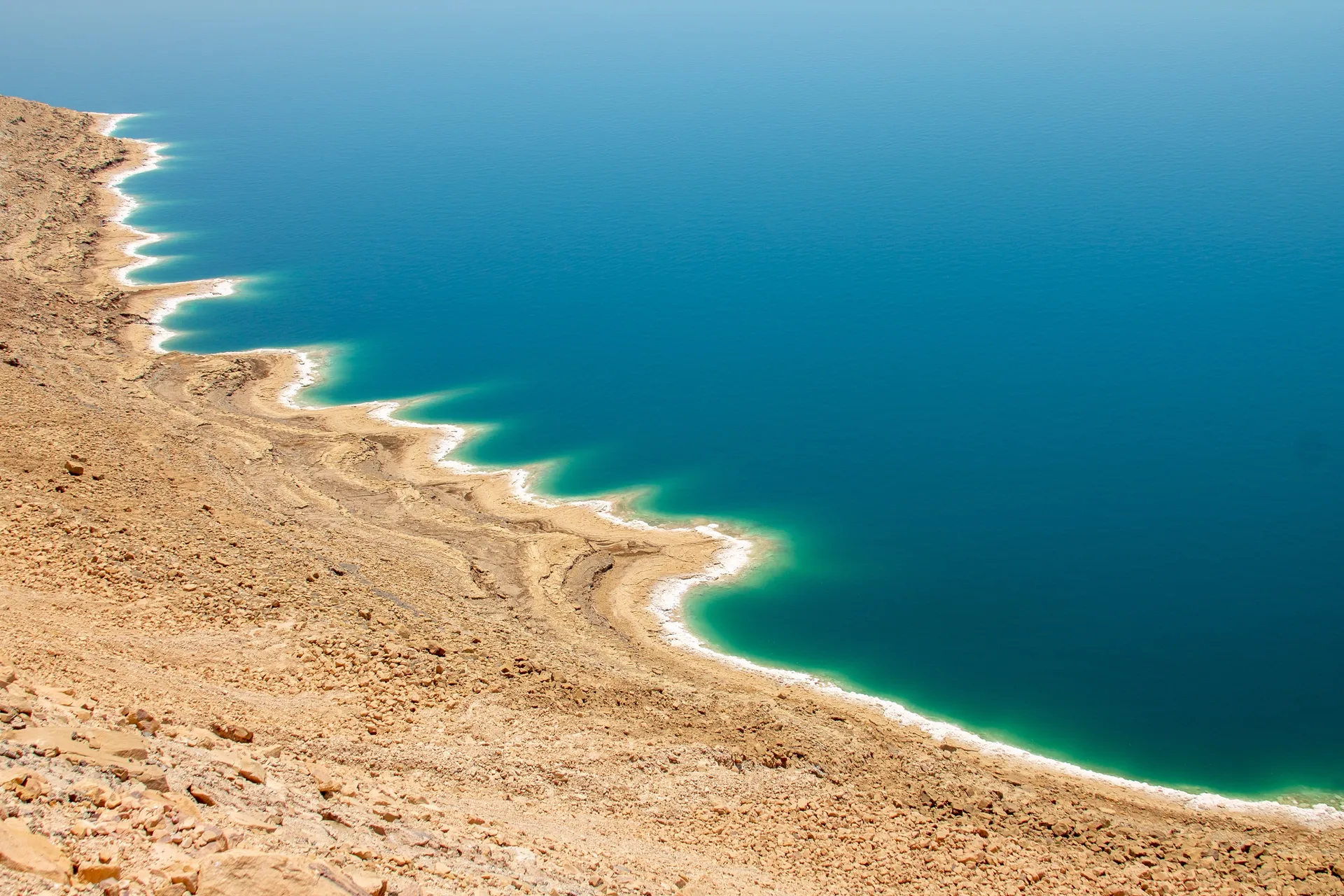
The Dead Sea lies at the lowest point on Earth's surface—430 meters below sea level and falling—a body of water so saturated with salt and minerals that no fish, no plants, and no macroscopic organisms can survive in it. The name is literal but misleading: the Dead Sea is very much alive as a destination, a geological phenomenon, a therapeutic resource, and a landscape of haunting, otherworldly beauty. The Jordanian shore, backed by the rust-colored mountains of the Rift Valley, offers a gentler, less developed experience than the Israeli side, with luxury resorts, ancient archaeological sites, and a silence broken only by evaporation-driven crystallization.
The experience of floating in the Dead Sea is unlike anything else on Earth. The water's salinity—roughly 34 percent, nearly ten times that of the ocean—creates a buoyancy so extreme that sinking is physically impossible. Bathers bob on the surface like corks, their limbs rising unbidden. The minerals dissolved in the water—magnesium, potassium, calcium, bromide—have been valued for their therapeutic properties since antiquity. The mud from the Dead Sea floor, rich in these same minerals, is slathered on by bathers and left to dry in the sun—a natural spa treatment practiced for millennia.
The cuisine available at the Dead Sea resorts draws on the broader Jordanian culinary tradition. Mezze—a parade of small dishes including hummus, mutabal (smoked eggplant dip), fattoush, and tabbouleh—precedes grilled meats in the Levantine manner. Mansaf, Jordan's national dish of lamb slow-cooked in fermented dried yogurt sauce and served over rice, is a communal feast of extraordinary flavor. The bread—khubz, baked in taboon clay ovens—is the constant companion. The resort restaurants offer international cuisine alongside Jordanian specialties, with terraces overlooking the sea at sunset.
The Jordan Rift Valley surrounding the Dead Sea contains some of the most significant sites in the Middle East. The hot springs of Ma'in (Hammamat Ma'in), where thermal waterfalls cascade down basalt cliffs into pools, provide a spa experience in a natural setting of extraordinary beauty. The ancient Christian pilgrimage site of Bethany Beyond the Jordan, where Jesus is believed to have been baptized, is a UNESCO World Heritage Site. Petra, the rose-red Nabataean city carved into sandstone cliffs, is three hours south—one of the undisputed wonders of the ancient world.
The Dead Sea is accessed from Amman (one hour) and is included in virtually every Jordan touring itinerary. The best time to visit is October through April, when temperatures are warm but not extreme. The Dead Sea's water level has been dropping approximately one meter per year due to water diversion, and the landscape is visibly changing—sinkholes, new salt formations, and receding shorelines are reshaping the experience. This environmental urgency adds a poignant dimension to any visit.

